
8 Menu Planning Tips
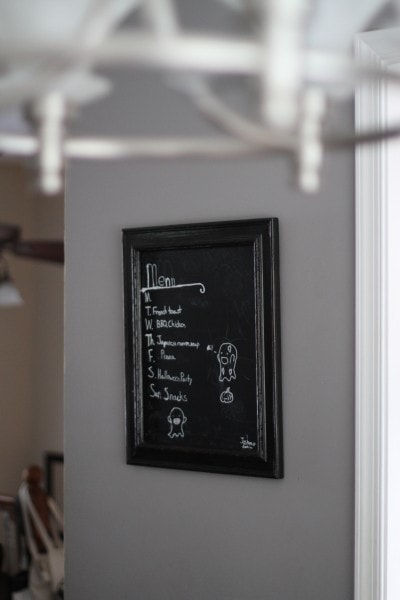
I was going to title this, "How to plan a menu", but there are probably a bazillion equally valid ways to go about this.
So, this is just a list of 8 tips that help me with my menu planning.
If my method helps you out, great, but if something else works better for you, that's great too. Chew up the meat, spit out the bones, as they say!
1. Don't plan breakfast or lunch meals
This is not going to work for everyone, of course, but this tip sure does make my life easier.
We generally have fend for yourself breakfasts, which require no planning (cereal, oatmeal, bagel, fruit, yogurt, leftover pancakes, etc.)
For lunch, my husband takes leftovers to work, and the kids and I eat leftovers (if necessary) and also bread and yogurt and fruit.
And sometimes I make veggie/egg skillet meals for myself.
(Here's how I make skillet meals.)
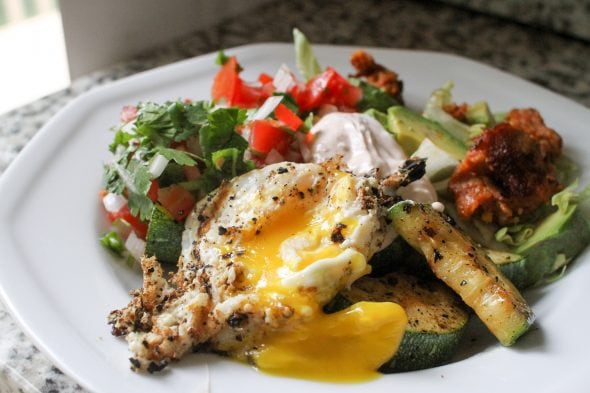
So, all I have to plan are our dinners, since the rest of our meals are pretty darn predictable.
2. Plan ahead to give yourself some lead time
I plan my menu on Wednesdays, and my weekly plan runs from Saturday-Friday. This means that I'm always planning a new menu several days before I actually need to.
This is handy because then if I'm a day or two late with getting it done, it's no big deal, and, well, I just like being ahead of things.
3. Use store sales for inspiration
Sometimes if I'm stuck for ideas, I take a quick peek at the front page of the non-Aldi grocery store ads.
The best deals are almost always on the front page, and sometimes something there will give me a good meal idea at a good price.
4. Look at your fridge/freezer contents
Using up the food I have is almost always the cheapest option, so I try to take a quick inventory to see what needs to be incorporated into the menu plan.
5. Use cooking magazines and cookbooks for ideas
I'm currently in a pretty heavy try-new-recipes stage, because we discovered rather recently that Sonia doesn't tolerate dairy very well, on top of all her other allergies.
So, I'm in the midst of searching for new meals to add to my repertoire.
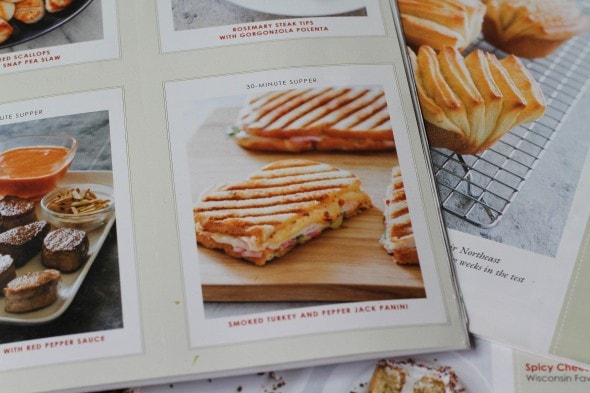
One of my favorite cooking magazines is Cook's Country, and one of my favorite cookbooks is Dinner Illustrated.
If you are in a less new-recipe-heavy stage of life, I recommend the next idea, which is:
6. Make a master list of main dish ideas
I need to make a new one for myself, since a bunch of my dairy-heavy standbys are off limits now.
But when I had one, I'd made a word document that divided my main dish recipes into categories, like Soup, Salad, Chicken, Ground Beef, and so on.
That way, if ground beef was on sale, or if I knew that I've got ground beef in the freezer, I could easily come up with some meals using that kind of meat.
This makes it easy to pick meals based on what's on sale and what you have in the fridge/freezer.
And this way, you're never in a position where you've planned a week full of chicken only to find pork is all that's on sale!
7. Use whatever planner page works for you.
I usually just write my meal ideas on my regular calendar pages in my planner, but there are plenty of printable menu planner pages available online.
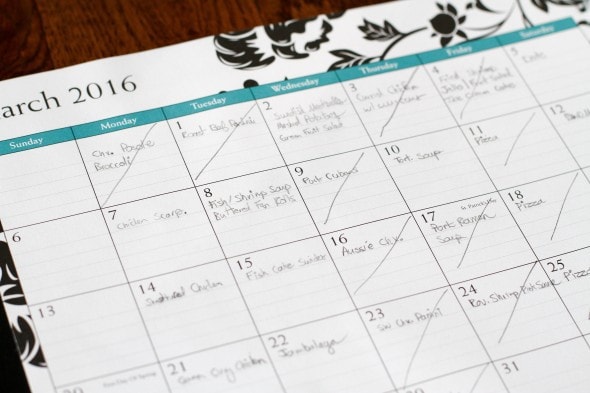
A list of meals on a plain sheet of paper works just fine too.
It does not need to be fancy; done is better than perfect.
8. Look at your calendar and the weather forecast
That way you can plan an easy meal for a night when there's a sports practice.
And you can put a grilled dish on the day when it's not going to rain.
(though I have a terrible knack for grilling when it's raining!)
Looking at your calendar and the weather will help you avoid roadblocks which could send you down the takeout road.
Related: 7 Reasons You Are Eating Out So Much
9. Main dish, then side dishes, then make a grocery list
I pick main dishes for all the days first, and then I choose side dishes, based on the produce that's in my fridge or is on sale.
Related: 6 Ways to Save on Produce
Once I've got everything picked out, I flip through the recipes and make a grocery list based on the ingredient lists (of course, taking into account what's already in my fridge/freezer).
That way, when I go to the store, I know I'm getting everything I need for a week of meals.
Wait, how long does this take?
Depending on how inspired I'm feeling and how much time I spend looking for new recipes, this process can take anywhere from 15 minutes to an hour.
When it takes me an hour, the time is still well worth it because it saves me way more time than that over the course of a week.
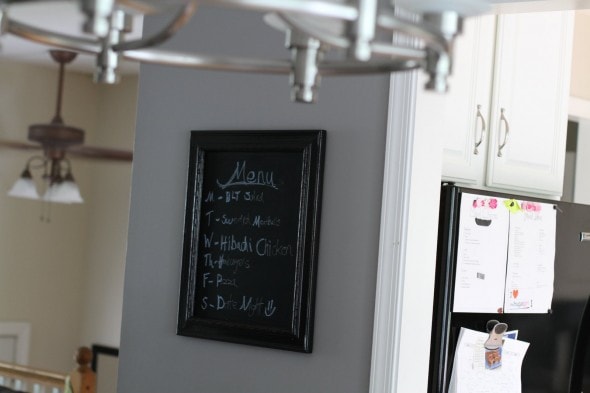
Then there are the financial benefits.
If I plan a menu:
- I don't buy unnecessary food at the grocery store (less money spent, less food wasted)
- I spend less on groceries because I plan to cook what's on sale
- I'm way more likely to cook instead of ordering out
Since even one night of fast food usually costs us $30-$35, the time I spend planning a menu is very financially worth it, even on the weeks when it takes an hour.
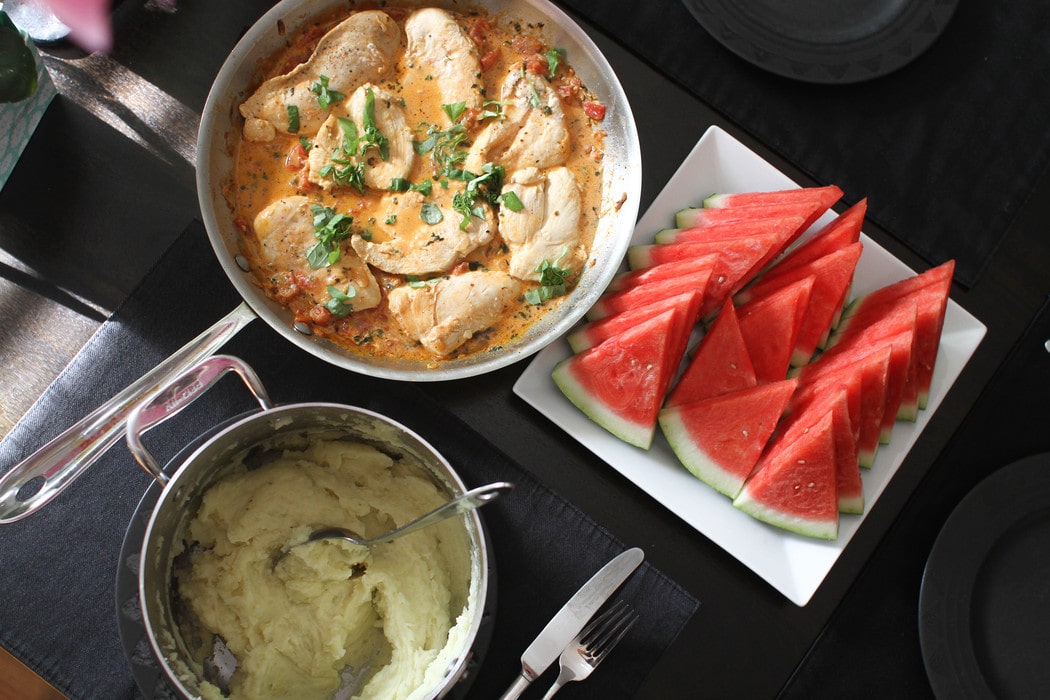
I've just started cooperative planning, working with my kids.
We're able to get just what we need at the store.
I'm able to respond to "But we always have that" arguments.
Working toward having less food to throw away, as well.
You have inspired me to make a dinner plan. This is something I have always wanted to do but didn't know how to start. I am a bargin shopper and read all the sale ads and can find deals along with the best of them but it is random with no planning or long term goals to go with my deals! Thanks for the step by step directions!
About the recipes...what are bacon and chicken wraps? and do you just create the bacon, chicken and chedder quesdillas?
Jill
Joe, that is a good idea for older kids. I think as mine get older, I'll try to involve them more. For now, I get to dictate the meals around here.(mwahahahah!) lol
Jill-that's awesome! I hope you find menu planning as helpful as I do. The quesadilla recipe is from the Cook's Illustrated site...but basically it's just your normal quesadilla filled with bacon, grilled chicken, and shredded cheddar cheese(and I cook them in butter). The bacon and chicken wraps are very easy...just cooked bacon, chicken, lettuce, tomato, shredded cheese and your choice of dressing all wrapped up in a tortilla. They're good though(is anything with bacon bad???). :p
It's so worth it. It's way too easy to simply eat out. But as a country, we're getting fat and broke by thinking this way.
Yeah...when I don't plan and prepare, eating out is so, so tempting. I'm scared to think how much money our family of 6 would spend if we ate out regularly, though. Even a trip to a fast food restaurant can easily cost $20.
I save time grocery shopping by making a aisle by aisle list of frequent used items at my favorite grocery store. I printed out the list and put it on my refigerator and when I was out of an item or needed it for my menu planinng I just checked it off. Now when I go to the grocery store I don't have to search for the items I can just go down the aisles and easily pick up items off my grocery lists.
I always here about people saving money by coupon clipping and watching for sales... What about people like myself who shops mainly at Aldi's (discount grocery store). Prices are always the same here (with occasional increases) but no sales on items. They do not allow coupons because their prices are already pretty cheap. How can we cut costs further?
We do not have too much waste food because a lot of what we buy is frozen or boxed goods with a long shelf life. But we are still trying to cut costs with our grocery spending. Perhaps I am being a little unrealistic that we could even be saving any more in our grocery spending as we currently are. We probably spend around $75/week for a family of 4 (one is a baby though, and her food is mostly free for us).
I definitely want to start menu planning, though for me it's not for the money factor. I absolutely hate cooking. My husband is the cook of our house, but he shouldnt have to cook all our meals. I have a hard time coming up with new things to make, even when looking up recipes online. So for me, menu planning is something that my husband and I could do together, and then I would be much more willing to get dinner started when I'm not having to also plan it at the same time. (Also allows for me to start thawing any meat we need for the meal the day before).
I know that this question was asked a long time ago, but wanted to put in a quick bit that my mom passed on to me in case someone else has this same question, as I once did as well. I had been doing fine budget wise before, but "healthy" foods had not been a concern for us as newly weds in our low 20's. Fast foods, convenience foods, simple foods... We ate pretty much what we wanted and if money got tight I would resort to cheap stuff: ramen, soup and rice, PB&J, etc... But now with a baby on the way and me no longer able to work (due to restrictions placed by my dr after some compounding, but unrelated medical issues) healthy food on a budget has become a necessity.. especially since I had been the primary income. I can't coupon because I go overboard. I tried it last spring and, while I did save a LOT of money, I ALSO spent nearly EVERY moment of free time looking for, cutting, and organizing those coupons and THEN scouring EVERY store comparing EVERY possible deal. I just couldn't "ease" my way in, my personality wouldn't let me. I'd tried several times to create a price book, but it was the same thing.. every week I was trying to track the prices at every store on all the items we bought, from stuff we used daily to stuff I "thought" we would use if we were to start cooking more. It was just too much and again, my personality just wouldn't let me do things halfway. So after several attempts at creating a price-book of my own I was about ready to give up.. I could CREATE a price-book very easily, it was MAINTAINING it that wore me out! More often than not, I just bought what I needed, when I needed it, and compared prices while I was at the store. Then I talked to "mom" (not my real mom, but we're closer than some "real" families) and she suggested something that I would never have thought of due to my lack of experience and knowledge (a nicer way of referring to her YEARS of acquiring both 😀 ).
Think of it as a simplified price-book. Instead of going ALL OVER town and EVERY store getting and tracking the prices for ALL the things you buy, just go to Aldi's and, since they are generally cheaper and their prices more consistent, track THOSE prices and ONLY for those items you buy most. Then when you look at the circulars, instead of comparing X #of stores to each other just compare them all to what you know you would spend at Aldi's and only note the other source when the price is cheaper.
The hardest part for me was deciding which items to track prices on, but mom had a solution for that too and that was to set a limit (maybe just 10 items), think of the basic things we already fixed and writing those down, then tracking ONLY those 10 items until I could look at an ad and know a good deal on those items without checking the price book. Once I'd fully familiarized myself with an item, I could add one more item. After I'd gotten Aldi's prices down, I could go to other stores and compare my tracked items to the other stores' regular prices and note any CONSISTENTLY lower than Aldi's. Since sales are generally advertised, those can be checked from home, but this gives you the chance to find low unit-cost items that aren't advertised. 🙂 I still get the urge to over-do it, but since I actually have a plan and specific rules and procedures now, it's easier to keep myself in check and "budget" my time. ^_^
I menu plan by month. This works for me as I have been shopping sales for a while and stockpiled my freezer with chicken, pork, we butcher or own beef, so I menu plan my main courses way ahead then fill in the sides with fresh produce/fruit based on the sales flyers.
I have recently started menu planning for my family of 5 and find it a huge help, not only financially, but saves me the headache of thinking if something to make everyday. I have certainly noticed a difference in my food bill and also my food wastage is so much smaller. We love eating leftovers the next day for lunch or tea, sometimes it tastes better the next day as all the flavours have had time to develop. I am trying hard to use my slow cooker more and have been enlightened by a few books that tell you a slow cooker isn't just for stews! In the UK though, I don't think we have such good food offers as in the US and we certainly don't have access to the coupons that the US has but I am still trying hard to be more frugal. Thanks for your tips!!!
Start by checking sale items (online) for food stores you shop at. Begin there if you are watching your budget (aren't we all?)
Work out from there and your inventory of fresh, refrigerated and frozen food on hand.
We date everything we put in the fridge for when opened/cooked/must eat or use by, to ensure we don't end up tossing food because it went bad.
When we are being super diligent, we put this info up on a whiteboard in the kitchen. It really helps to plan meals knowing what you need to use up and by when. Nothing is worse than tossing food you forgot was there.
That alone can really make meal planning easier.
I make food for only myself (and I have a lot of food restriction), so I don't need to meal plan.
However, I keep a white board on my fridge with three columns - produce I have, made or open foods that I need to eat soon, and things I need to buy. Since it's on my fridge I know what's in there, and I can say, oh, beans are getting old and so at oranges, so I'll put those in my meal. It's really helped!
A white board is a great idea!
Sorry, this was supposed to be a general reply!
Funny, I was just commenting with a friend about how much we hate meal planning! It's like you read my mind!
I do hate it, but you are right, it saves money now and stress later. I plan for a week at a time because my mind would explode if I tried to do a month at a time. I tried a master plan of dishes but got lost in trying. Maybe if I divided them into categories as you do, that would help. Thanks for this idea.
I use the sales ads online to help me plan as well as check my freezer and refrigerator. I have very little boxed or canned food so I don't usually check my pantry except to make sure staples like salt and coconut oil aren't low.
I know I sound like a broken record about AIP, but Kristen, you might try some of the autoimmune sites for good recipes for restricted diets, with no dairy, nuts, wheat, eggs, soy, etc. My personal favorites right now are Autoimmune Wellness, The Paleo Mom, A Squirrel in the Kitchen, and Gutsy by Nature. Just about all of them have e-cookbooks and some have physical cookbooks, too. I feel Sonia's pain, so I hope this helps!
Kristen, I had to laugh--I also don't sweat the breakfast/lunch thing and mainly focus on the evening meal--AND I also watch the weather (and our personal schedule) to see if we can grill out, if I need a quick-to-prepare and quick-to-clean-up meal due to needing to get out the door quickly.
In addition to your resources, I like the two following sites for recipe ideas. Both offer a good variety of meals, don't use fancy-schmancy ingredients, and are easy to follow regardless of your cooking expertise:
budgetbytes.com
averiecooks.com
Hope that helps someone!
Great minds think alike, girl!
My grocery stores in SoCal have stopped putting out sale flyers. No more rainchecks either. So sad.
I start by looking at my freezer and pantry, then looking at the sale ads. I write out 5 meals, thinking we'll eat leftovers. The weather is also a factor for me, soup on cold nights, grilling or salads on hot days. Allrecipes.com is a great site, you enter the ingredients you have an menus pop up.
I work so this helps me a great deal.
I am not a good menu planner, but am learning.
I like to "cook once, eat twice" meaning I can stretch a recipe into two meals, freezing one. I also love the ease of using a crockpot which has the added bonus of making the house smell cozy and wonderful - greatly needed in these times. And when it is just Hubby and me, I like to make a super simple dinner. Grilled chicken and a veg, with veg taking up most of the plate's real estate. And lastly, I was just saying to Hubby that we really need to help the smaller restaurant businesses out as much as we can - maybe eating out once per week. There are also some good deals to be had with free delivery and such at the larger ones, too.
I would save a lot of time and frustration if I planned. Before I leave for work I think of things then when I get home I’m too tired to cook. Then I just make what is easiest. I don’t waste much food though. If I cook I take leftovers for lunch.
I will make a list of menu options and make sure I have all the ingredients for it and then stick the list on the fridge. Then I can go with "what I feel like" each morning--I can't do a set menu for the week! 🙂 I usually go two weeks out so I have options. So for those who can't stand the idea of a rigid schedule, look at it as more "Options We Can Do"...I love having it, it cuts down on so much stress. I have 4 boys so I usually get asked about 10 times a day "What's for supper?" The days I already know its so much easier! If I don't know, I get frustrated at them (for my lack of planning--how rude is that? BUT they always seem to ask when I'm busy). Now I just get frustrated because "You already asked, remember what I said?" 😉