
An Orta Self-Watering Seed Starter Review (from a non-gardener!)
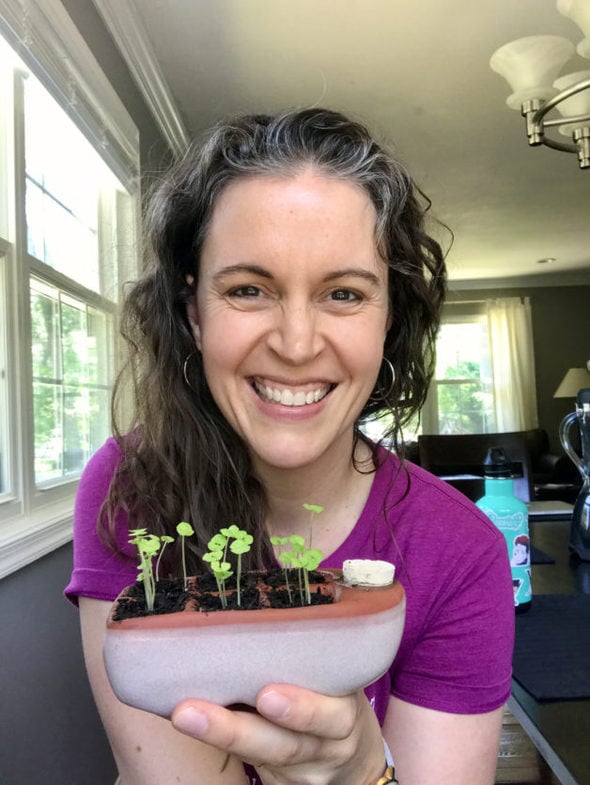
This spring, I got a little seed starter pot as freebie from that gardening bundle I participated in.
(I just had to pay for shipping, which for me was $10, coming to the east coast from California.)
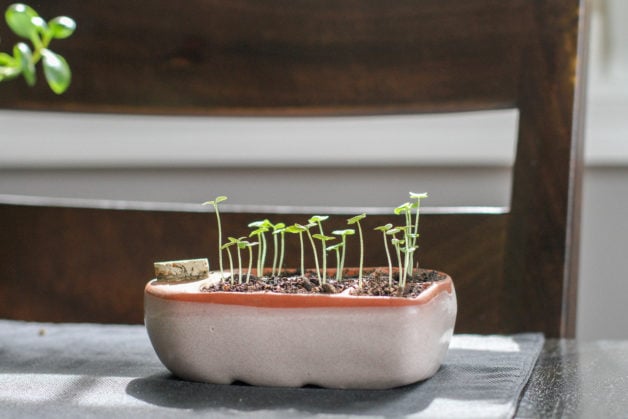
The free one is a factory-second, and that appeals to my waste-avoiding heart; I'm delighted to give a home to a less-than-perfect item at a discount.
I've posted photos of my little pot on social media and I keep getting questions about it, so I figured a little review post would be helpful.
What's a self-watering pot?
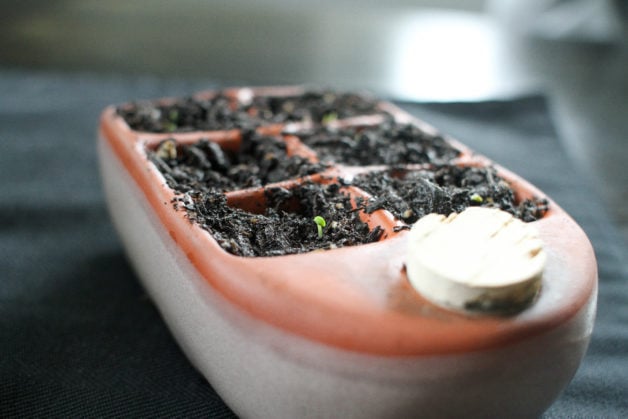
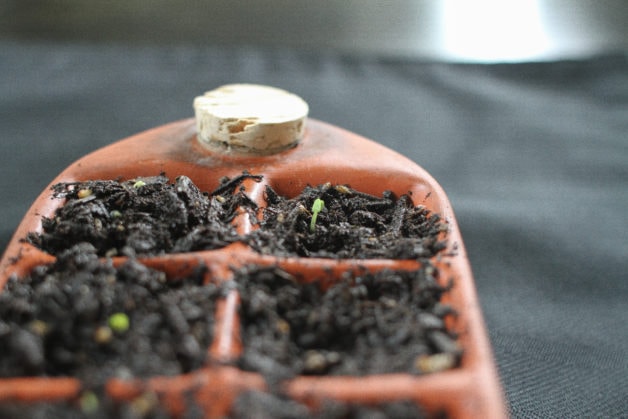
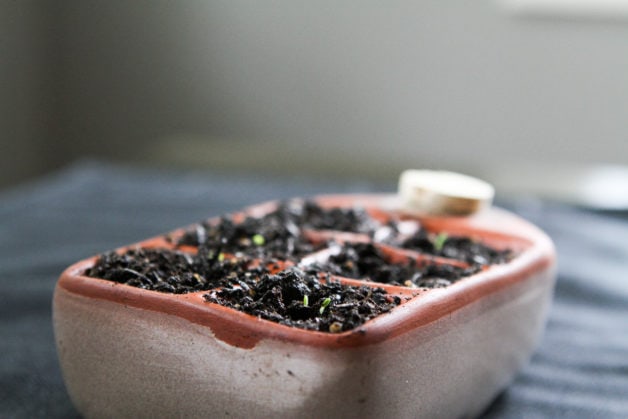
This little pot is made of terracotta and there's a reservoir underneath the plants. The terracotta absorbs the water from the reservoir and keeps the dirt around the seedlings consistently moist, but not too wet.
Does it work?
Most definitely! I've been very impressed with how evenly wet the dirt has stayed. As soon as the water is gone, the dirt dries up.
But as long as the reservoir has water, all is well.
If you've had trouble getting seeds to germinate, I think this pot would probably solve your problem.
What are the pros of the Orta seed starter pot?
- It's plastic-free (it even ships with plastic-free packaging)
- It's made by a small company
- It looks more beautiful than typical plastic seed-starter pots (I'm happy to have it on my dining room table!)
- You don't have to regularly water your seedlings
- It's durable and can be used over and over
What are the cons?
I really can only think of one which is: the price.
A no-flaws version of what I have costs $43! That's a whole lot more expensive than pretty much every other seed starting option out there.
And while this is plastic free, it's not like plastic pots are not the only seed-starting option; you can use peat pots, which are compostable, or you could even start your seeds in egg cartons, which can also just decompose into the soil.
Who should buy one of these?
Well.
I obviously do not think this is a good fit for experienced, super-frugal gardeners.
But if you are a person who will not start seedlings unless it's super-duper easy to do, then this might be worth it.
I'm pretty certain that the little basil seedlings I've started will produce well over $43 of basil this summer.
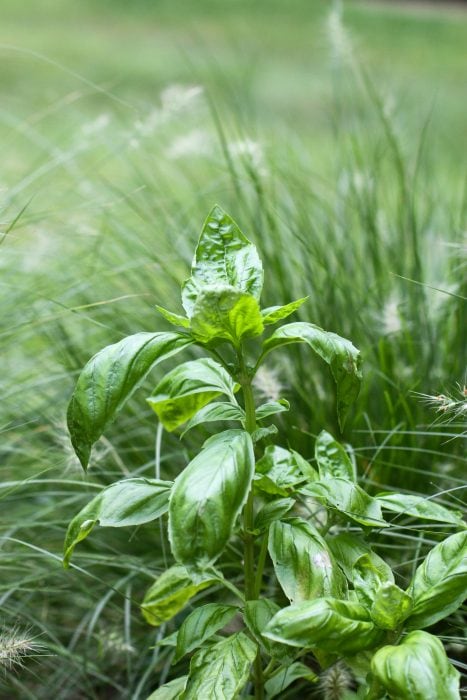
So, if this little starter gets you over the hump of putting some seeds into the dirt, I'd say go for it.
I also think that the seed starter pot could make a fun gift for a new-ish gardener.
I know that when I buy gifts, I often am much more willing to spend above the bare minimum; I wouldn't give egg carton seed starters as a gift, but I would definitely give this to the right person.
And if you are very interested in supporting a small, eco-friendly business, then I could see why you might want to buy an Orta pot.
A side-note about pricing
This probably could be a whole post in and of itself, but I find it interesting that everyone in my house (including me) was like, "Whoa! $43 for a seed pot is so much!"
But how many times over have we spent $43 on consumable things such as coffee or takeout or movie tickets, and thought almost nothing of it?
This is really not very logical; a reusable plant pot, which can produce plants, which can produce food for months is somehow too expensive at $43, but takeout or a streaming service is not too expensive at $43?
Anyway!
I personally will probably not get another Orta pot for my own use.
But I will definitely consider giving one as a gift in the future. And I would feel no judgement toward someone who wanted to buy one of these for themselves.
A flash sale starts tomorrow
(well, tonight at midnight is more accurate)
The gardening bundle, which is where I got my seed starter for free, is available through Friday at midnight.
So, if you'd like to get:
- the Orta seed pot (just pay shipping)
- my 4-week food waste course
- 24 other courses/ebooks
- several other bonus offers
for a total of $24.97, click here to get your bundle.
Is $24.97 a good price?
Well, my food waste course regularly sells for $49.00, and if you implement the things I teach, you could save about $1800/year.
So, for that alone, the bundle is worth the price.
And if you'd like the seed pot, either for yourself or for a gift (Christmas will come sooner than you think!), that really makes the bundle worth it.
Looks interesting! How difficult is it to take the seedlings out when you're ready to transplant?
I thought it was easy-I just used a spoon to kind of scoop them out. The plant roots tend to hold the dirt together in a little clump.
Hello Kristen. This is my first comment but I've been reading your blog for a while. I don't have a comment about the seed pot as I don't garden. However I had to respond to this statement: "how many times over have we spent $43 on consumable things such as coffee or takeout or movie tickets, and thought almost nothing of it?"
I have always preferred to spend on experiences rather than objects. Travel, restaurants, live theatre and music, movies, museums and galleries often create memories and help me learn new things or expose me to new cultures and ideas. Objects like furniture, clothes, tools, etc don't have the same value to me so I try to minimize their number and cost. Maybe you can talk about how you see this split between buying experiences vs "things"?
Jade
I think prioritizing either of those types of things is fine; you have to do what's in line with your own personal values and priorities.
I just notice that in my own mind, I might look at a pot like this and think, "No. That's such a waste of money!" and I feel like that's some inconsistency in my own thinking. Like, why am I expecting to pay so little for something that will serve me for many years?
I think mass production and poor quality products have unfairly lowered our idea of what is a reasonable price to pay for an item, whether it's clothes, food, appliances, or furniture.
Does that help at all? I keep thinking I should write a post about this!
@Kristen,
Hi Kristen,
I think that is the most important thing to consider - the true cost of seemingly cheap products. It most often entails mass production of poor quality products and to this negativ list you can add poor and unsafe work conditions and certainly the impact it has on our environment in terms of wasting all sorts of resources, energy, water and the garbage problem.
I am very much looking forward to that post of yours.....
If I lived in the US I would order the bundle. I am interested in your food waste program but transferring the money from Germany to the US is too expensive.
Hi Kristen,
The planter looks like a great gift and also I like that it has segments. I've used egg cartons and toilet paper rolls several times, but found that they would produce mould as well as seedlings. I've decided paperbased pots do not work for me. Also, I am hesitant to use peat pots, as peat (especially the cheap kinds) may come from protected natural environments (in Europe). It takes millions of years to grow peat, so we need to ensure that it is sourced sustainably and again, do not waste it just because it is cheap! Generally, I use an old plastic planter with some dirt, mixed with some peat and or some compost. Not all seedlings will do well, but most of the time the plants that are indigenous to where I live, will thrive.
Also, due to climate change plants from the mediterranean are doing increasingly well up north as well. A more pleasant effect than the drought/floods we are having too...
@J, I have recently learned about the importance of protecting peat bogs by not buying things like the peat pellets that I like so much and potting soil that contains peat through watching Gardener's World with Monty Don. Next year I am going to try using the Coconut Coir Pellets for starting my seeds.
@Rebecca in MD,
That's an excellent suggestion, thanks! 🙂
@Rebecca in MD, I came down to the comments to say don’t buy peat. It’s so bad for the environment and peat is good for sucking up carbon dioxide.
I’m in the UK and love Monty. He also has depression and reading about his experience is interesting too.
Kristen, I appreciate you reviewing this item honestly--it is quite nifty, but I'm also Team Egg Carton. I do wish you mentioned the shipping price, both new (is shipping included in the $43?) and "free" through the course so one could have the full cost in mind when deciding. (I read through your review twice and didn't see it--but it's also 6:30 AM, so it's possible I'm just not awake yet!) I actually skipped the gardening bundle last time it was on sale because I realized the shipping cost for the "free" items was more than I had budgeted to spend.
@N, Ah, I just caught the $10 shipping paragraph right before the first picture! Apologies for my 6:30 AM brain.
No worries! There was a sentence up there about having to pay for shipping, but I added the specific $10 (at least for me!) info after your comment.
Ooo, it's so CUTE! I love it. I mean, waaaay too small for the number of seeds I start, but I would still totally buy that for someone I wanted to encourage to get into growing plants.
Typically I use found items to start seeds--old plastic pots from previous plants, typically, although the best are those big plastic clamshell thingies with holes in them that fancy salad greens come in, because then you can leave the lid closed to hold soil moisture until the plants are tall.
This year, my husband asked me to get some of the peat pots for his melon seedlings. Melons are very hard to transplant, and the peat pots break down in the soil so you just plant the entire pot without disturbing the seedling. I got a big package of them and decided to use those for my seedlings so they would all fit better in the box I keep them in on the floor (we have a very fancy system, yes). And honestly, they were THE WORST. I could NOT keep the soil moisture constant. I felt like they were always too wet or too dry. They molded, which was gross, and fell apart before I even moved them outside.
I lost way more seedlings this year than I ever have. So I guess I'll go back to my junk pots next year.
@kristin @ going country, Another friend was talking about how difficult melon plants are to transplant! Her solution was to use (temporary) black plastic to warm the soil where she'd planted the seed, and then put water cloches around the seedlings as they came up. It worked pretty well - not sure where you live (this friend is in southern OH).
@kristin @ going country,
The fancy salad clamshells are an interesting idea! A couple of months ago someone gave me a plastic thing that holds a dozen cupcakes and I'm saving it because it looks like it'd be good for planting things in next year.
I've not had success with peat pots... They never broke down for me! They were still intact at the end of the summer after being in the ground for months.
My husband uses the black plastic seed starters bought online or (most often) at a nursery in our area. They come with clear vented covers to help keep the dirt moist and a bottom tray to hold the excess water, as there are holes in the bottom of each seed cell. A set is about $5, more or less, depending upon the source, and if one is careful, they can be used for several years. Of course, these are plastic, and if one wants to reduce plastic use, these aren't optimal. Removing the seedlings is just a matter of pushing up on the bottom of the cell a little bit while tugging very gently from above. Like Amanda, I'd also like to know how the seedlings are removed from the Orta starter. It is adorably cute, but we use a minimum of 24 cells when we start seedlings -- this looks too small for anyone growing an actual garden, but just right for a person wanting a few pots of herbs or flowers. And it's certainly more aesthetically pleasing.
We aren't fans of peat pots either. We've used them, but they aren't as workable as the plastic planter trays. Most of the big gardeners and farmers we know who start seedlings indoors or in a greenhouse use soil block makers and just set the formed blocks in open trays.
I typically use peat pods in those black trays with clear plastic lids. Each tray holds 72 pods and I use several trays. As the plants get bigger, I transplant them to old food containers filled with potting soil. Larger plants like tomatoes and peppers get another transplant to a large juice bottle (with the top cut off) filled with soil, before they are ready for their permanent home outside.
I definitely included the part about having to pay for shipping in a couple of places in the post. I also just went through the checkout process on Orta's website to figure out exactly how much shipping I paid and I just now updated the post with that info as well.
The $43 is for the new pot with no imperfections (and you get to pick the color!) and you pay for shipping unless your order is over $100. The pot with imperfections is not listed on the site, I assume because those are set aside for the current bundle promotion.
I hope that helps!
@Kristen, I found the factory seconds listed for $25, plus shipping. Much better than $43!
Goodness, how did I miss that?? Thanks for sharing!
In that case, the bundle purchase makes pretty good financial sense; if you were going to buy a factory second pot, you could just spend a few dollars more and get all the bundle contents as well.
I personally have never been a fan of the peat pots as I don't have a great success rate with the seedlings I try to start in them. They are either too wet or too dry no matter what I do. I have had more success with the black plastic containers that I purchase seedlings in from the nursery/store. I tend to save those and re-use them for any seeds that I plan to start before moving them to the garden or flower bed. I don't start too many seeds this way though - I tend to wait until I can sow them directly in the ground. I don't have a greenhouse space or any other area that I can use to start seeds that wouldn't require me to be constantly moving them to avoid rain, direct sunlight or other variables and at the volume that I plant I don't want to be tied to that kind of time investment. I have had a great success with starting seeds in eggshells. This is completely environmentally sound and even enriches your soil when the shell decomposes. Just save your eggshells in an egg carton trying to break them in even halves if you can, add seed starting soil mix and your seeds and away you go. This was particularly fun for my 5 yr old so great to try with young kids.
Ooh, I love the eggshell idea!
@Angie, The egg shell udea is brilliant! Thanks for passing that tip along.
@Maddie, and all,
Yes, I do the eggshells sometimes. Otherwise I crunch them up and put in compost pile or just in the ground around plants.
I have probably tried every way to start seeds over the years, except for a $43 pot! Now I mostly use the little things that seedlings come from when you buy them. Or little plastic pots- same thing. Friends and neighbors will happily save those for you, especially if you’ve given them fresh-grown garden stuff! Paper or recycled plastic drinking cups with holes poked in the bottom. Little Keurig- type pods. Washed out take-out containers of all kinds. Maybe with a coffee filter (even a used one when I dump the used grounds into the compost)- that can help contain the soil and makes transplanting easy. Small milk & juice containers with drain holes. Folded newspaper works well.
In other words, WHY spend money when this can be completely free? Save seeds and share seeds and trade seeds and plants! With what I save, I can buy good potting soil, because that does seem to make a big difference.
@Jenny,
A used coffee filter to help with transplanting??? What a fantastic idea! Mind blown.
I use the cardboard core from toilet paper to start my seeds. I stand them up in a leftover aluminum pan and fill with dirt.
The aluminum pan contains the water and dirt well.
When its time to plant I pick up the entire tube and plant that. The bottom is open for roots, it provides support for the new plant and it just composts itself.
Have any of you taken the time to visit the Orta website to learn more about this seeding pot?
https://ortakitchengarden.com/collections/seed-pots
After watching the video and reviewing the website and if you have a black thumb as I do this ingeniously designed handmade terracotta pot made explicitly for seeding AND if I get results as Kristin did this pot is worth at least the $43 asking price.
Watch the video. You won't be disappointed. See inside a pot and how it actually works.
Thank you Kristin for bringing this product to my attention. I signed up for the flash sale!
@Rob, agreed! I can grow plants, but I have had the worst luck with seedlings. I’m excited to try this pot!
I mostly use old trays from family or friends that have purchased plants from garden centers. I reuse them until they break beyond use. I've also got a number of small plastic pots from the same source. If I need to plant more than what I have with those I will use half-gallon milk jugs. I cut off the top half of the jug and use the bottom half. I used to use cardboard egg cartons but I felt like it didn't allow enough space for the root growth my plants needed. Since I usually plant 50-100 tomato plants a year the Orta seed starter wouldn't make sense for me, but it is cute!
Oh, Aldi yogurt cups also work great for starting plants!
"But how many times over have we spent $43 on consumable things such as coffee or takeout or movie tickets, and thought almost nothing of it?"
This is SO true. There's a current preference for consumables over things, which I like because few in the US need more stuff (insert obligatory George Carlin reference). Even so, I find it helpful to compare costs to what I'd spend on a meal. $10 for shipping might feel like a lot but - as I was talking with a coworker yesterday - that's what a non-frugal person would pay for a work lunch at a fast casual or food court place.
You can also calculate the per-use price. I've bought some expensive suits in my time, but since I wear them twice a month for 10 years or longer, that's a minimum of 260 uses. Even a $1000 suit would be less than $4 per use at that rate (notice that I used the subjunctive rather than the present tense).
Another option for starting seeds is old plastic pots - last year's, your friends' and neighbors', etc. Plastic ain't so bad if you use it many times.
I use all manner of plastic discards--cottage cheese containers, clam shells from grocery store purchases, and so on. The only time I purchased commercial plastic seed starting equipment was a 10 pack of extra heavy duty plastic flats that each had 72 cells in them. I plant hundreds of leeks every year and leeks will survive in the small cells and do okay at transplanting because you can trim not only their roots but their tops and they do fine. Other seedlings would not make it in those small cells. I have used toilet paper rolls and made my own newspaper pots, but they disintegrate quickly and some of my transplants need to spend 6 to 8 weeks indoors before I transplant them, so I no longer use them. The egg shell idea is okay but only for plants that are going to be transplanted into larger homes or the garden soon after their first true leaves develop; there is not enough soil and not enough nutrients to keep them in the shells for weeks at a time. Really, between the plastic containers I save all year long and four or six packs I get and save when I buy my yearly petunias (I cannot seem to grow those well from seed, no matter what), I don't need to spend money on seed starting flats. When I worked in a regular office, I let people know I wanted their yogurt, cottage cheese and so on castoffs and I was inundated with containers. A number of people told me they were thrilled to have a way to recycle them and began saving them year around for me.
I keep seeds from my garden year to year. I place them on a paper towel and let them dry. Then I put them dried on the paper towel in a ziploc bag and seal it. Then in March, I add a little water to dampen the paper towel and seal the sandwich baggie and place somewhere warm. When the seeds sprout, I move them to an egg carton. My grandmother, mother, and who knows how many of my family do this. I can and freeze almost all fruits and veggies my family eats. My family teases me that I am a 1940s farmers wife who was born about sixty years too late!
As soon as I saw this pot I thought “this is perfect for moms with littles.” Or homeschooling families, for that matter, just as an “educational” center piece. I’m definitely imagining some great dinner conversations as we watch seedlings grow! Thanks for sharing, I’m gonna get the bundle!
We were told by someone with more experience than us to start seed in a bag with a wet paper towel. We tried it and some took, but not all. We then transfered the to smaal plastic bag of dirt. The bags are sold with drinking water in them, we've collected used ones. Now I think our plants are ready to go in the ground, but we'll take them out of the bags.
I use the Jiffy Peat Pellets to start my seedlings and then when they develop true leaves I move them up to Cow Pots with special potting soil for seedlings. The Cow Pots are made from recycled cow manure and can be planted in the ground to gradually break down while feeding the plant. This system with my HydroFarm grow lights has been very successful, and I grow many varieties of tomatoes, peppers, herbs, and flowers from seed every year.