
Does homemade yogurt produce less trash?
This is a small thing I've wondered about for years, but never figured out!
So, I know quarts of homemade yogurt are definitely less trash-producing than individual cups of yogurt.
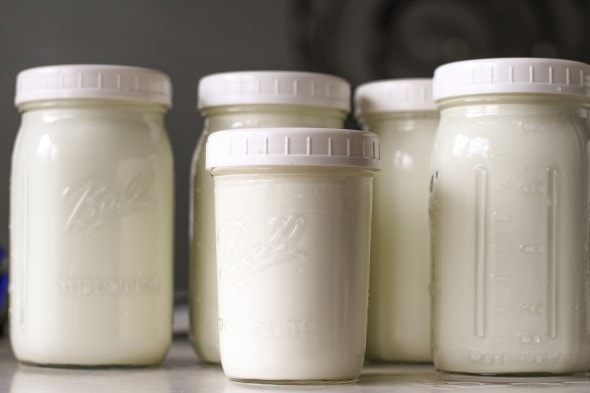
And I know my homemade yogurt is WAY cheaper than anything I can buy at the store.
(For instance, if you pay $4 for a gallon of milk, your yogurt quarts will be $1 each.)
But I've never been quite sure if the plastic from a gallon of milk is less than the plastic from four plastic quart containers of yogurt.

I needed a new starter last week (after 6-9 months or so, I seem to need a refresh), so I had the perfect opportunity to settle this question.
(Which, in the grand scheme of things, is not an enormous deal. I know. It's just the kind of minutiae that I wonder about!)
As it turns out, an empty gallon container weighs 2 ounces.

And an empty quart container weighs 1 ounce.
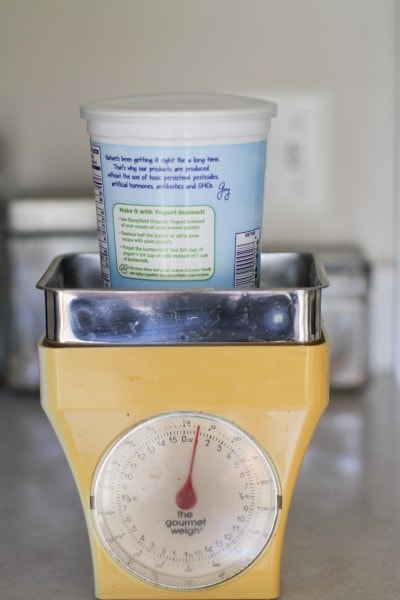
So, a gallon (4 quarts) of store-bought yogurt requires 4 ounces of plastic, whereas a gallon of homemade yogurt requires 2 ounces of plastic.
And now I don't have to wonder about this anymore. 😉
I'd have kept making homemade yogurt regardless of the outcome of this experiment, just because it's so affordable and so tasty (I love how mild it is). But hey, it's nice to know that it's also slightly less trash-producing than store-bought yogurt.
P.S. Of course, if I got my milk in returnable glass jars, the homemade yogurt would be trashless. But there's not a simple, nearby way to get milk in glass jars, so plastic gallons it is.
P.P.S. I use whole milk to make my yogurt every single time (it makes for creamier and thicker yogurt). But a 2% jug is what I had around when I took these photos.
P.P.P.S. Here's why I don't think you have to make yogurt.
P.P.P.P.S. Here's how you make homemade yogurt (no special equipment required). And here are answers to common questions about homemade yogurt.
http://www.thefrugalgirl.com/2016/10/im-getting-a-nose-job-and-its-going-to-save-me-money/

A search for yogurt-making methods was what led me to your site about, oh, six years ago now. I still read here every day, and I still make yogurt using your method every week.
Fun fact: I've only had to get a new starter ONCE in all these years, and that was only because it was so cold on my kitchen floor two winters ago that my yogurt wasn't setting in the four hours I normally give it in the cooler on the floor. I thought I needed a new starter, so I got one (I get mine from a local farm--maybe that's why it lasts forever?), and when that still didn't work, my MiL suggested maybe it was because our kitchen floor was literally about 45 degrees (old house, no insulation). So I moved the cooler near our woodstove and had no trouble after that. I even carefully hoarded a jar and brought it up in a cooler when we moved north this summer, so I could keep making my yogurt.
Long way of saying thank you for a very good addition to my family's diet . . .
I have often thought making things yourself is not always cheaper but you know exactly what you are eating. We have one local farmer who produces milk in glass bottles. But most stores do not stock it. So I treasure it when I find one.
You have enough posts on that last one to start a mail delivery.
But you're missing out on one of the key reasons to buy yogurt and that's the free containers. 😉
I have made my own yogurt but it's not been as often as I used to because my wife doesn't eat it and I have stopped eating it daily. It's still good but I just would prefer to get my dairy fix in the form of cottage cheese.
I could actually buy milk in glass jars at a place within walking distance of my house. I just don't feel like paying $3 for a quart of milk when I get a gallon for $2.19.
There will be even more trash if you're buying 6 oz containers, rather than 1 qt ones. Worse, the 6 oz containers can't be used reused as containers because they have tin foil covers; at least he quarts have reusable lids.
Sigh. Never mind, I just read the post carefully.
Oh man, I never thought about this!! I've been making homemade yogurt for about six months now and I'll never go back to storebought! We do end up saving a boatload of money, since I make organic grassfed yogurt (which is pretty pricey at the store!). Plus I do think it tastes better and I can put whatever I want in it.
I think the savings are enough to switch over, but I'm very happy to learn that it also can offset plastic waste! We use our milk jugs to throw away oil, so at least they get a second life that way. We also recycle them, too, so I feel a little less guilty. 🙂
I'm very interested in where your readers live that they have access to milk in glass containers. I can buy glass milk containers at the store, but they are still from a large dairy facility. I do not know of any individual dairies around.
I can get them here in Florida from local dairies, although some of them use plastic. It's not well known, but Florida has quite a few dairy cattle, and actually cattle in general.
I pay a deposit if I get the glass bottle, and get it back when I return the bottle in a decently clean condition. I shop at a food coop and also at Earth Fare, which is a somewhat small chain of stores, and see milk in glass at those stores. I haven't checked at the new Whole Foods, because I normally buy my milk straight from the farm anyway.
My Kroger has a brand of milk that comes in glass bottles.
We can get milk in glass containers from Whole Foods, but it's expensive - $4.19 for a half gallon of milk PLUS a $2 deposit for the container. It's not worth over $8 a gallon to me to get the glass container, so we typically just get the plastic containers from the "regular" store. I live in NW Oregon.
We get glass bottles DELIVERED to our doorstep (!) here just outside of Boston from a dairy farm just south of the city. The milk is more expensive than buying milk in a plastic gallon jug, but it is hormone free and I love that the 1/2 gallon glass bottles fit well in the fridge. Also, I don't have to deal with cramming the plastic jug in my recycle container - I just put the bottles in the milk box on the back steps and voilà - more milk appears once a week! Finally, my kids can tell the difference and like the milk (and the yogurt I make from it) from the dairy better, so I figure it is worth the extra obey.
FWIW, virtually all milk I've seen for sale is hormone free and even if it wasn't, your body just digests the hormones like it would any other protein. Plus cows produce the stuff anyway.
Farmers are shifting away from the use of rBST because cows are more likely to get mastitis when they produce too much milk.
Try fancier (pricier) stores that feature lots of local and organic foods.
I was making yogurt but stopped when I noticed we weren't eating it up anymore. My daughter makes it now and then as her kids like it. I prefer the taste of homemade, but I have to be on a yogurt kick, which I haven't been for a while. I like that with homemade, I can control the ingredients -- I use grass-fed milk from an organic farm --and it's absolutely cheaper to make my own than buy that expensive grass-fed organic kind from the store.
That's funny that you just had to weigh the plastic. That sounds like something I would do.
On a side note, don't you love your mason jar lids? I use mine all the time!
Yes! Those lids are so awesome. I love that they're just one piece.
When you used to use lids and rings I always wondered why you didn't get the plastic ones. Mayo lids fit too.
I would add too that milk jugs are recyclable, but in our area at least, yogurt containers only recently became recyclable.
That said, I don't eat that much yogurt, and try as I might, I couldn't get the recipe to work anyway.
I've recently had to admit I'm not tolerating dairy very well, and I missed yogurt. I can handle coconut yogurt, but that's REALLY expensive and full of awful additives when you buy commercial coconut yogurt.
Fortunately, I found an easy way to make it at home. My Instant Pot electric pressure cooker has a yogurt making cycle (but you could use any other method to incubate it just as you do for dairy yogurt). Coconut milk does not require preheating to denature the proteins as dairy milk does. I just add culture to room temperature coconut milk, and incubate it for 12 hours in the Instant Pot which maintains an ideal temperature.
This is even more frugal if you make your own coconut milk from dried coconut flakes (and you get a bonus of coconut pulp which can be dried and ground into coconut "flour"). And if you bring your own reusable bag to buy the dried coconut in bulk . . .
(Shades of "If You Give a Moose a Muffin")
This isn't the answer for everyone by any means, but I found that I had grown to be lactose intolerant, although I could still eat yogurt and cheese. When I switched to raw milk from a reputable local farm, I stopped having any problem with milk and drink it with no problem at all now.
My daughter's boyfriend can't handle any kind of cow's milk and I've wondered about using coconut milk for him for ice cream and yogurt -- I'm glad to hear it can be done!
Raw milk has enzymes in it that make it easier to digest. That's why some people who are lactose intolerant can drink raw milk and not have issues.
You can make yogurt made from regular milk virtually lactose free, you just have to culture it until the starter has converted all the lactose. This means you have to keep it at the proper culturing temperature for around 24 hours. It will be sour. I was on the GAPS diet and did this - if you search for "GAPS yogurt" you will find instructions.
I feel so lucky to get milk delivered from a local dairy in glass bottles. Yes, it is definitely more costly, but that's a place where I'm willing to spend more to get a high quality, sustainable alternative. Also, the plus of never running out of milk. Glad you are on the road to recovery. Your meds with the Tiffany blue bow gave me a smile this morning.
I make yogurt in 1 c. jars. I'm the only one eating it. Three years ago I started saving milk jugs in Sept. to make Halloween luminarias to put out with battery tea lights in them. Plenty of free outlines for carving purposes online. Just have to rethink what gets cut and what stays. I tape them on with clear packing tape. They store in a shed (no batteries) in a plastic trash bag rather well. Added some more last year and this year. Just had to replace dead batteries. I cut a hole in the side with the label to put my hand through. And they do need something to weight them down. Rocks work. But I recycled heavy springs taken off of pool cover and put two in each jug.
Double recycling! The springs aren't wanted by recyclers.
I read your site religiously, but never comment - felt the need to for this one as it just cracked me up and warmed my heart in the mess that is 2016, so thank you for that <3. It's such a tiny question in the grand scheme of things, but I bet it's one that's been bugging you every time you make yoghurt, and I can only imagine that it feels sooo good to finally know!
Keep on doing you, and hope you recover from your surgery well & quickly x
I'm glad it made you chuckle! And yes, it IS sort of delightful to know the answer to this not-so-pressing question. 😉