
4 Secrets for Raising Children Who Don't Pester
In the comments on a recent post, Vicki left this request:
Can you please write something about combating pester power in children? How do you teach them to live in a very consumerist society? My 4 year old is already asking for toys he sees in shops.
I had to think about this for a bit, and at first I thought maybe we hadn't really done anything to combat pester power.
But I think most of what we've done has been a little bit behind-the-scenes, and it's really about the culture in our home and the expectations that exist in our family.
So. Here are four tips that have helped us limit pestering in our family.
1) We rarely buy non-essentials for our kids outside of special occasions.
We take care of our children's needs, certainly...they have always been clothed and fed and provided for.
And given that they're not eating beans and rice three times a day, and that they aren't wearing bottom-of-the-barrel clothing, I'd say that some of their wants are covered under the "needs" umbrella as well.
But when it comes things that are seriously non-essential (toys, electronics, jewelry, fancy body care items, hobby items), we do not, as a rule, buy them for our kids outside of gift-giving occasions.
This doesn't mean they live a life of no luxuries. Birthdays come once a year, and so does Christmas, and they receive gifts from us, from siblings, and from grandparents.
Plus, if they want something, they always have the option of saving up their money to buy it for themselves.
Sometimes, especially now that we aren't living on such a low income, we will surprise them and buy them something out of the blue. But because they know that that's not the norm in our family, they know not to ask or expect us buy things they want whenever they want them.
Setting this expectation early is the easiest way to go. If your children have always known that you don't just randomly buy stuff for them whenever they ask, the pestering will certainly be reduced.
2) We do not say yes to pestering.
Children have really great memories for some things. They have difficulty remembering to do chores, to be sure, but if you say yes as a result of pestering one time, they will remember it for AGES, and they will keep on trying to see if they can break you down.
So, if you've been saying yes after being pestered, stop now, and stay strong. You won't be doing yourself or your child any favors by responding favorably to pestering.
I'm not saying you can never buy something for your child, but don't ever do it as a result of being pestered.
3) We are not afraid to say no, even to polite asking.
Pestering always equals a no answer, but even polite asking doesn't need to guarantee a yes.
If our kids asked us for something when they were younger, we would say, "Oh, that is a cool gidget! You could put it on your birthday/Christmas wishlist. Or maybe you could save your money to buy it."
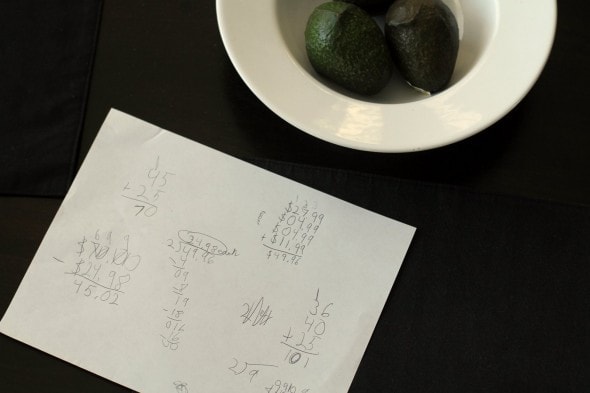
(Sonia's "Can I afford a hamster?" calculation sheet.)
No one wants to make their children sad, of course, but children do need to learn that they can't have everything they want right away, even IF they ask nicely. They need to learn how to wait for items, and how to patiently save until they have enough money.
Giving them whatever they want whenever they ask for it is a poor way of preparing them for adulthood because the hard truth is that few of us can have whatever we want whenever we want it!
I figure they might as well get used to that reality of life while they're little.
4) We try to model waiting/saving.
When Mr. FG and I were living on a super lean budget, there was very little wiggle room for fun purchases, so we had to save up extra bits of money or wait for birthdays/Christmas.

And even now that we have more wiggle room, we still try to be wise about non-essential purchases.
For instance, if Mr. FG wants a guitar pedal or some other non-essential, he considers whether he has enough money in his "fun money" account, and then decides whether or not to make the purchase.
____________
I realize that some of you might be reading this and thinking, "Oh, man! It must stink to live in such a joyless household."
But oddly enough, I actually think that operating this way makes our household more pleasant.

A lack of pestering = happier parents.
I'm sure I don't have to tell you that pestering is miserable to listen to.
And a lack of pestering = happier children.
I don't think children are actually happy deep down when they're pestering, and children who are accustomed to getting what they want are rarely happy even when they do get what they ask for.
But when a child who is accustomed to waiting does finally buy or receive a desired item, there's a great deal of joy involved. When you don't get non-essentials on a regular basis, they are automatically more special.

Plus, my children all say that they feel a sense of pride and satisfaction when they save up and buy something with their own money, and I think that's worth a lot!
__________________



My children are older now. My youngest in particular loves that her childhood wasn't filled with every want met. She is content and happy with what she has. My middle child is one who buys what she wants etc. She still tries to have me fund her ways....but she does admit she treasure growing up in home where reading, education, imagination and making do where valued. The eldest has asperger's syndrome and I worry about him and money. He has already learned some tough lessons that broke my heart. He says he likes that he was taught to be respectful and well mannered. As a chef he has grown to dislike noisy, fussy children.
You hit the nail on the head with the point of " Do not be afraid to say NO!" The biggest parent fail I see in my friends, and the parents I work with is that the ADULTS are afraid to make adult decisions and possibly make their children upset. Get over that mentality right now and things will get easier. Parenting is hard, there will be horrible moments in child training that happen in public but once you align your choices and stop feeling guilty for them you will overcome the battle. When my children were younger I was very clear with them when we went shopping-" we are here to buy XYZ.." I would tell them do not ask for toys, do not beg for toys.. the more I have to say no because of begging.. the less fun you will have the rest of the day. I had a not yet 3 year old when my twins were born so those early years were very chaotic. I ran a very tight ship discipline wise and it paid off. If I said NO I meant no. I also used a lot of positive and negative reinforcement. I am that mom that will purchase 1 child a treat and an instant reward/punishment to show the others that I mean business. I have bought 2 Happy Meals and then made child 3 eat a PBJ at home b/c of behavior in public.
I have done the same. There is nothing quite as effective as seeing what your bad behavior has wrought. Your brothers got something great and you. did. not. It works really, really well.
I wouldn't say my kids never pester. My oldest has autism and has trouble understanding the why of things, in general, and that causes issues when it comes to accepting that he cannot have the thing he wants just because he wants it. He is well-behaved otherwise so it is simply something he is still learning, I hope! He is 13 but developmentally more like 10, so it will take time.
The other two boys, interestingly, police each other on pestering. One will be prepping to ask and ask and the other will tell him not to so he doesn't get in trouble with Mom. 😉 They NEVER have asked for toys at the store though...because I have never randomly bought them a toy when we are out and about, I guess? It isn't a thing we do. Toys are for birthdays and Christmas...and the annual IT IS FREAKING SPRING, FINALLY!!!! shopping trip to replace broken outside stuff (or buy a bunch Nerf guns, this year. That was great fun.) because their birthdays are ill-timed for gifts related to outside play. Since they typically get one toy at their birthday and 4 at Christmas, plus the shared outside stuff...that keeps the toy clutter to a minimum too.
You are my kind of mom. I also mean no when I say no. Do not continue pestering me. I also have rewarded some of my children and not the problem maker. I can only say that now that mine are older, the behavior of mine is so much different than their friends. It is so much easier to teach everything along the way than to go back and correct bad behaviors. Learning consequences and critical thinking skills are most important in life. The earlier the better. My 21 yr old still tells the story of me throwing a Barbie doll out the window on vacation because they fought over one doll for over eight hours. My threats are never empty.
I totally agree - we have done similar things and at some points I wondered if it (contentment) would "wear off," like when we hit the teen years - but it is still going strong. Two things that help us: we make sure there are jobs available to earn money, and I also try to have ideas for presents given by grandparents/ others who live farther away and may not know the current "wants" of a child (if they ask for ideas).
You have to remember that pestering and whining go in phases with different development stages. However, I will echo the others that if you don't give in, they won't expect things and won't learn to pester for them. We handled things pretty much like Kristen with special things only showing up at Christmas and birthdays. In fact, when my children got a little older, they were hard to buy for because they didn't ask for anything. Whatever, they really wanted they bought with their own money or did without.
Suz makes a good point about making sure that there are ways that your kids can earn money.
Yep, I don't think we should panic if our preschoolers start pestering. That's pretty normal. What matters is how you handle it as a parent...are you going to feed it and encourage it, or are you going to curb it?
It's been a long time since I had small children, but I don't think they pestered much. We had the same philosophy that you have. Even the grandparents didn't give things outside of birthdays and Christmas, so they didn't expect anything in between.
Somehow my kids didn't ask, let alone pester, for things. We never responded to whining, and that was usually for some other reason than wanting something. I think they just learned our habits--when they got toys ,when they didn't. They had a great deal more than I as a child.
They did not question when I said it was time to leave (playground, pool, whatever) because they were told I would not want to bring them again. But I don't recall this ever occurring, so they didn't learn it from experience. I think we stayed long enough, got them a reasonable amount of gifts, and no one argued. The whining mentioned above-- not for acquiring things--just to express dissatisfaction about something, usually when tired-- did occur, but we ignored it over time, and it left.
From the time my daughter was old enough to notice toys at the store I would let her look at them, hold them, and at the grocery store it could take a ride in the cart with her BUT we always said "bye" to the toys and put them back. There was NO way I was going to be able to afford to be a SAHM if I bought her a toy every time we went out! Now, I will say that my husband started PURCHASING the things she's liked and I had to explain to him that he was undoing my work. He stopped and she never pestered for a toy. My son, on the other hand; well, my husband felt bad that he had so many hand me down toys and started taking him to get toys as a bonding thing. He would not pester per say, just quietly cry when I wouldn't buy him a toy. It took more work with him but he now knows that we can look but not buy. On the super rare occasion I let him get something - it is like Christmas morning!
We are not on a super lean budget and I was raised in a family of above-average income. It's just as important to teach children not to pester.
We follow the same rules that you do about rarely giving gifts (outside of birthdays and Chanukah.) We make one exception: We give rewards for very hard work in school; we started this because my oldest has AD/HD and we used behavioral, instead of pharmaceutical intervention (this worked in our situation.)
What has worked wonders in general for our kids:
1. My kids never pester for status brands of clothes, etc.- we buy a basic solid item and if they want, they can make up the $ difference and buy the fancy label brand. They rarely do.
2. We have been fortunate to get to go to places such as Disney World, etc. more than once. Before our travels, I have always posted a list of extra chores that can be done to earn trip money. The kids know they have to pay for their own souvenirs (amazing how self- restrained they can be when using their own money.)
3. I do a lot of work with inner city children. I talk to my teens about the poverty and hunger that I regularly see. It helps them have perspective.
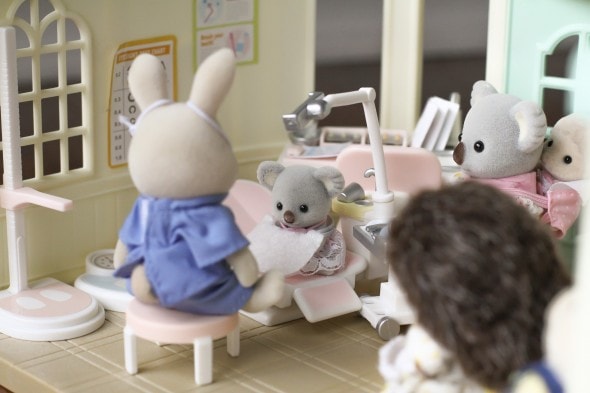
I realize the irony of asking this after a post on reducing consumerism, but where did you get those sweet toys? My son has glasses and I would love to get those bunnies for him!
Oh, I don't think that's ironic! I'm all about mindfully buying imagination-friendly toys, and these were a Christmas gift for Zoe. 😉
They're Calico Critter grandparents, and you can get a variety of animals (cows, bunnies, meerkats): They're easy to find on Amazon http://amzn.to/1QmFHTH and some toy stores have them as well, especially small, independent toy stores.
I'm a mom of four and a grandma of six. I was a stay at home mom for 17 years, and yes, we had a lean budget, for sure. My kids had everything they needed, and like yours, Kristen, birthdays and Christmas to look forward to. I think it sucks the joy right out of those occasions when you can get a new toy any 'ol time you whine for one. My parents raised my sister and me this way, but alas, this did not extend to my brother, the youngest, whose every whim was catered to and this continues to this day. He was so spoiled, that as an adult he has made some serious, and I mean, very serious, errors that cost him his marriage. He will do anything to get what he wants, but, lucky for him, my parents continue to fund his every need, and he does not even work. They blame themselves for his troubles but at age 50?? So because of their guilt, they continue. Now, I will say this. As frugally as my children were raised, and knew they had to wait for special occasions and whatnot, this does not necessarily extend to my GRANDCHILDREN, lol. Grandbabies are for spoiling, and while I still have a budget, I am much more open to a little toy on every shopping trip. The oldest (6&4)know the difference in a "little toy" and a "birthday-caliber" gift. I also buy them clothes and other necessities, because I want to, and it helps out their parents. I think I enjoy it more than the kids do....
Oh yes, I imagine I will be quite a bit softer as a grandparent. 😉
I also have a grandmother-in-law who does that, and I cannot begin to express how much the clothes-buying helped, especially while we went back to school
Great points! I would just add that it takes time. If your four year old is begging it's because he or she is four. It takes time for them to develop emotionally and conform to the family culture.
Starting early is definitely a key. We never gave in to pestering, and our daughter essentially never does it. She'll ask for something, we say no, and that's that. I don't think she even asks for stuff like candy at the checkout lane because she never got a yes, so it stopped. We're actually having to get her to ask for things now--she starts, then stops herself saying we'll do/get that thing. I have to encourage her to go ahead and ask because we might say yes if it's a sensible thing!
I want to note this doesn't mean my daughter *likes* it. She would much prefer to have name brand clothes bought new (we shop at Goodwill 99% of the time), junk food all the time, and a room crowded with stuff. I just tell her she can do that when she has her own money and place!
It can also help if you explain what an impulse purchase is, and how stores arrange things so we are incredibly inclined to make impulse purchases. The candy in the checkout lane is a perfect example: they're there so we see them, then think about buying them, and we're stuck in line for a while so we're thinking about it for longer.
Be strong and don't let the store decide what you're going to do! (That last bit works even better if you're dealing with an oppostional child.)
I can't remember which grocery store it was, but when my kids were little, there was one with "candy free" checkout lanes.
In addition to the strategies you use, we also do not just go shopping to look at what all is available. If we are in a toy department, it is getting a gift for someone or checking a price to see how much more a child needs to save for a purchase. I found that once I cut out unnecessary trips down a toy aisle, the asking for toys dropped drastically.
Also if I am shopping with kids, we talk about what items we are going to the store to buy and divide the list with each person having something they are responsible for. This helps keep even the 3 year old focused on watching for the item they are in charge of putting in the cart.
I don't have much to add to your blog post, we basically work the same way!
My kids are 4 and 6. The 4 year old never ask for anything (not materialistic at all). The 6 year old likes stuff, but she knows that we buy gifts on birthdays and Christmas, and that' about it. They do have a play room FULL of stuff, games, craft material, etc. They are not missing anything. And they both receive a weekly allowance (1$ for the 4yo, 1,50$ for the 6 yo) that they have to split in two (savings/spending), so my oldest knows that if she really wants something she has to save her money. She's becoming really good with this!
Another thing that REALLY helps is that we don't have TV cable (zero channels received at home). So the kids watch movies on Netflix = no commercials. So they are not exposed to all the "You-need-to-buy-this-and-that". It's a major component I think.
And they don't go on the computer yet.
Plus, we don't do much shopping in general. Both hubby and I dislike shopping, so it's only for necessary things and it's in and out. So, again, kids don't see shopping as a "fun activity".
The biggest thing we did was that we don't let our kids watch commercial tv!! They can watch PBS, and Netflix, but no exposure to commercials means less whining for toys and junk food!
Our four children are adults with children of their own now. They grew up in the age of the Sears/JC Penney catalog. I remember them, heads together, pouring over the enticing pictures in the catalogs and hearing, "I want that". We always tried to steer the "I want" into "I like". It's fine to "like" a lot of things, but one doesn't need to "have" it or even "want" it. Contentment.
One thing my son has learned from me is the thinking, "that's expensive for what it is." He now does that himself, weighing whether something is truly worth the cost--whether it's coming out of our pocket or his.
It's also true that you (most people, at least) get more joy from something you've waited and worked for, than something that comes easily. Not an easy lesson for a 6 year old but a valuable one nonetheless.
I don't have kids but my parents raised us similar to what you do and it worked. We were given an allowance and the opportunity to do chores for extra money. We were given the basics but extras had to come from our own pocket. It made us all appreciate the simple treats in life more and we learned to shop carefully. When I started making my own money I did get a bit carried away at first, I think that's normal for most teens and young adults. However I quickly learned that I couldn't expect my parents to bail me out if I overspent and that set me back on the right path.
My siblings are teaching their kids the same valuable lessons. We like to treat our nieces and nephews when we can but we keep it realistic and they are always appreciative. Like us, they learned the true value and power of money by example.
I agree on all fronts, Kristen, and we practice a similar model in our home.
I'll also add that, on the rare occasion I need to visit Target or the like, I don't bring kids. I've found that toying around stores like this (and Toys R Us) really bring out the "gimmies" in the best of kids. When making a birthday it Christmas wish list (not that we buy everything he wants) he can use the Internet.
I also put toy catalogues directly into the recycling bin.
I'm also teaching my son to routinely (maybe once a year) go through his room and gather things he no longer plays with. He then cleans them up (if needed) and we (together) take them to s children's donation center. He knows these items are going to kids who don't have much at all, and he had said it makes him feel happy knowing they will get enjoyment out of them.
I struggle with not wanting my son to be teased for not having the name brands. I was bullied something awful in school and I just have trouble shaking that feeling 🙁
I am with you on the teasing part because of no name brands. I will always remember the day that I wore red salvation army pants to school and was asked repeatedly where my mom got them. I don't think I ever gave it up that they were purchased at the salvation army! Now as I look back at my childhood, I realize that my entire school was just as poor as I was and we all were probably wearing salvation army pants, mine just stood out because they were red! I do think about how my children will be treated when they go off to school but I hope that our teachings will give them the confidence!
This is the way I was raised and I remember being a very contented child. Even now as and adult I'm content with what I have and am hesitant to make unnecessary purchases. I'm starting a new job this week that requires much nicer clothes than my current one. Thankfully I have money saved up for unexpected expenses. I still hate to spend it on clothes, but the new job brings a bigger salary and much better benefits, so its a win win 🙂
My 35 year old daughter saw those little critters in the store the other day and wished she was little enough to get them! (There was a bit of whining!)
Really sensible response, Kristen. Well done.
Us too! kids get toys and new clothes from family members at their birthdays, Christmas and epiphany. Otherwise, no new toys. As a result birthdays are A Big Deal in our family, and it's a lot of fun because it is so exciting to see what they got, most of it in the mail as family is far away.
Somethings if we're at a shop, they'll say "oh I want this toy", but I taught them and keep teaching them to say "Oh I like this toy", and then we can enjoy talking about how fun that toy is, what you could do with it, who might like it and we move on. It works! They'll ask if I will buy it but I just say no, that we are not there to buy toys. And they mostly accept it. If they keep asking I just say that I am not going to answer the same question with a different answer, so please stop asking.
My kids are grown up now, and while I wouldn't say they're brilliant with money or we were amazing and disciplined parents one thing that really DID work was the "Wish List." Similar to your working with your child about "what does it cost?" Whenever we'd go to a store and they'd see something they desperately wanted (we never gave in at the exit line, firm rule, stopped asking) ... I'd say "that's a GREAT one for the wish list!" And then we'd go home and with great fanfare write it on the wish list on the fridge. Then, when they had a little money saved or got some "free money," we'd go over to the wish list and talk about what might be a good choice. It is amazing how unappealing things become if you do this and how certain things always rise to the top when you look at them in context! Often it was worth saving for a better item, and that teaches a lesson as well. This made our lives so much easier and I can say they never threw a tantrum or whined or begged. And they're wonderful adults!
We raise our son the same way as you: whenever he would ask for something, we would tell him to put it on his birthday list or Christmas list. Since he is an only child, he generally hit the jackpot at both times (from all of his relatives, birthday parties etc.) Since Matt has become a teenager, it is now mostly about electronics. We got him a MacBook Pro for his 8th grade graduation. He has been using an old iphone4 for 3 years now. We thought he would lose it, but our surprise, has taken very good care of it. Last December, I told my son that I would get him a new iphone for Christmas if he wanted one. His response: Why?, my iphone4 works perfectly well. I think he is the only child at his high school that doesn't have the most updated model. I like that my child doesn't feel the peer pressure to get "the newest & latest gadgets."
Good post! My siblings and I grew up rather poor, so no allowance, and no gifts except on birthdays and Christmas. My husband and I raised our kids on a very lean budget for most of their growing up years, and so we did basically the same thing. The difference was that my kids were allowed to earn money at a part time job when they turned 14, and could spend their money on things they needed or wanted. My dad never let us work while we were in school because he HAD to work after school and in summers from the time he was eight, and I mean plowing behind a mule kind of work. Actually, he started earning money at age five by killing a chicken for the widow next door each Sunday -- five cents each Sunday. (He was taught how to "pop' their necks to kill them. The widow didn't like doing it.) So he said his kids would only have to concentrate on school and being a kid. My husband was raised to get most of his gifts on birthdays and Christmas, but he could get other things anytime he asked, which he rarely did. He just wasn't the kind to want a lot. He worked from the time he turned nine, mowing lawns, and later, farm work and even construction work in summers, so he always had his own money to spend on what he wanted and didn't have to ask his parents anyway.
That's not to say my kids never whined, or that he and I never whined. It comes with the territory of being a child, but the rule was -- and we stuck to it, as did our parents -- if you whine or pester, the answer is an automatic no, even if it was something we would have normally given them had they not whined. Never give an inch on that, because a child will take a mile, and not be one whit happier in the end for it.
You nailed it!
I have two toddlers and man, can they NAG. For me, it's a two-strategy process. If they ask, I answer with a "no." When the pestering starts, I calmly reply each time with "I already gave you my answer. Stop asking." I have to say that over and over and over sometimes. But eventually they get it that my answer will not change and it no longer pays to keep asking. It's exhausting and annoying to have to do this but I'm establishing an environment where my first answer is my final answer.
If the pestering is accompanied by whining, my response is, "I can't understand you when you whine. Ask me again when you can use your words." And guess what, my answer may still be no. This is even more annoying but again, it's establishing the culture that whining and throwing a fit do not get you positive results.
Yes, yes, yes, yes and yes!!! This is SO good for helping kids learn contentment instead of entitlement!
Besides modeling behaviour from the parents, a VERY large influence for "pestering" is other children in school, especially as they grow older. Kids see what other kids have and they want the latest iPhone or jeans or video game or whatever. Especially in junior high and HS, there is tremendous competition and pressure, so I think home-schooling nips a lot of that in the bud. Send the most polite, nicest home-schooled kid to public school and guaranteed, in a month, they'll be pestering too: why don't WE have this? Can I have $20 for ___?
Great article! As an adult who was given everything as a child (I didn't pester, but I also didn't ask for ridiculous things that I knew my parents would say no to), I find myself having trouble staying out of debt or saving up for things that I really want, but don't need. I'm definitely NOT blaming my parents - my spending choices as an adult are exactly that: MY spending choices. I know they did it because they went without as children, and that was how they wanted to show my siblings and I we were taken care of. But I do wonder if it would be any different if my parents hadn't been so generous when I was a child. And I don't have any children of my own, but I also wonder how I would do it differently. Thanks for sharing what works for your family!
unmarried/without children speaking here but my impression is that the "see it-want it" scenario can also be an excellent opportunity to teach about quality products. I'm assuming that the pestering for toys mostly goes on while grocery shopping. The cheap plastic toys hanging in the cereal aisle will not last until the next trip to the store and that is planned by the merchandisers. Teach the children about quality workmanship when they are young and they will purchase heirloom quality merchandise as adults.
I found a paper napkin (from a Saturday-night take-out sushi splurge) on our table Sunday with some calculations. Our second-grade daughter was adding up how much money she had from savings ($112, not counting allowances, which go right into her bank account), and how close she was to owning a full-sized drum set -- her goal right now. This is pretty much how I get to large purchases, as well. Our three kids pester plenty, but I realize after reading your article that they don't pester nearly as much as they could. Also, each of their money styles is so different. Our second grader saving for the drum set told me a year ago that she was saving for college, and if she had extra, she was going to buy a house. Meanwhile, her older brother was saving to buy a giant gummi worm. Money styles definitely highlight Nature vs. Nurture!
LOL!!! A giant gummi worm! I love that. My 10 year old son has been saving for a "golden car" for years now. Not gold in color, gold in material!! Haha! He likes shiny things.
YES to avoiding commercials! And I try to avoid taking my kids to badly arranged Walmarts for groceries. If we have to walk by toys, they will ask for them. (They are preschoolers.) Out of sight, out of mind--they don't want what they don't see. If I must shop at such a store, I go alone when possible.
I was blessed with the easiest child ever. I can't take very much credit for him not being a moaner for the most part. But one thing I did do was give the same response when he started to pester me about anything...whether it was something he wanted to buy or do, ect. When the pestering started I always said no & explained that the reason I said no was that he was pestering me. He could ask then leave me a lone to decide yes or no but if he pestered it would always be no.
I hate whining & it didn't take many times of doing this that he pretty much never pestered me. Once when he was around 10 he & a friend came to ask me permission for my son to spend the night with him. As I considered, the friend began to plead & pester with me, wanting a yes right away & even becoming argumentative with me. My son jumped in & told him, if he didn't stop I would say no for sure.
When my children were younger and we went to a store, we would make a list before going. I would make a point to tell my children that we could look at everything (and we all enjoy that), but we were only buying what was on that list "today". Often my children would see something they'd like to have and they would mention it. "OK, put it on your birthday/Hanukkah list," I'd tell them. Since the list was mental, it was up to them to remember something they especially wanted. As it got closed to birthdays and Hanukkah (both kids have birthdays right around the time of Hanukkah) I'd ask them what they wished to have. It turned out that very few things they expressed an interest in during shopping expeditions were even remembered. Only things that they really wanted enough to remember over time ever really made it to their list. And because I was not saying an outright "no" during the shopping trips, a momentary thing they wanted didn't become the object of a power struggle between us.
Buying gifts for other kids' birthdays can be particularly challenging. That's when the gimmees might really surface. Often we bought books for other kids, and I am always happy to buy a book for my kids too, so that was no problem (we even included a book for each on our "list" before setting out book shopping). If the decision was to buy a particular toy for the birthday child, I'd be especially careful to remind my kids that was all we were buying that day, and in later years I just order toys for other kids on Amazon so we could bypass the entire shopping "experience". (My kids still chose what to buy for the birthday child).
Like Kristen, we don't buy things for the most part except for special occasions. Now that one is a teen and one is a young adult, I find it's really hard to even get them to name a desire when I want to treat them--a little frustrating, actually. We also helped our children earn money for expensive electronics by giving them extra chores and things. I think that when they buy things with their own money they take much better care of them.
Another factor in avoiding the gimmees was that we didn't allow our kids (when they were young) to watch commercial tv. We were OK with PBS and cable kids' channels that didn't have commercials (and then, only on weekends). Because our kids weren't constantly bombarded with ads for stuff and junk food, they simply didn't ask for it.
When my kids were very young, the other issue in stores is what is OK to touch. When they were very little I'd say "Not for babies", and when a little older I'd remind them "This is a "don't touch store" because there are a lot of breakables". I like this much better than constantly having to say "no" or "don't touch", and because I wasn't saying outright "no" there was no reason for an oppositional 2 or 3 year old to touch it anyway, just to get a reaction out of Mom. And I'd heap praise on their good behavior in stores. "I'm so proud of you for watching what your hands did around all those breakables!"
My kids were actually a joy to go shopping with. I loved having little ones in a grocery shopping cart--they are at your eye level and you can both have fun talking about everything around, touching and smelling the veggies and fruit, etc. (carts are also very convenient for giving a little kiss on a soft, sweet head). In department stores we loved exploring all the stuff, but we didn't have to take it all home with us.
I can imagine this can all be more difficult with kids that already have a pattern of "gimmees". You might try starting before you ever leave the house, explaining the behavior you expect (and even role playing). Make a list with your kids and explain your resolve to stick to only what is on the list. Don't forget to praise good behavior (often!), and maybe plan a reward for good behavior built into the day (e.g. a trip to the park on the way home). One other thing I see other parents doing that just doesn't work is threatening. E.g. if you offer a trip to the park for good behavior, but kids are not behaving well in the store, it doesn't help to threaten to take away the trip to the park (IMHO, they already lost the reward). That just gets into a power struggle. Simply just go straight home (without remarking) and if kids ask about the park trip, explain that the behavior didn't warrant the reward today, but maybe next time.
I try to stay very positive. I'm not afraid to say no to my kids, but I'd rather try to elicit appropriate behavior than set up a power struggle with a toddler.
Fantastic comment.
I rarely link to my own blog but this is a story I wrote about teaching our children that seems to fit your topic today: http://sandcastle.sandsys.org/2016/02/the-self-made-man/
Fantastic comment.
Yes to Kristen's techniques, yes to limiting kids to PBS to avoid commercials. We also didn't allow our kids (now 10 & 12) to peruse shopping sites online and make lists of what they want (I have friends who didn't discourage that behavior and it has caused problems).
Something that we didn't plan but worked out well for us was to encourage the kids to make gifts for birthdays/Christmas. They love doing that and have even made cards/gifts for our big Christmas celebration with cousins (who, thankfully, have similar values when it comes to possessions). It sparks their creativity and by investing something of themselves in their gifts, it makes it all the more special to receive ... although the year my son made a full-size beaver costume out of paper for my husband's birthday, it was hard to keep a straight face.
Something that worked for me during the toddler years was to tell the kids we would "visit" the toys but we were there to look, not buy. They were allowed to touch/hold the toys and then said "bye-bye" and returned them to the shelves. I never had a problem with gimmee behavior using this approach. Also, sometimes I would purposely find an item in a store, maybe new dishes, and I would have a staged conversation with my kids. "Oh, look at those nice plates. Boy, mommy would sure like those plates. But you know what? I already have dishes that we can use and they are in good shape. I guess I don't need them now".
I love your daughter's delighted expression in the last picture. It's a joy to give your kids something that you know they will truly appreciate.
My husband and I raised 7 children on one inecome since we homeschooled. We too were able to make ends meet by being frugal. There were things we didnt have and of course clothes were from thrift store. We fed our children healthy and well and did it on a budget. Our children wernt pesky or whiney and we didnt make them wait till Christmas or Birthday for hobby items. We alway felt that it was aimprrtant to give them something constuctive to do(besides chores) and to eccourage thier creativity and develop skills and talents. We bought paper, crayions, markers, paint, canvas,glitter, glue, diarys, ect. The girls sewed, crocheted, needlepointed. My mother helped by giving us her unwanted yarn(she wasnt so frugal) and my aunt once gave me a bunch of fabric which lasted for years. This cut down on some supplies.The boys had thier hobbies too. In the summer we got them seeds and gave them thier own plots for vegetables or flowers or whatever they wanted. They rarely asked for these things and were content with us making the decisions of what to buy and when. This made it easier on us to stick to our budget. If our children wanted to cook something special we got them the ingredients if we could afford it even if they had to wait a few weeks.
Once we took them to a toy store to spend a little of thier own money. This was not a regular practice with us however.They had some my pretty poney on sale for 69 cents a piece. I added to thy ier money and got the girls 10 dollars worth. They played with them for many years and made many adventures with them.
My children are all grown and and to this day they are responsible, resourceful, and creative. Two of them are writing and illustrating novels. Some of them are frugal and some are not but none of them have credit cards and all live within thier means. Frugality helped us to provide for our children in the way we wanted and they dididnt have everything but we we had love and we had fun and we learned. My husband and I did not save alot of money but I do not regret it even a little. To me there are more important things than putting alot of money in the bank.
This reminds me of a purchase our daughter made last summer. She's been playing violin for almost ten years now, and has become pretty good at it! (Mom gets to brag a little, right?) 🙂 Anyway...she had been using the rent to own violin that we purchase through the school for years, and wanted something better. She ended up purchasing a very nice violin and bow with mostly her own money. We gave her a little to put towards it, but then she was "on her own". When we talked to her about it, she said, "I don't want you to pay for it. I want it to be MINE!" There's satisfaction in saving and buying something that you really want/need with your own money.
Haven't had a chance to rad through the comment but I agree starting young is the best way to teach kids that pestering will get you nowhere. Of course, that's not to say they won't continue to try at least once in awhile. As any parent knows, taking kids to the store, any store, is an invitation for them to start in on the "I wants!" Early on whenever we would go to the store (I'm thinking the grocery store and Target!) before leaving the house, I would always tell my kids one of two things- either "no treats today" or "one treat today." If it was a treat day I would be very specific as to cost and type of treat, ie-candy bar under one dollar, or one item from the dollar bin, etc. I would really regret it if I forgot to set the limits prior to our shopping trips as the "I wants" would come out full force as we made our way through the isles.
As they got older, however, I no longer have to set such limits and when they ask me for something-a simple yes or no, with an occasional explanation of my reasoning, usually suffices My kids are 11 and 15 and they have both expressed gratitude they don't get everything they want because they feel they have more appreciation for the things they do have, more so than their friends they perceive to have everything! Of course, my kids are far from perfect and occasionally I see their younger selves show up at that door-lol!
Thankyou so much for responding to my original comment. And thanks for all the great tips added by everyone in this comments. Some great advice.
Kids pester for the same reason that adults play slot machines. Sure, you might lose most of the time, but every once in a while you might get lucky and hit the JACKPOT.
So my advice is to keep the NOs coming. Then the game just isn't much fun.
I totally agree with you. 🙂
Oddly enough when our budget was tighter, when the older kids were little, we bought more wants than we should have which was not a good thing.
I took my friends little girl to the zoo today and she wanted something and I said "Do you have your allowance? No, well it looks fun, but not today." She was really good about it and moved on.
I have always given my children boundaries. I won't say they don't ever get special items unless it is a special occasion. On occasion I used going to pick out a special toy as a reward. In the grocery we follow a list. If they acted up then they stayed at home the next time and since going to the grocery usually involved a trip into town, a picnic and visit to the playground they just didn't act up. They also got to pick item at the store: cereal, snack, and lunch items. I made it easier for them to make choices for later. We always have crafting items and art supplies. At Christmas they get 4 presents and a pair of PJ's. Less "stuff" was also accomplished by rotating toys. What is old is new again.
Bravo.