
How I teach my kids to drive
A reader recently asked me if I'd written a post with tips on teaching teens to drive.
I haven't done that, because it felt a little off-topic for a frugal blog.
But, I did a poll on my Facebook page asking readers if they wanted a post on the topic, and the results said yes.
(And a few sweet people said they didn't need the tips but that they would read anything I write.)
So!
Off-topic or not, here I am.
First: I'm not a driving instructor, and this should not be construed as professional advice. I am just sharing what I do with my own kids.
My kids have not had much at all in the way of driving experience prior to getting their learner's permits (we don't have a tractor or a boat or a go-kart), so we really are starting from scratch.
Given that, here's what we do.
We do 30 minute sessions at first
Driving with a total newbie is a little stressful for the parent.
And it's a little stressful for the teen too.
To maintain a cheerful attitude and sufficient focus for both of us, we just do daily 30 minute sessions at first.
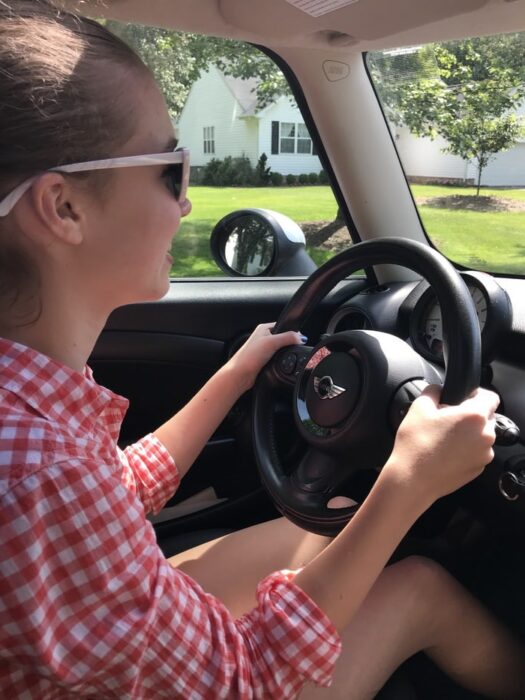
We start in an large, empty church parking lot
Midweek, most church parking lots are really empty, and there are very few cars coming and going.
This means there's almost nothing to run into, which makes it perfect for a new driver.
We usually do several 30 minute sessions in the church parking lot making laps in all directions just to give my new driver a feel for turning, accelerating, and braking.
Next up, neighborhood streets, early in the day
Generally speaking, there's less traffic coming and going in the early to mid-day. And unless people are working from home (!), there are fewer cars parked in the streets.
Neighborhood streets are annoying because there are no painted lane lines and because streets can be narrow, but they ARE great for someone who is driving super slow.
We start out in our neighborhood, but we usually end up touring alllll the neighborhoods near us.
At this point in the driving process, I keep a "new driver" magnet on the car just because we are often so slow, I feel the need to announce it. 😉
Small-ish side roads come next
I actually breathe kind of a sigh of relief here because these roads feel a little easier than neighborhood roads.
You do have to drive faster, but no one parks there, no one is walking, the roads are wide, and there are lane markers!
Once my new driver gets to this point, it's easy to do lots of local exploring, combining side roads with neighborhoods.
Highways
I try to start with practice on highways that don't require merging (some of the smaller highways here are that way).
Once my driver has gotten a little more comfy dealing with high speeds, then we start working on highways with merge areas, starting with simple ones.
I'm not gonna lie, teaching a kid to merge is sort of un-fun! There are so many things to keep an eye on.
I usually take off the "new driver" sticker at this point, because I've discovered that on multi-lane roads, people actually seem to drive more dangerously around you if you have the sticker.
Adding driving into regular life
Once my new driver is comfy with highways, we can really work driving into regular life instead of having dedicated driving sessions.
Drive to church, drive to college, drive to friends' houses, drive to run errands, and so on. This is usually when we really start doing a good job of racking up the hours because it's so much less effort.
These kinds of trips do require some parking, which is a little bit hard at first. We generally park in the back of the lot at first to make it nice and easy (fewer cars to run into!), and if the parking situation is just too tough, we switch seats and I take over.
The more experienced they get, the more parking they do, and eventually, they get much better at it.
Hours and hours and hours...
So, that's basically how I've gotten my kids through the many hours of the driving required.
They also get six hours behind the wheel with an instructor from the driving school, and that's when they learn to parallel park.
I don't mess with that. 😉
Three other random tips
One
I put the new driver in charge of keeping track of the hours in the little booklet, just for a little extra responsibility, and one less thing I have to do. I have them write the hours down after every session so we don't lose track.
Two
If you are feeling stressed while teaching your kid to drive, it can help to remember that driving with a new student feels incredibly dangerous, but it's statistically not.
(A study showed that teen crash risk goes up once they're on their own; with a learner's permit, the crash rate is similar to that of their parents.)
And if you need more proof, consider that insurance companies generally do not raise your rates until your living-at-home kid gets their license.
If learner's permit accident rates were high, I think insurers would ask us for money as soon as our kids get learner's permits!
If you are in the car with your kid, helping them anticipate problems, helping them know when to turn and when to merge, they're not going to be super likely to make bad driving decisions.
So, take a deep breath; you're probably going to be ok, regardless of how it feels. 😉
Three
It try to be kind and encouraging.
My kids have all tended toward self-doubt and discouragement rather than immediate cockiness as they learn to drive, so I've tried to be kind and reassuring as we learn.
"It's ok, everyone makes mistakes, you're doing fine, it's normal to feel like 50 mph is VERY FAST, everyone has trouble parking at first..." etc.
And that's the end of what I have to say about teaching teenagers to drive (1000 words later.)
If you have tips to add to mine, add 'em in the comments!
And if you have questions I didn't address, feel free to leave a comment as well.

Holymolly, I'm reading this thinking that it doesn't apply to me at all since my kids are still "so young", but I'll actually be there in only 5 years!!!
My mom was a stressful teacher and I'm not a patient person (learn by example...) , so I'll have to really chill and bite my tongue when it's my turn to teach....! Good tips!
I always thought the Lamaze breathing exercises you learn before birthing your kids, come in handy when you teach them to drive.
Thanks for this! We have a young nephew who wasn't interested in driving until now (he's 20), so this is the summer. We hope he will be ready once our DMVs are offering road tests again.
He also tends to be a nervous driver, but I think I prefer that over cocky!
I'm the early stages, how often do you take them out?
Thanks so much for this! My oldest just got his permit last week and we're navigating new waters. We do have ATVS and go-karts, so I'm hoping that helps, but I was looking forward to enrolling them in driver's ed class as a supplement for some of the extras (like the gruesome videos that I remember!) That's not an option now with Covid, so was looking into virtual classes like you'd mentioned Sonia taking. May I ask how you like the one you chose and if so, can you share which one? Thank you for the continued posting and especially for Thankful Thursday, they're a lovely reminder of God's continuing mercies!
Sonia's taking online classes at the local school my older two kids went to. So, it's not an online course specifically...just a local school that is using Zoom for their classes right now.
So, I'd read reviews of local driving schools and ask around to local friends with kids a little older than yours. They should be able to recommend a good school in your area; that's how I found the one we use!
I do not have good memories of learning to drive from my dad the fighter pilot--he tended to be somewhat impatient and stern--so I'm going to try very hard to be more relaxed and encouraging with my own children. I'm still five years from my first kid learning, but at least I don't have to worry too much about too many cars while they're learning. 🙂 Actually, it's probably going to require some trips to bigger cities to teach them about things like traffic lights, since the nearest one is 60 miles away.
My mom was no fighter pilot but I, too, have bad memories. Actually only one. We got in the car, drove about two miles, she told me to turn right, I did, there was a wall on the right and we were going down a small hill. She got hysterical and started yelling because she thought I cut the wheel too hard. I went a few hundred feet, pulled over, got out, we had an epic fight and mutually agreed dad would take over driver's training. And we all lived happily ever after. 😉
I was wondering about this, so I'm glad someone asked. I am also hoping, on a frugal note, you can mention how much your insurance goes up once you have a teen driver with a license on it. Also, do you notify insurance once your child gets a learner's permit?
This might differ some depending on where you live, but here, the driver with the learner's permit is covered by the parents' insurance, so you don't have to have them officially added to the policy yet.
The amount the insurance goes up when you add a teen all depends on your policy and your car situation. If you call your agent, they should be able to give you an idea of what to expect.
Definitely call your agent so that you can get situation-specific advice! Our agents were great about answering all of my questions the first time around.
No kids here but as someone who drives multiple vehicles, I would add a small tip: be sure the new driver knows where all the buttons and knobs are for windshield wipers and lights and the emergency brake and how to operate them. Turn signals are pretty much the same on every vehicle but lights, wipers and the emergency brake vary a lot. It pays to know where and how to operate these devices before you're caught in a storm or other emergency. It can be scary trying to figure out where the wipers are and how they work while trying to drive in traffic. (This is good advice for people renting cars, as well.) It's sad there is not standard placement for these items in all vehicles!
Isn't that the truth? Some standardization would be pretty handy.
Agree with you on the standardized placement of buttons. Couldn't find the wiper button while driving hubbie's new-ish car. Had to pull over to find it. I always pull through one spot into the one in front (Sam's, grocery stores) to be free to pull out without having to look behind me. Hard to see some cars coming toward you as you back out, especially with a really large car next to you. Hubbie taught me to drive his Volkswagon beetle. Had to park at the top of hills, in order to roll forward to pop the clutch to start the car. (He also worked on his own cars.) It's good to learn how to drive a standard transmission, you never forget how. Just might need to figure where that spot is on any other standard if it becomes necessary to drive a different one.
Side note, had a minor accident pulling out of parent's driveway in sister's new-to-her car the day I joined our church as a teen. Glad she made me get back in and drive us there.
We did not have such a disciplined approach but did do similar things. We were able to drive at the local college on Sundays when there was generally not much traffic early in the day. At some point my husband took over because our daughter felt better driving with him.
I have the cocky kind of kids. In fact, the first thing my son said when he got behind the wheel for the first time was, "So how do I pop a wheelie?" hahahahaha, oh boy.
Haha, he's definitely cut from a different cloth than my kids!
I think both types of attitudes present their own special challenges. Zoe's the only one left who hasn't gotten behind the wheel yet, so we'll see if she follows in the path of the other three. She might be a more zesty driver, based on her personality.
My last teen driver will be getting her license in a few weeks. We managed all 3 similar to you. I will say that learning to drive is easier for some kids than others. My oldest has some fine motor deficiencies and driving was a lot for him to manage physically. You have to control your hands, feet and eyes simultaneously which isn’t a big deal for most of us but is exhausting and nerve racking for him. He has been licensed for 4 years now. I don’t think he will ever love to drive, but he is a safe driver now. I just wanted to mention this because it really wasn’t on my radar that driving would be extra challenging for him. Learning required patience, perseverance and a lot of time for him to practice and get comfortable behind the wheel.
My husband and I split the teaching time
and it worked well. He however got the parking lessons!
First an empty parking lot, then one with carriages marking the spot (bc you can bump them out of the way and no harm done!)
Also, my daughter found that backing into a spot is significantly easier than pulling in and excels at this. Also feels jt helped with her parallel parking skills when they got to that point. Something to keep in mind
Cemeteries are good too. Cant really hurt anyone there!
My kids started driving on the lawnmower. Unbeknown to me, my husband had taken the blades off in the unlikely event the mower flipped. They then were upgraded to an ATV and then a vehicle. This took years, but by the time they made it to a car, they were comfortable with handling it. I also started learning to drive in a field on a tractor, many many MANY years ago.
I let my son do a few sessions with his driving instructor first. Then I went out with him. He’s a very good cautious driver now.
My tip for how to start teaching your teen to drive is to start explaining some driving decisions and things to anticipate/look out for while driving before the teen has their permit but are studying and preparing for the test and thinking of traffic rules. Before starting the car for the first time, we also go through the controls and what they do.
We do the same thing of starting in a big empty parking lot, and do not move out on smaller roads until the teen is maneuvering the car in a way that doesn't feel jerky, and things like using the blinker, stopping at "intersections" and looking in the mirror is happening without prompting.
Also, I found that we could not start with driving lessons in driver's ed until we had done some driving ourselves, as the driver's ed was more about checking off what the teen could do rather than teaching them. I found this a little odd.
Yes! My husband is the one teaching the kids to drive and he sits in the car with them and goes over what everything is. Also covers basic car maintenance with them. Teaches them how to change a flat, checking the oil, how to put gas in...all that necessary stuff that isn’t “taught”.
I know that states differ in what they require. Michigan is fairly stringent in its requirements, which is a good thing but kinda overwhelming at times. We have requirements for driving in different road conditions--daytime vs nights, clear and sunny vs rain or snow, and so on. It can be challenging to drive in windy or foggy conditions. I think you have a great approach, Kristen, and while this seems obvious, I would add that kids should have their first experience in good weather and progress to more challenging conditions as they improve.
My only added advice is to be sure you get them on the highway fairly soon. I have seen a lot of friends kids, who have not been allowed to get on the highway for the first few months of learning, become afraid of getting on the highway at all! So, I got my kids used to getting on and off as soon as they could navigate it. The first few times we should just get on and go one exit and get off so that they don't have to master too much at once!
I took drivers ed during summer school at my high school. One thing our in-car instructor did was take us to a large empty parking lot and practice driving in reverse. We went in circles, first with all right turning, then with all left turning. Then we did figure eights, all in reverse!
I did this with both of my kids during our practice sessions. My daughter, about to turn 30, Todd me not long ago that a lot of her friends are terrible in reverse, and she's glad I taught them that.
I get to practice that myself every day because I always back into the driveway and garage. It's much easier to unload groceries and to pull out of the driveway - our street is very busy at times, and backing out can be a real headache.
Told, not Todd - good grief!
A couple of other things, my dad had me drive on the interstates when we went on vacation, and taught me to drive a stickshift in a large empty parking lot. Not such a terrible thing when you kill the engine letting the clutch out too fast! He also took me to the empty parking lot after a good snow to do doughnuts - a great way to learn how to keep the car under control in slippery conditions. Now that I think about it, Dad and I spent a LOT of time on the interstates and in empty parking lots - LOL!
So true! I never thought about it, but yes, backing up is not taught. Huh. Gonna add that in to teaching the kids.
We were not nearly so organized but our teen had 6 yrs of driving before leaving home, 2 yrs on a permit. I do think the more time you can have them drive while living with you the better. By the time our son was 16(when he got his license) he'd driven in all kinds of weather from heavy rain to ice & snow & all kinds of circumstances from country dirt roads to driving through major cities on an interstate.
We also let him begin driving the riding mower (with the blades off) & the car around our circle driveway at age 7. If you do have private land to practice driving on before getting a learner's permit I do think it makes such a huge difference. Because we let our son drive our oldest car around the yard at such a young age, he was very familiar with how to operate the car before he had to deal with other drivers. I can't imagine waiting until your child is 16 or older before they even start. That would be pretty scary to me....sending them off 2 yrs later to college & driving on their own.
Thank you! Thank you! We are hoping to get a learner's permit and get started this week. I'm loving reading all the comments, too. Great ideas.
I would second what Kristin said about asking friends for recommendations for drivers ed - in our state, the class part is all standardized, so you'll get the same material regardless. So, how good/engaging your instructor is can make a huge difference (in applying info to real-world situations, making it vivid and memorable, helping kids stay awake...). Another thing to ask your potential drivers ed company is - after the kid takes the course, how long do they have to complete the driving hours? Our company gave a full year to complete the hours; other friends had much less time, and they had problems getting the hours in (it can be difficult when every kid is trying to schedule the hours on a Saturday, so you have to schedule 2-3 months out).
As far as the on-the-road driving part of driver's ed - if you can get your kid pretty good on the road first, and then schedule those instructor hours right before they take their test, that can be really useful. Our instructor "fine-tuned" the skills and basically took the kids through the test the state would give them. Gives the kids a lot of confidence when they're about to take the test!
Great advice, Kristen!! Looking back, one of the best things we did with our new driver was practice at a big high school parking lot. There were lots of small streets, tons of signs (Stop, Yield, etc.), quite a few one-way sections and plenty of parking at our local high school. Sundays and during the summertime were perfect times for practicing. We also made sure that our new driver (after he was driving on his own) was extremely comfortable with locating the insurance documents in the car and what information he should collect from other drivers if involved in an accident. Pulling up to gas pumps and pumping gas was also practiced many times.
I learned to pump gas before I was allowed to get a permit. We lived close to the NJ border, and a few of my classmates from NJ didn't know how to get their own gas because all of the NJ stations were attended (still are maybe?) but PA ones weren't. Periodically we had to help our classmates out to make sure they had enough gas to get home.
Jersey girls don't pump gas! 😉
Hi! Thank you for the post. Our daughter is getting her learners permit in July. (It was delayed due to Covid-19.). Where did you get your new driver sticker/magnet?
Here, they're available when you get your learner's permit; at least, they were back in 2016 when my first kid got a permit. I just had to ask for it.
If your department of motor vehicles doesn't have them, I know they are available all over Amazon.
Thanks !!
35 years ago when my ex taught me to drive at age 20, he desktop-published (that's what we said back then) signs to be taped in the rear window. CAUTION NEW DRIVER, with some clipart of humorous accidents. Then he desktop published awards for me as I learned each new skill, with humorous bad grammar, known as the Good Driving Awards. I gained awards for Shifting Good (it was a standard transmission), Parking Good, Steering Good, and so on. We were so happy back then.
Aww, that is so cute!
YES, to the big empty parking lot as a starting point. You can have them use the parking lines as a guide to going straight forward, straight backwards, and parking. Empty school parking lots and in these pandemic times, empty shopping center parkingnlots as great too. As they may have stop signs and lots of turns.
Teaching a new driver is like befriending a nervous story cat. Stay calm, no sudden moves or outbursts, patience, and determination....treats as motivation help too.
Stray*
One thing I would add is have them learn how to go thru a drive thru. I grew up on long island and needed to learn how to pay tolls (can't get off without it obviously before EZ pass). Its a little nerve racking to get close enough to pay thru the window.
Hahahaha, so true. My adult sister managed to roll her car at a Chick-Fil-A drive through!
(If anyone knows my sister and recognizes this tale, shhhh! Don't tell her I posted this.)
FWIW, I did most of my practice training with my grandfather, in his tank of a Buick Riviera. This was in the seventies and that sucker was huge! My grandfather was visiting for a few weeks and didn't have much else to do. We both enjoyed the experience (I think), and he was much calmer than either of my parents.
When there's not a pandemic going on that makes it prudent to avoid them, don't forget the value of grandparents as teachers. Driving sessions with my parents were pretty miserable and made me less confident. My grandfather came to visit for a week and took me out driving for hours every day. It was great! He was so much more patient and much calmer than my parents were. I made so much progress that week, and really gained a lot of confidence. It was also a wonderful bonding experience with my grandfather. That was over 20 years ago, and he has passed away, but that week of driving with him is one of my fondest memories of him.
In our house, my best piece of advice would be: have dad teach them! 🙂 Worked perfectly four times. Mom is much better at lots of other things.
Haha, that's a very handy piece of advice.
It's funny reading the comments here; sometimes the mom is better at this, sometimes the dad is, and sometimes neither of the parents are!
I don't know how it is now in our state, but my kids didn't have to go to a driving school or hire an instructor. They had to pass the written and driving test, and get six months (now a year) of learner permit experience, not a certain amount of hours of driving. Period. It horrified me. My kids are in their 30's, so that's how long ago that was. One of them was the super cautious type, but the other one jumped in and jumped on the gas, almost backing into our yard light pole as her first act. She had a heavy foot and an "I'm bulletproof" attitude - still has it, in fact. I poured sweat teaching that one.
In fact, I'm so old, my own high school taught the class, free of charge, during school. We spent one semester taking classroom instruction and one of the coaches or teachers took five kids at a time, driving for six weeks during that same assigned time period as the class. Our six weeks of driving time depended on our birthdays, timed to end just before we turned 16, so I took all of my instruction in the winter, which meant I got some good winter driving experience in. The school owned two vehicles just for driver's ed, with the brakes on both sides. They even offered night courses for adults (those were paid, though).
One of the things we did when a child was about to turn 15, was start teaching as we were driving. For instance, we'd point out a car sitting at a side road, and tell our child, "Watch that car. They may very well let us get close and then suddenly pull out. Always watch for what could happen." I can't tell you how many times a vehicle would do just the thing we were warning them to watch for, so our lessons were reinforced well. We'd talk about blinker use, school bus rules, road etiquette, roundabouts, etc. When the kids could see how it worked and see the mistakes as they were happening, it helped them remember once they started their learner's period driving. Both of my kids had some experience driving a tractor and a go-cart, at least, before a car.
Is this a duplicate comment? I can't tell if I posted.
I don't know how it is now in our state, but my kids didn't have to go to a driving school or hire an instructor. They had to pass the written and driving test, and get six months (now a year) of learner permit experience, not a certain amount of hours of driving. Period. It horrified me. My kids are in their 30's, so that's how long ago that was. One of them was the super cautious type, but the other one jumped in and jumped on the gas, almost backing into our yard light pole as her first act. She had a heavy foot and an "I'm bulletproof" attitude - still has it, in fact. I poured sweat teaching that one.
In fact, I'm so old, my own high school taught the class, free of charge, during school. We spent one semester taking classroom instruction and one of the coaches or teachers took five kids at a time, driving for six weeks during that same assigned time period as the class. Our six weeks of driving time depended on our birthdays, timed to end just before we turned 16, so I took all of my instruction in the winter, which meant I got some good winter driving experience in. The school owned two vehicles just for driver's ed, with the brakes on both sides. They even offered night courses for adults (those were paid, though).
One of the things we did when a child was about to turn 15, was start teaching as we were driving. For instance, we'd point out a car sitting at a side road, and tell our child, "Watch that car. They may very well let us get close and then suddenly pull out. Always watch for what could happen." I can't tell you how many times a vehicle would do just the thing we were warning them to watch for, so our lessons were reinforced well. We'd talk about blinker use, school bus rules, road etiquette, roundabouts, etc. When the kids could see how it worked and see the mistakes as they were happening, it helped them remember once they started their learner's period driving. Both of my kids had some experience driving a tractor and a go-cart, at least, before a car.
This is such a critical part of the teaching process ~ the "watch what could happen" process (as our teens are passengers with us). Being aware, anticipation and staying proactive are all keys to safe driving.
Oh, for sure! I tell them, 1) make sure that you let everyone else know what you are going to be doing by signalling, slowing down, etc. and 2) assume that no one else is going to let you know what they're going to do. So, you gotta be good at anticipating.
Two things that I am so thankful for my learning to drive experience:
1. Being required to know where all the fluids go (windshield wiper etc.) and knowing what fluids to get.
2. Lots of snow practice. I did a lot of winter driving on my permit since that's how my birthday fell, and to this day (20 years later) I feel comfortable with snow and ice. I've met so many people who are terrified of snow and ice, and if you know the tricks it doesn't have to be terrifying.
I think it’s also super important to teach kids to be courteous drivers. For example if they are going straight then Should stay in the left lane to allow other drivers to turn right on red (if allowed) etc. Drivers ed instructors don’t teach common courtesy. So, parents need to.
Hmm... maybe this only applies in towns? Where I live in Canada, highways all have signs saying stay in the right lane unless you want to pass. I have driven extensively in the US as well, and my experience on freeways is that it is better not to stay in the left lane, because you can cause the traffic to bottle neck. Stay in the right or center lane if you are following speed limit, so that others can go around you easily.
BUT while driving, only go in the left lane to pass. It’s shocking how many people creep along there on the highway, blocking everyone and creating danger.
The graduate level course is teaching them to drive a stick shift. 🙂
You are telling me! I learned to drive a stick when I'd already been driving for a few years. I can't imagine learning at the same time as learning to drive; there's enough to think about without having to manage a clutch!
My dad taught all four of us to drive on a stick shift. It wasn’t so bad, as long as you don’t mind the smell of burned clutch, and it means I can pretty much drive anything. Lessons 1-5 were all about car control in the parking lot and you mostly stuck to first gear or reverse. He used to put slalom courses of paper cups out and you had to run over the cups forwards and reverse and he’d randomly yell “brake!” so you could practice emergency stops. Then we did figure 8s with a shift up to second gear and in reverse. Lesson 6 was highway driving - onto a quiet highway at one exit (merge with no traffic), up through the gears to highway speed, then drive a few exits until you were comfortable with the speed, and only then did you start doing side streets. Lesson 8 was mall parking, and Lesson 9 was the marble in the frisbee: Dad glued one of those shallow mini frisbees you get at arcades to a suction cup and stuck it on the dashboard; he popped a marble into it, and you had to do figure eights forwards and in reverse without bouncing the marble out of the frisbee. Once you’d mastered that you moved on to Mom lessons; Dad still did technique lessons (smoothness, parking, bad weather, maintenance) but anywhere you went with Mom, you had to drive and you couldn’t book your test until Mom decided you were ready. In my case, I was very happy not to be ready, so Mom eventually booked my test for a Friday afternoon and then booked herself a weekend away so that I had to pass or cancel all my weekend activities. It worked! Dad also took me out in our first snowfall and made me practice spinning the car and recovering it in an empty parking lot, which must have been deeply nervewracking lessons for him! (Long after I had my license, he also took me out in his new four wheel drive in the snow to practice spinning it with and without traction control).
A few years later, I had the privilege of being my baby sister’s responsible adult driver while she was practicing and learned just how terrifying it is to teach someone how to drive. She’s a much better driver than I am, but I’m also a better driver for having taught her. And I still (20 years later) automatically cede the wheel when we go somewhere together, even in my car!
I survived teaching both of our kids how to drive and I'm sure glad we only had two (although I did help a friend's daughter practice after her dad had a stroke and she had to learn to drive herself to school). I attribute all my grey hair to driving sessions (just kidding).
The "Student Driver" signs really helped with my very cautious and SLOW new drivers.
Here's my big tip: Before your kid ever gets behind the wheel, have your child hold up his or her hand as if it was a gas pedal and push down with your hand to teach them what it feels like to gradually apply pressure to the pedal instead of a sudden, fast mashing of the pedal. It's just something they won't know unless you show them, and it helps that first time behind the wheel go more smoothly.
Great tips. One thing my husband has taught our boys when they're pulling out into a busy road- "If you have to say, I think I can make it....... Wait!"
So wise. Better to err on the side of caution, especially when you are inexperienced at judging how much time it takes to pull out.
My first child just got her permit 2 weeks ago. We have been practicing in the empty school parking lots. They are also empty this time of year and a bit larger than the church lots.
Why do you track hours? Is it a state or insurance requirement? I do not have to track hours in SC (at least, I’m not aware of that requirement)
Yup, it's a requirement to track hours in some states.
Back when I was a teenager, they didn't require any tracking of hours, but now they do.
We registered our children in a Young Drivers of Canada program. It was a bit pricey but they learn information that we as parents may not include in home driving teaching. Information that remains with them for all their driving years. They taught me some good driving facts! The most important information is safe driving with defensive driving.
I would also suggest learning to navigate! Before my son got a permit I would ask him to give me directions when I was driving. I would also quiz him on the name of the street or highway, and what direction we were going. Often teen passengers don't actually pay attention to where you are going.
Another skill is learning to navigate while listening to a GPS give directions, including what to do if you miss a turn! My answer is that a u-turn should be your last option. I was once a passenger with a new driver (not my own child) who decided to do a U-turn, nearly ended up in a ditch, then was hit by an oncoming car!
stop where you can see the tires on the car in front of you touch the pavement. If for some reason that car doesn't move, there should be enough room to go around.
And if you 'social distance' in the car, stay 6 feet away, you can never hit anything.
My mother taught me the stick shift in school parking lot.
This is so timely for us! We are going this week to get my daughter's learner's permit. She is super cautious, and we have lots of time. Our state requires her to practice different situations not just hours, and log them. I will be the instructor rather than my husband because he is SO nervous!
Good luck! You can do this. <3
I taught my mom to drive stick shift in her late 40s after my dad died because only her car in the family was an automatic. I drew the gear pattern on a sheet of paper, used an umbrella as the gear shift, a slipper as the accelerator, and sat facing her chair holding the umbrella in place and with her feet on mine for the brake and clutch. Then I would give her instructions to start the car, put it in gear and drive, slow down gear down and stop. We did that for about a week before I let her drive my car because I could not afford a burned out clutch. She did very well.
Reading this reminds me of how patient my parents were teaching me how to drive a decade ago.
Thank you for your thoughtful description of how you help your children with learning to drive. Very timely in my life! I forwarded it to my daughter (22!) who I am trying to help learn to drive.
We called those small, neighborhood streets "semi-streets."
Two helpful things I learned late:
1. Adjusting side mirrors. Plant your rear end to the far left of the seat with your cheek against the side window. Adjust the mirror until you can just see the side edge of your car. Move to the other side of the seat and place your cheek above the middle of the console. Adjust the right mirror until you can just see the side edge of your car. Now oncoming vehicles will move from your rear view to your side mirror then outside your window. No more blind spots.
2. Parallel parking. Pull up beside the car in front of the empty space. Look over your right shoulder as you back up until you see the back corner of the car beside you. Turn and look over your left shoulder turning the wheel all the way, and back up until you see the front corner of the car behind you. Turn the wheel back the other way and back into the spot. If you need to do so, straighten the wheel and pull forward to get centered in the spot. Done.