
Q&A | How do you motivate homeschooled kids?
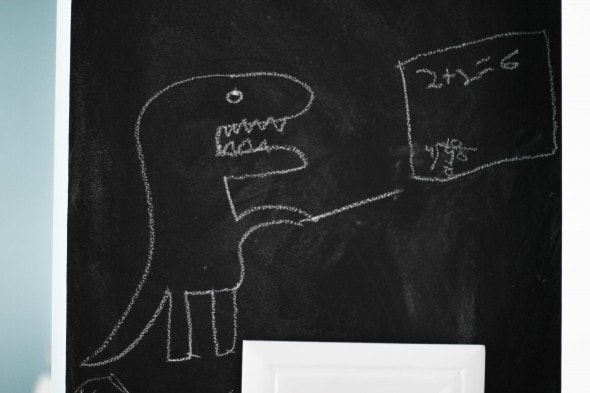
Several readers have written in recently to ask about how to keep their kids on task and how to handle kids who are less than enthused about doing their schoolwork.
Since this isn't a homeschooling blog, I know this is technically off-topic. But hey, it's Q&A day. And since several of you wondered, I thought it might be worth devoting a post to it.
Sooo!
First, let me say that I don't think there's a silver bullet solution here, and I think some kids are just more distractible than others. For instance, Sonia would tell you that she isn't a super-focused kid, even though she's grown up in the same environment as her siblings.
But here are a few things that have helped my kids (Sonia included!) to get their work done each day.
(Well, most days! It does all get done by the end of the year.)

No screen time/playing with friends until work is done.
From the time my kids were pretty little, this rule has been in place and they know that schoolwork and chores have to be done before they can have their screen time or play with friends.
As long as you're consistent with enforcing this rule, it's a really effective way to keep kids on task. No one wants to be the lone kid still working on school while their siblings are out playing with friends!
And if a kid is prone to getting distracted, it's pretty simple to remind them that if they want to play, the work has to get finished first.
(We also have the rule that if you sneak screen time before your work is done, you forfeit that day's screen time plus the next day's time. So we haven't had much sneaking to deal with since the kids know it's not worth it.)
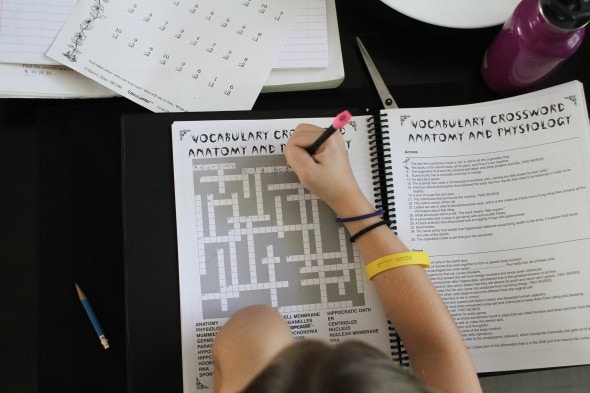
The work has to be done by the end of the school year.
We don't do school for a specific number of days (our county doesn't require that), but we do make sure that we finish our curriculum each year.
So, Sonia and Zoe know that they can choose to take a day off of math in February, but that means they'll have to do that lesson in the spring. They aren't getting rid of work; they're just pushing it off.
They do still choose to take days off sometimes, but the big picture (Let's get done before summer hits!), inspires them to keep at it.
I don't overschedule their days.
It's really hard to get schoolwork done if you have are barely home. So, it's important to give your kids enough time and space to do their work or they'll still be working math problems at 7pm.
And that's a pretty sure way to guarantee bad attitudes/slacking.
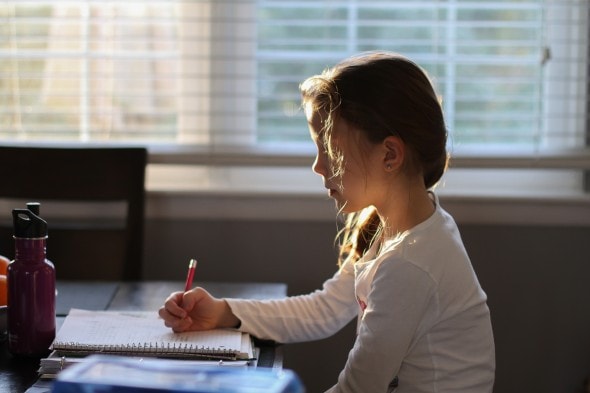
I don't expect them to love every part of school.
While some parts of school can be fun (History is pretty enjoyable! And science too. Also time tests, because you get M&Ms if you come in under the timer.), some of it is hard work.
So, if they tell me, "Mooooom, I don't feel like doing subject X." or, "I haaaate subject Y.", I tell them, "Hey, that's ok. You don't have to love it and you don't have to feel like it. You just have to do it."
I feel like that's possibly more helpful than a pep talk ("Oh, honey! Adding trinomials is actually super fun!") because I'm not sure any kid ever started to love a subject after their parent tried to convince them it was fun.
Also, this approach is more honest because most of us have subjects that we hated and probably will always hate. And so will our kids.
(Me? Music theory. Blech. Also: geometry proofs.)
There are lots of things in life that are work and that you have to just soldier through. That, in and of itself, is a huge skill to learn.
I let them take breaks.

If one of my kids is struggling with an assignment or a subject, I will sometimes suggest a walk around the block, a 15-minute fun reading break, a shower, a jump-on-the-trampoline session, or a switch to another subject they like more.
Of course, not every situation in life allows for strategies like this, but learning to do something that calms you down/helps you refocus is an important life skill that'll be useful through adulthood.
_________
A quick note before I wrap this up: The things I'm mentioning here were a lot more important to establish when my kids were younger. Joshua and Lisey are 17 and 16 now, so they manage their own schoolwork time and we don't enforce screen time for them anymore...we're in the midst of a gradual letting-go process with them, since they'll be out on their own in not so crazy long.
And since Sonia and Zoe are 11 and 13 now, these habits are pretty well-ingrained and don't take a whole lot of work on my end.
(Ok, except for the part about, "I don't feel like doing school!". That one we are still working on.)
_________
Readers, if you have tried and true tips for keeping kids motivated and on-task, add 'em in the comments and help your fellow readers out!


I don't really have anything else to add to what you have written, but as an adult who did years k to 6 by distance education your tips and tricks are pretty spot on.
We lived in a small remote community, like an Indian reservation in the US, and we weren't eligible to go to the local school so our parents had to enrol us in the nearest School of the Air and organise a space for us to do school work in. We normally followed the hours and curriculum suggested by the state, but there were kids I knew who did all their school work in the morning so they could help with station work in the afternoons and others who had longer periods away altogether because their parents needed them. Sometimes they would have to help walk cattle to another property for agistment.
Dude, in 7 years they'll be all graduated and (possibly) out of the house! That's nuts. It's also funny to think that I'm like 2 years younger than you and pondering if I should have kids, lol! Funny where our different paths take us. 🙂
I know...and actually, Zoe's a grade ahead, so if that keeps up, she's graduating in just six more years.
Whoa. That just really hit me. Geez. Only six more grades. It's hard to wrap my brain around!
I mean, I've counted out before how old I'll be when Zoe graduates (45), but thinking of it as just six more years is crazy.
Like they say, the days are long, but the years are short.
I hope your kids/no-kids decision becomes clear to you!
Reading this today, I was thinking about how I am older than FG, with my oldest child not yet 8. We are at very different stages of parenting life and I love to read her more experienced parenting advice. It is funny how different everyone's life journeys are and awesome that we are able to learn from each other 🙂
I like your approach a lot. You're very understanding yet firm with your kids. That's what they need from a great teacher. This is a question I've asked myself a lot. I'm afraid I might be either too tough or too soft. It's always great to find a middle ground.
Finding middle ground with everything in life is so, so hard. Really easy to err on one side or the other!
I love your tips. I would strongly emphasize the "work before you play" rule and BE SURE to include chores with that rule. We have motivated teens as far as schoolwork but they aren't strong in the clean room/don't leave stuff out/do your chores department. That's because we didn't consistently insist on it from when they were little!
I love your perspective on handling subjects that kids aren't too passionate about. Another reason why I am leaning towards homeschooling! It gives you more of a chance to nourish and expose them to things that they are passionate about - maybe art or music or science. My dad always said...never push a kid who hates math to be an accountant. As long as he can balance his checkbook and pay his bills, let him pursue his true passions. 🙂
Great ideas! I love the idea of giving kids break during schooltime. I went to public school and one recess a day just wasn't enough for many kids. Heck, adults can hardly stay attentive for more than an hour; it's silly to expect that kids can do it without a break, too.
These are great tips! As a mother of two schoolgirls, I learned the importance of balance. They have schedule for working on their homework, using the computer, reading a book, playing, etc.
I am not a homeschool parent and have no interest in being one, but I found this post fascinating. These really are great tips about parenting in general: set limits, enforce boundaries, show them grace, and do it young because 17 is too late to start training a child. Because really whether your kids learn reading and math at home or in an institutional setting it is ultimately the parents responsibility to make sure the kids are educated in math and in how to manage their time.
We are seven years into our parenting adventure with three little ones, and we've already found that building character is overwhelmingly about the small day-to-day decisions and the culture we create in the home. I am constantly reminded that I can be a better parent. But it is incredible to see them start to grow into little people who will one day be successful adults.
Thank you for a great post.
So true-things are a lot easier to address when children are small! It's less like turning the Titanic around.
FG wrote: , these habits are pretty well-ingrained and don’t take a whole lot of work on my end. (Ok, except for the part about, “I don’t feel like doing school!”. That one we are still working on.)
So what you're saying is that that part is pretty well-ingrained as well. ;->
I have some experience with distractable kids. Establishing a routine is enormously useful in this situation. Make a daily checklist, even, so they have something to refer to. To help establish the habit, let them earn rewards when they succeed in finishing each list (if short) or each subsection of the list (if long). You can also set up longer-term rewards, like for the day or the week; these are usually hitting a percentage of the smaller rewards, say 75% or 80%. A small reward could be a sticker, tatoo, or piece of Lego. A daily reward could be extra screen time or biking with Dad. Some people use food/desserts; for the record, I think this is a very bad idea.
Haha, yes! I've said the, "It's ok. You don't have to like it." line a lot of times. 😉
I generally agree about using food as a reward. Although, I instituted the M&M/time test thing because we were having too many tears about not finishing time tests (despite me assuring them that it's ok! You don't have to finish them, especially when it's a new test.). So, we started a thing where you get two M&Ms just for doing the time test and three if you finish the whole thing.
And it's made time-test-taking a much happier experience. There's still a small extra reward for finishing the whole thing, but there's something cheerful waiting at the end of the test even if you don't finish the whole thing.
I don't make a habit of using food as an incentive, though. Or a dis-incentive.
I'm curious how Zoe ended up a year ahead? And did you have to do anything formal with your state for that? I'm asking because I have a 4 year old who, if we were sending him to public school, wouldn't be old enough to start kindergarten this fall. However, since he has begun teaching himself to read, add and subtract, I feel like I need to get going with full on home school kindergarten in the fall, but I'm not sure how that might effect things down the line. Thanks for being an awesome homeschool resource for those of us preparing to start this journey!
Well, she spent a fair amount of time hanging out with Sonia and me during Sonia's kindergarten year (there was no one else to play with because her older three siblings were doing schoolwork!). She's a pretty smart cookie, because she picked up enough to learn to read the summer before her kindergarten year was supposed to start. And she also did some busy-work math pages during that year as well, which presented no challenge to her.
I thought there wasn't a whole lot of point in doing an official kindergarten year with her, since basic math + learning to read are really the cornerstones of kindergarten. So, in the year she was supposed to start kindergarten, we just jumped in with first grade curriculum, and she's been able to keep up every year since then.
I haven't officially switched her grade with our umbrella group (a state-approved organization that keeps track of our records for the government), but I may do that once she gets to high school grades, just so the records will be in order.
I haven't wanted to lock her in to staying a grade ahead, but at this point, I think she's probably going to keep it up. If she hits a wall in a year or two, I'll be flexible, of course, but right now, I'm not anticipating that.
Joshua's story sounds a little bit like yours...his birthday is September 2nd, so he'd have missed the cutoff for public school. He was an early reader too and he definitely did not need to wait another year to start school. I've always felt grateful that it was so easy to just go ahead and start him right away, as I know it can be a bit of a process to do that thru the school system.
He's graduating this spring, and he won't be 18 until the fall. So, he's a teeny bit on the young side for a high school graduate, but nothing crazy.
It definitely sounds like your son is ready for school, so I'd say go for it!
I am homeschooling an only child, so the distractions of siblings are not present, but that does not mean she is distraction free! She finds so many things to distract herself with (staring into space, using the bathroom repeatedly, constantly hungry...to name a few). The M&M's for minutes left on the timer for work pages works well at this age (8). I have to get in 180 days for my state, and we are THREE days away from that! So excited to be done for the summer! 😀
Woohoo! You are so close!
I don't homeschool and have zero interest (I don't think it's a common thing here, I don't know anyone who homeschools) but I have to say : wow! How do you "parents/teachers" do it all? You have to be really smart to be able to teach all the subjects! Like, you have to know everything about everything!?!
Even regular teachers don't do this, they are specialized in 1 or 2 subjects and that's it. It's really impressive!
I would be sooooo stressed to have that kind of pressure on me, I would fall apart!
Good job!
We live in the information age....if we don't know something- we find the information. We watch a youtube video, we attend a class, go to a museaum, read a book. Good teachers don't spoon feed information they teach the student to attain the inforation they require. My husband and I went to school for a total of 34 years and have two degrees. We THOUGHT we were well educated but we are learning so much with our four kids now in so many fun and interesting ways. While we instruct occassionally on specific things most often we encourage, motivate, inspire, mentor and parent them....they teach themselves. Fostering this inate love of learning is the life long education that we hope for them (three of our children jumped into public school in October for the first time ever out of curiousity- they are doing exceptionally well acedemically, had no problem adjusting to the expectations and routine and love their classes and teachers. If we were concerned they wouldn't fit into a more commonly held approach- we needn't be;) Remember most teacher textbooks have the answers section in the back....no teacher is expected to know it all;)
I sent before I corrected my spelling errors...so embarrassing... 😉 Yes I CAN spell "museaum" I swear! 🙂
Lol- how about academically? Seriously, auto-correct sometimes misspells things way worse than I did! Or changes correct spelling into incorrect! This seems to be much more frequent lately for some reason. Again, I'm just being silly, not critical.
Good tips! These apply to raising children in general, and it's pretty much how I managed with mine, although I had to get creative with the motivations, because what motivated one usually left the other one disinterested, since they were/are polar opposites in personality. The hardest, but best thing I did was keep digging until I found the most effective method for each child.
Thank you! ⤠I appreciate this more than you'll know. The comments are really helpful too!
Geometry proofs are the best! Sometimes during faculty meetings I'll prove triangle are congruent instead of doodling. I'm a bit disappointed that our public school's geometry is so good because I was kind of looking forward to teaching them to my son this summer but now I don't have to. (Years ago I did teach my sister so she wouldn't have to retake geometry when she moved to private school.). I even bought a copy of my favorite text-- Geometry for enjoyment and challenge. (I got to meet one of the textbook authors too. He was really nice.)
In any case, have you seen the dragon box version of geometry proofs? Even my four year old enjoyed playing with the first few levels. Gamifying proofs.
Ha, well, they're fun for YOU. But not for everyone. 😉
Maybe you can come visit when it's Sonia's turn for geometry in a few years. I'd gladly delegate to you!
I love the homeschooling posts that you do. Here in the UK there are some home-schooled children, but it's very much a minority. Both of my children attend state school (one primary and one high now! how the time has flown - I started my blog when my first child had just started school).
Although my kids 'go' to school I'm keen to support and engage them at home myself (personal tutors are common now in the UK outside of school) and read your posts with interest!
The art of motivation of kids--home or outside schooled-- is the same. Natural born teachers know how, as you do,Kristen. As a retired public school teacher, I love to read what your practices are. I am always interested in what you do and find it doesn't matter where a child learns; what matters is the teacher's know-how.
Great post! What are Joshua's plans for next year? Assuming he'll enroll in college while living at home?
He's got one more year left at the community college after this semester, and then he should have his AA. He plans to transfer to an in-state college after that to get his four-year degree.
So far, he's planning to live at home as long as possible so that he can save money, but we'll see. He may get stir-crazy before then and want to move out, but he really, really wants to start his adult life out without a pile of debt, so he's pretty motivated to stay here.
I think a bit issue is age-appropriate expectations, which you mention. I do expect my almost-13-year-old to keep his focus on his school work for the bulk of the school day, without needing too many breaks. With him, it's more a matter of reminding him that, even if he doesn't like writing, he still has to do it, giving him some praise and the occasional cup of half-caff coffee, and trying to make sure to reduce the distractions his younger siblings create for him as much as I reasonably can. He usually spends the morning working independently while I work more hands-on with the other kids and help him if he has a question, and while he does need to stay focused, I also feel like it's my responsibility to make sure his younger siblings aren't being unreasonably distracting. (Some distractions happen and you need to deal with them, like hearing the toddler singing in the other room. You can't work if she is climbing onto your lap while banging cymbals, though. That's when I need to step in and find her something to do, away from the workers.)
With the younger kids (5 and 7), a lot of it is me keeping them on task. My 7 year old can complete some work pretty independently, but for some subjects she still needs me there as a motivator. My 5 year old, forget it: if I'm not right there, he's not on task. With my oldest, that drove me crazy, but at this point I accept it as typical 5 year old behavior and deal with the fact that I can't, as much as I'd like, set the little ones up with worksheets and then go do 20 minutes of chores and come back to check their work. I'll come back and they'll be playing secret agent upstairs, having done two problems each (if that). So with younger kids, sometimes you do just need to accept that keeping them on task, at this point, is going to involve you being there to keep them on task, but it will get better as they get older!
I completely agree. I can expect Sonia and Zoe to mostly stay on task by themselves now, but 7 years ago, that was definitely not the case!