
Over-Dressed
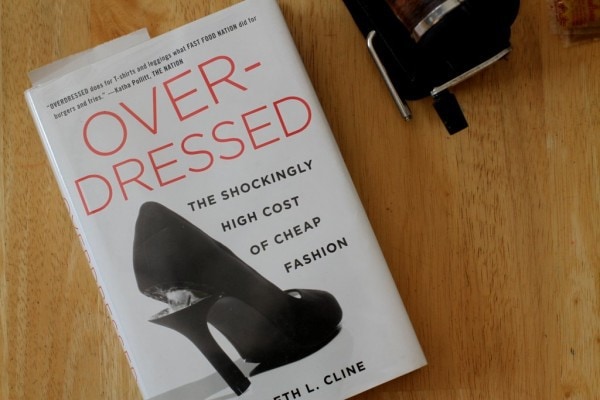
I first heard of this book sometime last year, and it instantly piqued my interest, so I contacted the publisher to see if they'd like to do a review/giveaway here. They said yes, but my review copy never quite showed up.
Eventually, I decided to count that a lost cause and I put the book on hold at my library.
Fortunately, the wait there was pretty short. In a few days, a "your book has arrived" email showed up in my inbox and I scooted off to the library really promptly to pick it up.
Once I picked it up, I could barely put it down, and I finished it in just a few days.
Elizabeth Cline has been called the Michael Pollan of clothing, and I can see why. She takes us behind the scenes, exploring the reason our clothes, shoes, and accessories have gotten less and less expensive and why we've been buying more and more of them.

Her tour of overseas garment factories was fascinating, and I was also really intrigued to learn more about the history of clothing manufacturing.
In addition to being interesting, some of the information in this book is downright depressing (again, not unlike a read through Michael Pollan's books!)
Though I knew that much of our clothing is made overseas, I was so surprised to learn about how recently this switch happened.
Currently, only 2% of our clothing is made here in the U.S., but as recently as 1990, 50% of our clothing was made in the U.S.
1990, people!
That wasn't that long ago.
Companies make their clothing overseas because labor there is so inexpensive. So inexpensive, that even with the added costs of shipping, it's still cheaper to outsource the job.
And since companies can reduce costs so much this way, clothing has gotten less and less expensive as time has gone on.
That means we buy, buy, buy, buy, and then do some more buying. And then we end up with way more clothes than we can wear. While we do donate some of them (more than thrift stores can even sell!), we also throw a lot away.
In fact, Americans throw away 12.7 million tons of textiles every year, which works out to 68 pounds per person.
(Whaaaaa??)
I'm sure I don't need to go over how incredibly wasteful this is...to use labor and natural resources to make things that we wear a few times and then throw away.
In times past, people tended to spend much, much more on each piece of clothing, and their wardrobes were only a fraction of the size of ours. It's not so much that they spent a far greater portion of their income on clothing, it's that they spent more on fewer pieces. We still spend a fair amount of money on clothes, but we get way more items for that money.
On the surface, this seems like an awesome thing (More for less. Woo!), but the clothing we buy is poorly made, doesn't last, is generally made in factories which abuse their workers and pollute the environment, and we've got so many clothes, we can't possibly use them all.
Which makes me think this more for less thing is not such a great deal after all.

What should we do about this mess?
The scope of our clothing problem is overwhelming, to be sure, and it seems like we can't possibly make a difference. I do think there are some things we can do, but when I started writing about them here, this post became unbearably long.
So, I'm going to stop this post right here and then tomorrow, I'll share my thoughts about how we can practically handle the clothing problem we face.
For now, I'll leave you with a quote from the book.
"Building a wardrobe over time, saving up and investing in well-made pieces, obsessing over the perfect hem, luxuriating in fabrics, and patching up and altering our clothes are old-fashioned habits. But they're also deeply satisfying antidotes to the empty uniformity of cheapness."
____________________________
You can get buy a hardback copy of Overdressed (affiliate link) (paperback is coming in August) and there's also a Kindle version
 (affiliate link) available for $12.99. Your local public library should have a copy as well.
Whatever method you choose, do read this book. I think you'll find it to be eye-opening and life changing.
____________________________
Joshua's 365 post: Shoes Wednesday
Also, I'm giving away a $100 Shell gift card. Unless you're carless, you should totally enter. 😉
Thanks for the book review - I've been concerned about the origins of my clothing for a while, and that concern has been intensified with the recent tragedies in Bagladesh. It's just frustrating that even more expensive clothing from "reputable" stores can originate in a sweatshop. Looking forward to your post tomorrow, and I have the book on hold at my library already!
I completely agree with the comment above. since becoming a mom I have income awareof what I purchase and the effects it has on the world around me. For instance packaging is it made in America and how well it be put to good use.I love consignment shopping which has just happened for me in the last year or so. There is something so gratifying about recycling and reusing especially clothes and toys. I'm looking forward to your post.thanks for creating this blog you have taught me a lot and I hope that I'm passing it on by the changes I have made in my family's life however small. Thank you.
This sounds like a great book. Thanks for the review!
I've learned more and more about the food industry and tried to change our life to avoid things like getting eggs from chickens with their beaks cut off. I'm looking forward to learning more about the steps you are going to take.
I end up buying my clothes at Marshall's. I can get designer clothes (well made) for less, and I have them MUCH longer than other less expensive garments you find in Target, Kohls, etc. Buying quality is MUCH better than quantity.
Sounds like an interesting book. I'll check to see if our library has it!
I'm almost finished reading this book and find it rather depressing. I'm really tired of crappy clothes and synthetic fibers and I gave up on worrying about fashion and trends because, as discussed in the book, they change so rapidly to get us to buy more (or could be because of my age). Beyond shopping used and getting back to making my own clothes as I did for years, I'm not sure what the answer is to this problem. I'm interested to see what other ideas that you may have.
It isn't just clothing unfortunately. Most of our goods are made/assembled in export processing zones in terrible conditions by exploited workers. Our computers, our phones, our knick-knacks, our dishware, our electronics, our printers, our small appliances. . .so many things.
I totally agree, Pamela. Our culture has been tuning into the origins of our food for a while. Now clothing is the focus--all of which is great. But we still have such a long way to go!
I too have recently been reading Overdressed (which followed the book American Wasteland). And I agree it is depressing at times.
I am in my 60s, so I am from the generation that remembers quality made, fewer clothes in the closety. My mother made (well-made with linings, etc.) my clothing. Much of my clothing comes from the consignment shop (I have a personal shopper there). I wear my clothes for years (so I am "way" out of style); and by the time they are given up they are worn out. I remember my mother having some of her things made by a dressmaker. The cost was reasonable, the item well made, and the fabrics were luxurious. (We were middle-class.)
Yesterday I dressed in a skirt bought approx. 4 yrs. ago and shoes bought approx 12 yrs ago. I only own 2 pair of jeans.
That sounds like a really interesting book - thanks for the review 🙂 I have bought cheap clothes in the past but over the years have moved more and more towards buying my clothes from op shops (what we call thrift stores here in Australia).
I think a while ago you mentioned (or it might have been another blog) that the clothes that make it to the thrift store in good condition have already been tested and have lasted well. I have definitely found this is the case.
On the other hand, I searched far and wide for a winter coat but couldn't find one in an op shop (I live in a warm place). I eventually bought one new for around $100, and a year later (after maybe 10 wears) one button fell off and a few of the others were loose. When I contacted the company as asked if they could sell me a button, they said they didn't have any and offered me a 20% voucher for my next purchase. Needless to say, I didn't take them up on it!
You may as well go buy your own buttons (buying a few extra just incase) and sewing on new buttons. Or depending on how long it is take button from very bottom or very top. You can always reinforce all the buttons yourself. 🙂
This sounds like a fascinating, though depressing, book. I've noticed for awhile that clothes seem to have less quality, even in my admittedly short lifetime; something I bought in high school has lasted me until now, while an expensive shirt I bought in college frayed into a mess within a few months.
I've always wanted to make some of my own clothes, though I wonder how much better that would be since the raw fabric still has to be made somewhere.
Last Thursday I heard a radio interview with Elizabeth Cline on NPR's Fresh Air with Terri Gross. It was fascinating. I am waiting for the book to come to my library. It is so easy to make mindless purchases without realizing the true cost. Thanks for this post
It isn't just the low-end clothing, either. Much of the high-end, designer apparel is made under questionable circumstances, as well. When I order from catalogs or online I do check the country of origin information and it's shocking to find very little is made here in the US. If this matters to you, you really need to check the labels.
I suspect that sewing from plain fabric won't guarantee that you aren't exploiting a population either. Although, if you do sew, at least you can guarantee that your workmanship is of a certain level.
That's an excellent point about the fabric. I guess opportunities for exploitation are everywhere in this crazy world of ours!
This book is on my summer reading list. I've been trying for a couple of years to sew garments but always struggled with the fit. Recently, I took a dressmaking class and emerged with a wearable dress, very well-made by ME! I'm so excited to make more quality garments that fit me well and don't contribute (as much) to the demand for cheap overseas textile labor.
When my mother made her own clothing, she stuck to one style that looked best on her and fit her well and then utilized fabric, buttons and trim to change it out. The dress style used by the dressmaker was what made her look nice and with different fabrics changed the dress from day to evening wear.
I wonder if the book is printed in China.........??
Ha!
I had read a brief review of this book months ago. I had forgotten to put it on my list. Thank you so much for the review. I am on my way to the library website to reserve it.
I am excited to read your action plans about the situation. I gave been refashioning our castoffs for my boys, but we still have so much!
I've noticed the poor quality. Especially finding good slacks. I have to wear black slacks, since I work in a restaurant, as part of the uniform. No matter what I do it seems as if they wear a hole next to the crotch seam. I'm wearing pants that fit correctly. Used or new, various brands ...same issue. I'm guessing it's the movements I do between standing, walking, squatting and crouching etc... :/
Oh, I HATE it when that happens. It makes it nigh into impossible to repair or repurpose the pants.
The way I have found to battle this is to put patches in that area BEFORE I ever wear the item. It seems to work and my pants last much longer as a result.
I've thought about trying to do that. What's the best way to do that ...?? I just purchased Dickies work pants to see how they last. I've never tried them since they're in the men's section. The material is heavier.
Amie, I reinforce with a similar weight and color fabric using sturdy fusible web. Fusible web is sold by the yard, so you can buy 1/8 yard for very little money, and a scrap from worn-out pants (back of the calf usually is least worn) will do for the fabric. Just follow the instructions on the fusible web wrapper. You can also use black thread to sew around the edges of the reinforcement. It's all but invisible in that location and prevents the edges of the patch from curling in the wash and becoming uncomfortable.
I am going to buck the trend by saying that I do not value "made in the US" more than "made in [insert other country here]." I think a job is a good thing, whether it's in the US or somewhere else. Since Bangladesh in particular has been mentioned, I'd like to point out that it's an interesting case in human development. The country is still very poor, the politics are thoroughly corrupt (which is a leading factor in the factory collapse: factory builders/owners bribe inspectors and police, and inspectors and police take the bribes). Yet the Human Development Index for the country has risen far faster than average income or GDP. This is generally attributed to development programs being aimed towards Bangladeshi women.
OK, hopefully interesting lecture over.
As far as clothes go, I think there are two different factors at play in FG's conversation. One is working conditions. The other is the interplay of quality, quantity, and price. To be honest, the first is very hard for the consumer to address. As has already been mentioned, even buying expensive quality clothes is no guarantee that the working conditions are acceptable.
OTOH quality and quantity are fully within the consumer's control. By buying quality, resisting fast-changing fashion, and keeping (and mending!) the clothes, we speak with our dollars. To industry, there's little more powerful than the consumer's dollars.
I'm not entirely against clothing manufacturing in other countries and neither is Cline. She highlighted a really fair factory in Bangladesh, actually. They make college attire for the Knight clothing company and they pay fair wages to their workers.
Because there are more worker protection laws in the U.S. than in, say, Bangladesh, the odds of a factory worker being treated properly in the U.S. is higher than in Bangladesh. So, you're more likely to be supporting good worker conditions by buying something made in the U.S. You're not necessarily supporting sweatshops by buying in Bangladesh, though.
You are correct about worker protection laws. What I'm not sure about is, if a shirt says "Made in the US" does that mean the fabric as well as the assembly? OTOH even if that just means the assembly, that's still part of the chain that was produced in safe(r) conditions.
Unfortunately, it's just not clothes that are cheaply made. I think just about everything is cheaply made and designed to be replaced after a few years. It's all about the money!
You said it!
Exactly! I just heard an article on the radio about how much harder today's cheap manufacturer processes are making it for people to to fix/repair their stuff. The option is being taking away and because prices are so 'cheap' people replace instead of repair. One example was tablets - in order to make them fast and cheap, they are replacing the screws with glue. Thus, even if the repair is a simple battery replacement it is next to impossible to do because it is glued together. Disgusting. This is why buying less and quality items (that can be fixed) is very important, I believe.
PS. Just bought a Miele vacuum - thanks FG for that review too!
So true- our 10 year old DVD player died and it was going to be twice as much to repair it than to replace it. We were very disappointed.
I considered having a local woman make a few dresses up for me but they were going to cost me $35 an hour (plus the fabric and taxes) to be made, which is far more than I can afford for a small wardrobe. I've opted instead to shop 2nd hand. I'm still maybe wearing these outsourced clothes but I am at least extending the life of them.
Our furniture and most every day products suffer the same outsourcing fate. My grandmother in the 70's filled her home with 'Ashley' furniture and the wood was of good quality and is still in excellent condition today. My husband and I bought 'Ashley' furniture 2 years ago and we hardly ever go into our living room to use it but it is already creaky, poorly made and is easily banged up. The kitchen table from Walmart (last year) is the same 🙁
I really think the solution is to start being happy with what we have and shop less, but when we do it is with our heads and not our impulses.
I wanted to add that I don't think it is the outsourcing that is the problem. I guess the term 'disposable culture' is more fitting.
In Ireland we are pretty conscious of this stuff. Years ago there was uproar when it was discovered that local chain stores were using third world labour and people were working in terrible conditions. It really prompted these stores to look at their suppliers. There are statements about workers conditions all over the websites and I stores here. Still the recent tragedy in Banledesh is a huge reminder to us off of the hidden cost of our cheap clothing. Here in Ireland we recycle everything now. Refuse collectors take our bio waste our glass recycling our paper recycling and our clothes and also our non recyclable waste. All in separate compartments. The clothes are collected on behalf on a local charity for adults with an intellectual disability. There are also many many other charities who have their own stores where you can donate and clothes banks too. Since the recession hit here more and more of those clothes for cash places have also open up where people can sell their old clothes and for many families here they need every penny. As a nation we are very aware. We are also good at spreading the word. The little guy here makes a big difference. When South Africa was still segregated and apartheid was the norm. Some workers in a local supermarket refused to handle South African produce. They wanted the supermarket to boycott South African companies until apartheid was dismantled. They went on strike and gained huge public support. They achieved their aim and their bosses stopped doing business with those who kept apartheid in place. Nelson Mandela even met with them when he visited Ireland after his release. So one person or five or six people in this case can make a difference. Question your store owners. Ask for statements regarding their overseas suppliers working conditions and environmental impact statements. If they get enough questions they will have to answer.
I think one of the key issues at play here is the mind set of each person having so much clothing. I'm a sucker for the show House Hunters and I always get so irritated when some homebuyer is going through the master bedroom's huge walk-in closet and makes a comment about how it will "maybe" fit HER clothes but her husband will have to put his somewhere else. REALLY?! You have an entire room to put clothing in and it still won't fit more than one person's wardrobe?
Over the last four years, I've mainly shopped at thrift stores for my clothes, mainly because my budget is really limited. While it's pretty time consuming, I have found some really well made, high-end pieces at a fraction of what they would cost new. It has completely spoiled me now - I don't think I could bring myself to pay retail at a department store even if I could afford it.
This is something I've often wondered about, but never got much further than that. Logically though, there has to be something going on when you can buy clothing at most of the big box clothiers for the price of a cup of coffee.
I spent time in India in my late teens, and saw first hand the working conditions of some of the better factories in the area, and I still remember thinking those conditions were pretty awful. (We were not allowed to tour the factories that were considered to have poorer working conditions).
Looking forward to reading your follow up post tomorrow Kristen. Hopefully the author of this book can do for the clothing industry what Michael Pollen did the food.
Thank you for raising this issue. I've made some effort in the last couple of years in particular to aim for quality over quantity. It's harder with clothing in my experience. I'd appreciate some recommended sources for good quality clothing that provides some assurance that workers receive a fair wage for their work. I bought everyone in my family some Fox River socks at Christmas time. I've also purchased some gifts from Fair Indigo. And last summer I opted to buy Okabashi flip flops for myself and my daughter rather than the $1 to $2 variety that would last one season at best (they are guaranteed for 2 years and can be recycled). My son is in need of some spring/summer clothing and, short of checking local thrift stores that will allow us to reuse existing clothing, I'm not sure the options are too great.
I'm wearing my Okabashi flip flops today! They're so comfortable! Depending on the size of your son, you might be able to find something at allamericanclothing.com. I have a tee shirt from there (American made) and it's holding up well so far (I've only had it a few months, but it gets worn at least once a week).
A friend runs a fair trade retail store, and she carries some clothing "” enough that she even started a fashion show as a night-out type event. If there is such a shop in your area, you might check.
This might be covered more in part 2, but does she include any suggestions of brands/stores to buy high quality, ethical, long-lasting clothing? I'm having trouble with that! I bought a shirt I loved, of great material at Madewell, which was not cheap. I wore it once, washed it in cold water and line dried it and it was a completely different shaped shirt! So frustrating!
Holy Moly! I think I've only purchased about a total of a dozen pieces of new clothing in my entire adult life, and to be honest, it always seems to fall apart quicker than the things I buy used. Maybe that's because the really poorly made stuff never makes it into the used market, I dunno...
I guess this is all just another reason to aim for a small but meaningful wardrobe, which is a goal I am ever-so-slowly working toward!
This book is on my wish list too. My main problem with cheap clothing stores is how they contribute to the homogenization of America. I walked into an Old Navy the other day after many moons of refusing to go in there, and got that icky feeling like I would walk out looking like everyone else. This is why I shop thrift.
I would love it if you did a article on made in the USA clothing companies. I like to buy Brooks Brothers (very expensive, but well made and timeless) for myself and my husband. My 11 year old boy is the hard one to buy for.
I heard a long interview with this author the other day and it was quite interesting. Two points I remember in addition to the ones Kristen made. In 2005 US stopped putting quotas on garments coming into the country and that is really when the big turn around happened with the made in the USA vs. other countries happened. Also, it is hard for companies to know exactly where their clothes are made. They can contract with a certain factory and inspect it, but then that factory subcontracts the work to another factory. These factories may have poor working conditions that the original company didn't know about.
William B. also makes some good points. As with everything else, it's never simple.
I'd be very interested in suggestions for kids clothes. I buy thrift/consignment for them whenever I can and of course there's hand-me-downs and trades with the neighbor boys. But even with that, the boys are SO hard on clothes that I still buy mostly new (so tough to find pants without holes in the knees when I need them!). I'd be willing to pay more for high-quality, ethically made clothes, but I just don't know where to find them for kids!
I have to say that as much as I feel like I do have a lot of clothes and shoes, I use them all a lot! I'm always mixing and matching. When I go to buy any new clothes, I have to be able to think of at least three outfits I can make with it at home right off the top of my head, or I can't buy it. I've built a lovely wardrobe of mix and match that I love!
I was watching Mary Poppins last night and noticed that a supposedly wealthy family in 1910 London had a surprisingly small amount of clothing. The "spoonful of sugar" scene shows the little girl's closet. She has maybe 4 dresses with matching hats and coats. They are all very beautiful and high quality, but she doesn't even need a rod in her closet. Just 4 simple hooks on the back wall of her very shallow closet.
Makes you think about the whole HGTV/organization craze, too... doesn't it?
An article inhttp://www.nytimes.com/2013/05/09/business/global/fair-trade-movement-extends-to-clothing.html?pagewanted=all&_r=0 NY Times about the clothing industry
Nice review!
I started the book but couldn't quite finish it. One effect it had on me was to make me more aware of how poorly things are constructed, and of how cheap/flimsy the material is. It makes it very difficult for me to buy anything new now. Now that I am not blinded by advertising, even the big brand names just look like cheap stuff I wouldn't even buy second hand in the Salvation Army store.
Wow! I read both of your posts and I really appreciate you bringing this topic up. Both posts were thoughtful and informative and have caused me to rethink some of my shopping habits. Thanks!
This is a late post, but I wanted to let you know that I just got the book from the library and was amazed. I am so glad you brought this book to our attention. I counted all my cloths, just like the author did, and found that I have 192 items of clothing! 37 of this number is found in T-shirts! I am now encouraged and emboldened to do a better job with my current and future wordrobe. Thank you for doing this book review.