
On teaching kids to work hard
When I wrote about how happy I am to see Joshua and Lisey going out into the world and being both kind and hard-working, several of you asked me to write about how to parent in a way that encourages these two traits.

So, I'm going to try to do that in two separate posts...one for hard work and one for kindness.
Before we get to that, though, I want to say that though I'm willing, I don't feel particularly well-equipped to write about parenting. I've only parented my own four kids, and that hardly makes me an expert.
Plus, it's hard to know how much of our children's good traits are due to parenting anyway! Some of who they are is just innate and Mr. FG and I deserve no credit for that.
And, since we're Christians, we believe that God is working in our children's hearts. Obviously we don't deserve credit for that either. 😉

Ok!
I think those are all the caveats I have for now.
So.
Here are some ways that I think we've encouraged good work habits in our kids.
We've given them chores.
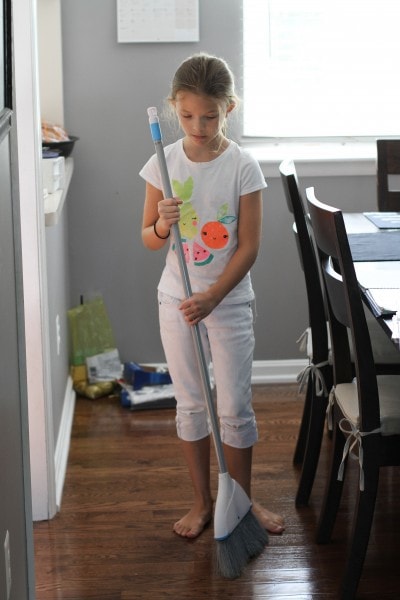
From the time our kids were little, they've had responsibilities around the house.
It started with being responsible for picking up after themselves, and gradually evolved into more typical chores.
For example, Zoe's 11, and she makes her bed, washes, dries, and folds her laundry, cleans up her room, and does an array of household chores like bathroom cleaning, vacuuming, sweeping, and window-cleaning.
We set firm work-then-play rules.
Our kids always have been expected to do their school work and chores before they use their screen time or play with friends. Knock out the tasks and then you're free to do whatever you want!
This is a helpful system because it teaches that dilly-dallying doesn't pay, but focusing and working hard does.
We haven't accepted poor work.
If my kids do a halfway job on their schoolwork or chores, I make them go back and finish it properly.
Obviously, I take into account their age and skill level (4 year olds won't make their beds perfectly!), but if it seems clear to me that they aren't doing their best, I have them fix it.
Sweep in the corners, clean behind the toilet, put away all the shoes, wipe the whole table.
(Joshua and Lisey don't need these reminders anymore, and Sonia and Zoe mostly don't either. But there was a lot of re-doing of chores that happened in years past!)
We've encouraged independence in work.
Of course we're there for our kids when they're truly stuck, but if they just need to try harder or read the directions again, that's what we want them to do.
For instance, if my kids come to me with a math question, first I ask them if they've gone back to try to find the information in the relevant lesson. If they haven't, I have them do that (or look up relevant terms in the index or glossary). After they've exhausted their independent options, then I'm totally willing to help if they're stuck.
(Usually they can get un-stuck themselves!)
The point is that I want them to know how to solve problems for themselves and how to keep trying instead of giving up easily.
We taught them to obey.
When our kids were very small, one of our big parenting focuses was laying a foundation of obedience.
(I love you, I'm here to take care of you, and you need to do what I say.)

As they've gotten older, our parenting has become more nuanced and less black and white, and we do a lot more talking and discussing and explaining than we did during the toddler years.
Even so, we hope there's still an underlying current of expecting respect for people in authority and a willingness to do what they ask (so long as it's not an unacceptable request, of course!)
When you live in someone's house, you need to respect the rules. And when you work for a company, you need to respect the rules and do what your boss tells you do to.
(If they say no phone use, you don't use your phone. If they say you need to wear a particular uniform, you wear the uniform. If they ask you to do a task you dislike, you do it.)
We don't expect them to love all of their work.
Few of us adults love every task we have to do, right?
So it makes sense to tell our kids, "Hey. We understand. Sometimes we don't feel like going to work/doing laundry/paying bills/cutting the grass. It's normal. If it was all fun, it wouldn't be called work!"
If my younger two say, "Moooom! I don't feel like doing X.", then I say, "That's totally ok. You don't have to feel like it. You just have to do it."
And sometimes when I'm facing a task I don't like, I'll say something about it. "Oof. I really don't feel like painting anymore." That's honest, and I think it's helpful for them to see me dread a job and do it anyway.

Learning to acknowledge and then push past lazy/tired/bored/"I'd rather play" feelings comes in awfully handy in the adult world.
We don't rescue them from consequences.
There are times when we show them mercy, of course, but as a general rule, they've had to face the natural consequences of not doing their work or of doing poor work.
If they skip doing school one day, ok, but the book still needs to be finished. A day off now is an extra day toward the end of the school year.
If they don't do a breakfast chore, then by lunchtime there's a breakfast chore and a lunch chore to do.
If they're not careful during a math lesson and get a bunch wrong, there are a lot of problems to go back and correct (which takes more time than being careful in the first place would have!)
I asked Joshua and Lisey...
I asked Joshua and Lisey about this, and in addition to the things I mentioned above, they both said that they're motivated because things just go better at work and school if you work hard. If do your assignments on time, you don't end up with a huge workload at the end of the semester. If you are consistently productive at work, you don't get in trouble and you do get praise.
I'm not sure if we did anything to help them see that clearly...maybe it's just that whole natural consequences thing I mentioned earlier, and they can see that this is just how the world operates. Work hard and you get smoother sailing most of the time.

Ok. I'm pretty sure that's not an exhaustive list, and I'll probably think of something else to add to it later. I hope it's helpful to you guys, though!
P.S. I know you might read this post and think, "Geez. These people run a cold, hard-nosed ship." And while it's true that we do have expectations of our kids, (and plenty of structure during their younger years), we also hope that our kids always feel loved, know that we are for them, not against them, and that we're on their team. We want to help them and encourage them. And they know our desire is to do what's best for them because we love them.
P.P.S. If you've got wisdom and experience in raising kids who work hard, feel free to add your own advice in the comments!



I give thumbs up to all of these, and I might add one addition I can think of: the parents should act as one when it comes to raising kids. I know that can be hard in some families, but it was very important to us. I don't mean we were identical, but on this stuff, we talked it over and made sure we agreed. If we disagreed, we told the kids we needed to talk it over, and then did so, in private, till we could agree. If one parent is constantly undermining the other one when it comes to tasks and school work, the results can be disastrous, and unfortunately, I've seen it happen too many times.
That's a great post, Kristen, and we followed those rules as well. It's not harsh nor cold -- our kids knew for a fact that their parents loved them and were there for them and would have taken a bullet for them, but our big job was to raise them well, not to cater to them.
This is a great addition! It's awesome to have a great relationship with your children, it's not so good if they don't respect you because you're always "the friend" and not the parent!
I am an old mother with 2 grown kids. They are married, responsible, productive adults contributing to a stable society. I'm not at all sure what my husband and I did made a big difference in their outcome but I like to think we helped. We were lucky enough to have kids that made good choices in life. We tried it all. Because having children is an"On the job " training. The little suckers don't come with a manual of instructions!! They had chores but many times we helped them out, especially when they are older and had more extra stuff to do ie: baseball, soccer,dance classes, etc. which we considered important to give them a rounded education. No one wanted to cook but they learned to clean, do laundry and they saw us pay bills and discuss vacations and daily life. What we did do is love them. They knew then and now that our love was NEVER conditional and ALWAYS constant. They learned by our actions how to put others before what you want. To be responsible for the comfort and well being of others and that family is the most important relationship that you can have. Friends will come and go but if you treat them well your family will always stand with you. They also learned that if they lay down with dogs they are gonna get up with fleas so to choose their associates with care. I am very proud of my kids. They are wonderful adults. Our work with them is never done however, Now there are grand kids and home owner advice. Life is good.
I love this so much and am absolutely stealing "I love you, I'm here to take care of you and you must do as I say". As a new Mom, I often question my parenting skills (am I being too tough, am I enabling them too much, am I expecting too much too soon) but I do try and lead from example. I came from a loving home full of structure and we were expected to work hard and be kind. And honestly, if those are the only things I can pass on to my kids, I'm 100% ok with it.
Thanks for a great post.
Yes...I think that whole, "Do as I say" thing is super helpful when kids are very young. You can try to explain the reasoning behind your decisions to a 2 year old, but it's not going to make much difference for them. There's plenty of time for getting into all of that as kids get older and can understand things better.
There's very little, "Do as I say" going on with Joshua and Lisey now...I think that would be an unhelpful tack at their ages. We want to talk things over with them, help them think through things, and help them through the process of coming to their own conclusions. Because in not so very long, they'll be doing life independently, and we want them to be ready.
2 year olds, though? Firm and clear parenting surrounded by lots of love will do just fine for them.
My son is 17 and has never had chores--or I should say very few chores. But he's in public school so there's a full school day, plus a lot of homework--and that's his job and he's taken that job super seriously. He has never, ever not completed a homework assignment--and that's with no prompting from us. He has an awesome GPA--most of the time straight A's. And he's been prepping for, and taking, the ACT for college and has worked super hard on that with no prompting from us. And he got a summer internship on his own volition. So...no chores and the rest of his time is his. He plays tennis, hangs out with nice friends...and does things like mastering chess (playing with his friends). So...he's had it easy on the chores side. But he's excelled at the academic side...and that's fine with me!
Joshua and Lisey are definitely doing fewer chores around the house now that school and work are taking up more of their time! They're still responsible for their rooms and for their own laundry, and for meal chores if they're here for a meal, but that's about it.
That's ok, though...I'm happy to pick up some slack around the house so that they're free to work.
My daughter feels the same about the grandsons although they do have a few chores. Their main job is to do well in school. Oldest just turned 15 and almost all his friends have jobs for the summer that will probably continue through the school year. Of course, that means no extracurricular activities. I have 3 adult children- I always had very high expectations for them and they all did very well in school and life. A parenting tip I have is to find something each child really likes- his or her passion- and to nurture it. My girls both loved reading and they still do. Their passion was books. My son loves to travel- he always has- so saved money whenever he could to visit someplace new. As an adult, he's been to India, Japan and Europe several times.
Do you worry about your son being able to juggle work and household responsibility when he is an adult? (Read this as a kind and interested question!)
We raise our kids very much like The FGs and I'm always curious in a fresh perspective.
(To preface my comment, this is not a "you're doing it wrong" it's just a food for thought thing)
I was raised in a similar way though every child reacts differently to the same parenting. School, sports, extracurriculars, and my job, those were "my job". I was captain of the soccer team, valedictorian (straight A's since kindergarten and got it due only to my number of AP classes). But seeing all that as my job and then the rest of the time was me time was bad for me personally. When I got to college, I didn't see cleaning and all the house upkeep as "my job" even though I knew it was. Same thing when I got home from my first job outside of college, when I was done, I was done. Someone else had always been in charge of that and though I helped here and there, it was not my responsibility. I still to this day as a parent of toddlers struggle with this. I wish more discipline in keeping my room clean and daily chores had been added to my load (though I wouldn't have liked it). In that area, I was not prepared to be on my own. Again, just food for thought, no judging because all kids are different.
I had very few chores growing up--school was my job. I think my only jobs were feeding the dog and setting the table. I didn't learn how to do laundry until I was ready to leave for college and my mom quickly showed me how to do it. But I got to college and did fine. I washed my clothes, and made my bed, and went to class, and life was fine. Not a big deal. Maybe my son will freak out and expect his chores to magically get done in college--but somehow I think he'll be smart enough to figure out it. 😉
not criticism (per se?) but from the perspective of someone who recently married a 34-year old "grownup" whose parents gave him one priority and one priority only (academics), please do teach your son some other "life skills". obviously, my husband was doing "fine" before we met but once we got engaged and moved in together, I kept questioning, "what did his parents DO?" because I felt like he only knew how to do one thing, and that one thing was school/his job. He had zero idea of how unhappy I was with how much of the household stuff I took care of (we had a "family meeting" about a month in and he was shocked at the list of chores I'd printed off the internet to discuss and divvy up).
If your son is naturally empathetic and kind and all that, that's great! My husband is very kind but doesn't know how to be thoughtful/useful/helpful (to others) unless prompted. Which is great that he IS helpful when asked, but it's frustrating b/c I anticipate our life will get a lot more complicated/busy/noisy (as our family grows) and I won't always have the wherewithal to ask nicely. I point that out because I really enjoyed reading the post about how to raise kind kids and especially Kristen's point about anticipating and responding to others' needs. So - yay I'm glad your son is doing well in school, but there are other skills to nurture and develop as well. (and as I love pointing out to my husband, my parents gave me chores and EVERY DAY told me I should think of how to make others' lives better/happier and I ended up at higher ranked colleges/grad school than DH) 😉
Good post! But one question, do your kids ask for rewards once in a while? If they do, how do you handle it?
Yes, I have the same question. Do they get an allowance? If so, do you mind sharing how much? My children do chores and have a chore chart. They are young and for each chore they do I give them 10 cents. By the end of the week they can earn up to $5. If they don't do the time, they don't get the dime. I'm interested in how it works in other families. Thanks!
I gave my kids an allowance, but never tied it with chores. An allowance was to learn how to handle money and chores were because you need to learn how to do things and you need to contribute to the household. Paying for chores gives an option.
I agree with Mary Ann. A small allowance allows kids to make money decisions (save, spend, give...) and see the consequences. Once the money is gone, it's gone. Chores are not optional and keep the household running smoothly. When our kids were younger and wanted extra money, they had the option of asking for extra small jobs when their chores were done that we would pay them for.
Check out the book "The Opposite of Spoiled" as it talks a lot about this: https://www.goodreads.com/book/show/22249664-the-opposite-of-spoiled?ac=1&from_search=true
Chores at our house are part of being a fully functional family. They are not going to get paid to clean their own place when they move out. My kids started folding washcloths at 2 yrs of age.
I think that's all pretty common sense stuff, and it sounds about right. Especially the disclaimers! I have four, too, and I don't think having 4 makes me any more of an expert. I follow that old advice of "when you know better, do better".. I think parenting is a process and I admit I have my hits and misses. Thankfully, my crew are mostly reasonable humans and I think the majority of what they learned about, Hubby and I gave them. The rest they will have to get from the scary real world.
Moms who give their children NO chores: Beware. My son is 16, straight A student, lots of AP classes, varsity athlete etc...but he also does chores everyday. Why? My husband grew up in a house where his parents did all the chores so "he could focus on his school work." What do you think happened to my husband as an adult? He thinks that chores get magically done. Chores are for "other people to do." He doesn't do anything inside or outside of the house. I cook dinner & when dinner is done, he gets up from the table & walks away from the dirty dishes. DO YOU WANT YOUR CHILDREN TO TURN INTO THIS KIND OF PERSON? And yes, I also have full time job in addition being a full time housekeeper for my husband.
Tell him to help. He's an adult, and you are enabling it.
I'm an adult who really had no chores as a kid. My parents were really great in so many ways and we always knew no meant no. No amount of whining would change snything so we didn't argue and we didn't misbehave in public(or at home mostly). However because we didn't do chores I have very deeply ingrained bad habits in this regard. I know I'm an adult, I know what I should do but it is a struggle for me. The off the cuff remark of " just tell him to help" and saying someone is an enabler ignores how hard it can be to overcome habits. I want a cleaner tidier house and I know things would be better and I wish it weren't such a struggle but the reality is that it is very difficult for me. The happy part is the rest of my life, relationships, career etc is pretty good.
I had very few chores as a kid, too. and my room was a mess. But as an adult I do what needs to get done...even if i don't feel like it. And my house is clean enough. It sounds like you have a good life and if being neater was important you would do something about it. But to be a maid to a husband is ridiculous unless he is disabled or she doesn't mind catering to him. But she sounds like she does mind so she has the choice to stop catering. And he can step up and help. It is never too late to start.
I can only speak for myself...neatness is important to me, I do try to improve but I have a very hard time of it and I think as a result I try to be gracious to others who have struggles whether I can identify or not.
Does he make enough money that you can afford a cleaning lady? Soninlaw never did much around the house until DD threatened him with expense of a cleaning service. Now he even does the floors.
A cleaning lady is a great idea! 🙂 Maddie--all I am trying to say is that a lack of childhood chores (I had few and my son has few) doesn't cause irreparable damage that dooms someone to being incapable of doing chores--or clearing his own place at the table--as an adult, unless someone else is willing (however grudgingly) to do it for them. As for help with neatness, Kristin has done some great posts on this topic about reducing clutter and making sure there's a place for everything. But it sounds like you're doing great--and having a good life--so celebrate the good. Have a great day!!!!
YES to this comment. I had to call a "family meeting" with my husband when we first moved in together! I was going crazy from all the stuff in the house that I would do, and he would do things when I asked, but asking a grownup PARTNER who lives with you to take out the trash EVERY SINGLE DAY gets old. I read a lot of things on the internet and printed off various sheets with household chores listed and we talked about how to split responsibilities and not wait to do something until you are ASKED to. If I have to ask you to take out the garbage, it's too late.
I really struggle with the "teaching your kids to obey" part of parenting.
On one hand, I have a toddler. I need her obey -- right away! -- because, as you state, “I love you, I’m here to take care of you and you must do as I say”.
On the other hand, I am not sure that having her growing up respecting authority is my goal. Sure, I want her to respect authority when it is appropriate, and if there is immediate danger involved, listen first and ask questions later. But blind respect for authority? As someone in positions of authority, I'd actually rather she not!
I suspect that comes from two things: 1) the idea that she should be able to speak up when she sees abuses of authority, and 2) if she is one day in a position of authority, she can recognize just how much authority comes from the judgement calls of real human beings, albeit human beings with a lot of power and a corresponding lot of responsibility at their fingertips.
I definitely understand your concerns, and I totally agree that we don't want to raise children who are blind to abuses of authority, or who just quietly go along with the flow and never speak up.
Even as Christian children, the Bible says to obey your parents "in the Lord". Meaning, if your parents (or by extension, other authority figures) ask you to do something that's wrong, then you are totally not supposed to obey. We didn't talk about the nuances of that with preschoolers, of course, but we definitely did as our kids got older.
And our kids know that Mr. FG and I make mistakes. We are not perfect authority figures, and when our kids bring us a legitimate complaint or concern, then we try to own it and apologize.
Anyway, while Joshua and Lisey are willing workers who generally follow rules, I've also been pleased to see that both of them have been able to speak up at their workplaces when they see problems or when they are treated inappropriately.
I'm going to be purposely vague about this, but when I was a kid, there was a person in my life, older than me, with some authority, who handled me inappropriately and I didn't know what to do about it. For that reason, it's always been very important to me that my kids know what to do if placed in a similar situation.
So, when Lisey ran into a similar problem at work recently, I was so, so encouraged that she came to us and spoke with the people in charge. She's compliant when it's appropriate to be so, but she's also obviously not going to be a doormat.
I hope that helps explain my perspective a little better. I'm definitely not thinking that we should send blindly obedient kids out into the world. That just wouldn't be wise.
My parents taught obedience as a survival skill - if it was a matter of safety, we were expected to obey without question or hesitation; if it wasn't a question of safety, then they set age-appropriate expectations and helped us to reason our way through to a solution. So for example, you were told to hold a hand when crossing the street and given no alternative; putting on your shoes was not optional, but they would help you choose which shoes to put on and whether you put them on yourself or had a parent do it for you. As teenagers, telling them where we were, who we were with, and what time we'd be home was non-negotiable; what we did with those friends was entirely our call. I'm sure there were more than a few conversations which were fairly uncomfortable on the parental side, but we never felt like we were in a position where our blind obedience was required.
Exactly. It is a myth that teaching children to obey proper authority (meaning YOU as their loving parent) somehow sets them up for abuse or for blindly following evil people. I often remove myself from the equation entirely, it's not about me and my ego... I remind my children of their relationship with their creator and how their decisions affect him personally. And my street cred here is that I'm a mom to 7 and have a young adult, and they're all quite delightful if I do say so myself. 😉
I'm of the mind that teaching children proper boundaries helps them AVOID situations in which things will happen against their will. I want my kids to be strong-willed - for RIGHT and not for evil things. Does that make sense?
But for young children, prompt obedience can quite literally mean their life. There is no time for endless reasoning - that is exhausting for both child and parent, and as you add more babies to the family it becomes quite impossible anyway.
I do focus on obedience with my kids. And I also encourage them to negotiate where there is room. I think both are important skills for real life. For example, we often talk about the activities for the day or the weekend and they might say "no, I don't want to do that", so if there is room to negotiate, I'll ask them to explain why and what the propose instead, we can negotiate. Sometimes, we reach a compromise or a different solution altogether but sometimes it's not doable and I just explain that that is the plan.
Same with complaints, if a kid complains, I tell them that a complaint is not very helpful so to come back to when they have an alternative solution or a proposal and we can discuss. In our view this encourages thinking, analysis and engagement. Nothing is perfect, but hey so far this has been useful.
I feel the same.
Just the word "obedience" rubs me the wrong way, it feels to me like we are talking about dogs... I want my kids to be respectful but also able to question the world and the people living in it. Someone in authority will not always act ok and I want my girls to feel like they can state :"No, this is not ok" and walk away from a potential destructive/dangerous/bully situation.
I think maybe this is a thing that has to do with connotations and understandings of the word.
I'm a Christian, which means I'm pretty comfy with the word "obedience". But partly that's because whenever the Bible talks about obedience to people (who are all fallible), there's always a caveat that says, "Yeah, obey, but only if they're not asking you to do something wrong."
When children are supposed to obey their parents, it's only as long as the parent is following what God says to do.
When Christians are instructed to obey the government and respect the authorities, it's only as long as the government isn't telling us to do something wrong.
So, I think you and I probably agree on the fundamental issue here: we should obey, but also be willing to question and resist when an authority isn't doing what's right. Neither of us are interested in teaching blind obedience.
You wrote an outstanding post! If I were a parent I would refer to it often. 🙂 I can feel both the love, and the discipline that comes from a loving place.
Too bad there's no giant "LIKE" button for this! So, consider this as one of them. 🙂
Wow these are such great parenting tips! I really like what you said to them "You don't have to feel like it. You just have to do it." I'm new to parenting, so reading your post gives me a lot of great info on what I should do to raise my kids. Thank you!
It's great advice for adults too, right? Just because we don't FEEL like doing something doesn't mean we should skip it!
Often my parents said, "Just do it," (and not in the Nike commercial way.) They are fabulous Christian parents, but I do wish they would have given me loving permission to not have to "like" some dreaded thing--be it a chore or a food on my plate. It was an "Aha!" moment as a young adult when I realized this... I'm sure my parents implied "you don't have to like it," but I wish they had actually said it.
Yes! I think it's helpful to normalize those, "Ugh, I don't want to do this!" kind of feelings so that kids don't feel like there's something wrong with them for not enjoying a task. More like, hey, this is a universal human experience...we just have to learn healthy ways of dealing with it.
I think that's a part of helping our kids feel like we're on their team too. It's not like we've magically reached some stage where we love every task, and we're looking at them wondering what's wrong with them. The truth is that we struggle right alongside them with these same kinds of challenges even though we're adults.
I know it's a few years back for you but I would LOVE a post about how y'all laid the framework for discipline. "I love you, here for you, do what I say." What would that practically look like in the 1-3 yr range to get them to actually obey. discipline, consequences, etc. And of course please include your Biblical viewpoint as well. I have a 1 1/2 yr old boy, we are believers, and I want to parent well but it is HARD to get them to obey. I'm having trouble deciding what are realistic expectations and how to handle disobedience. And of course getting on the same page with your spouse who doesn't witness the majority of the day. I really admire how you have raised your children. It definitely encourages me it is possible and hard work pays off 🙂
Under-three's don't actually understand consequences, so you're fighting a losing battle here if you're using consequences for discipline. They do, however, have a huge drive for autonomy. Getting them to obey is about framing choices carefully - so "put on your shoes" becomes "you need to put on your blue shoes or your red shoes, please choose a pair"; "but I don't want to wear shoes" is replied to with "you have to wear shoes because we are going out. Are you going to choose your blue shoes or your red shoes?" and "I pick no shoes" gets him "well, no shoes is not an option. Mummy's going to put on your red shoes". 99% of the time, that will result in a demand for the blue shoes, and problem solved. The most important thing is consistency - your child needs to learn that when Mummy gives you a choice, you make a choice or Mummy makes it for you; whining, complaining, objecting, squirming, does not get you out of the activity, it just means you don't get to choose.
Also, try very hard not to get angry - disappointed works, angry doesn't.
I think getting into specifics of how to parent preschoolers is probably beyond the scope of my blog (and my expertise!). I know Sophie feels differently about the effectiveness of this, but we did use consequences with our kids when they didn't obey us. I'm not a parenting expert, but I do think even very young children understand consequences on a basic level..they have a simple understanding of cause and effect, which you can observe when they whine to get their way, or when they avoid something that caused them pain in the past (a dog bit them, so they stay away from dogs in the future).
Anyway, I know that's not super helpful or specific. I'd recommend talking to wise, older moms in your real life who know you and know your kid and can provide some more specific advice than I'm able to here.
Think about your approach to getting the toddler buckled into his car seat (or getting his shots or any other unpleasant thing you insist your child do and will not be taking no for an answer). No 2 year old loves being confined - but I'm guessing that there is ZERO compromise! In other words, this is a battle you WILL win.
As a mom of 7, my motto has always been to pick my battles very carefully - and be willing to defend them! So I have few rules, but I am a BRICK WALL when it comes to those few rules. So if the child doesn't buckle up, he doesn't get to go. If he throws a fit in the grocery store, he stays home with daddy next time and doesn't get the free cookie at the bakery. Natural consequences work very well at this age.
I use the “I love you, I’m here to take care of you and you must do as I say” quite often with our 3.5 year old. I try to refrain from simply saying, "Stop that!" or "Don't do that!" or "Because I said so!" That's not to say that those phrases don't come out of my mouth - but I try to explain why I don't want her to do the certain thing I just told her not to do. For example, we tell her constantly not to run through the kitchen. Our dishwasher is right at the door leading to the kitchen, and when it's open you have to maneuver around it to get through. Couple that with water on the floor here and there from loading/unloading dishes...it's dangerous for a one-track minded running toddler. She slipped pretty hard yesterday running through and I was able to have the juice with the squeeze when I explained that I'm not just disciplining or yelling - I tell her not to do these things because she could hurt herself and that would make me sad.
I love this!! Since my oldest is only 9, you are sort of an 'expert' to me...or maybe a mentor. ☺ï¸
Not saving them from consequences and not accepting poor work are my favorites... We do all of these in our own home, but I struggle with teaching kids to obey in a loving way. Some days my attitude is 'Because I said so!!'
My friend's go-to lines include "I don't need to explain myself to you (at this time)" and "You're not in charge (of this thing)." Too soon to see how it works out but pretty much anything is probably better than "Because I said so."
I'd add one thing about discipline: when they do something wrong, always make sure the child knows what s/he should have done instead.
I think this was spot on. It's how we tried to raise our kids also...although we certainly didn't do it perfectly and can't take all the credit either. I think we were very fortunate that the kids God blessed us with tend to be by nature, compliant and easy-to-parent kids. It's rewarding to see how their teachers and coaches have commented on their character and work ethic, and how their employers have reacted to them. That makes the struggle worth it! I'm sorry you had to go through a hard experience when you were younger with an authority figure...but I'm glad you can use it to teach your kids how to respectfully stand up for themselves when necessary.
I too believe that God is working in our children’s hearts- it gives you all kinds of goosebumps. I'm a muslim and I'm glad that we share something so wonderful :).
Thank you Kristen.
LIKE! Great post!
Nice post. I'd like to mention a resource that we read years ago when our girls were in elementary school (they're now 24 and 21!). We found this book to be very helpful in setting guidelines/goals for them in our home. The book we read was an earlier edition, but here's a link to it on Amazon.https://www.amazon.com/Children-Who-Do-Too-Little-ebook/dp/B007W4SZWW/ref=sr_1_2?ie=UTF8&qid=1497384771&sr=8-2&keywords=kids+who+do+too+little
We have one child, a daughter who is 46 - today! We were not so clever as you! But next time we will be!! But we did a thing least try to set a good example, talked to her, told her right from wrong. She had a few wobbles along the way, but, she turned out great. Some of the stuff must have rubbed off on her. ( she said that to me only last week when she read one of my letters)
One thought, when it comes to chores, and I probably won't say it well. But my experience as a parent of now grown children as well as working with kids in my career is that the kids who get into the chore thing and family rules the easiest are those who are fully invested in the home and the family. It was not my house, it was not even mom and dads house. It was OUR house and becaue it was OUR house, our kids were invested in keeping it clean, caring about what it looked like and yes, even choosing things for the home on occasion that I might not have since the home belonged to all of us. This is a difficult perspective for many parents who come from the "my house, I pay the bils you live here because I let you". But in the long run, especially as kids become teens, it makes them part of the solution, instead of part of the problem.
The bad news? As a parent you mainly become part of a team instead of a kind dictator.
Love. You may not be an expert but you have raised 4 sweet and becoming independent children, so I think your perspective counts! Always love to see wisdom shared from those ahead of me. Thanks!
I am 64. Our son is now 44. I think you said it all. My husband and I pretty much did as you dsecribed.No "helicoptering.." no saving them from "consequences." a lot of responsibility appropriate to their age. Accountability,Expectations, some rules, some expectations. Being a parent not the best friend,although, as time has gone by, we ARE all BEST FRIENDS NOW!!!!!! Being a part of a happy productive family means EVERYONE does their part. This many years later, our son is a happy healthy prosperous man .. It works. As Crosby Stills and Nash said "TEACH YOUR CHILDREN WELL..." Don't over protect! Give them WINGS not fear!!!!!
My only kiddo has just recently become a toddler, but I'm trying to start a foundation of love/obedience/kindness now. What a great post!
Very good points. Regarding chores, I do think it works well here where your children were home schooled and you had a lot of time to incorporate chores in the day, and also had less structured activities in the evenings. With long days separated from the kids and sports in the evenings, chores have not always been my top priority for the couple of hours I get to spend with my children. Instead we go out biking together, play games, etc. The house is a mess 🙂
That said, we do have some standing chores the kids are expected to do, usually around dinner time, and we expect them to help out on the weekends with house cleaning (we have never employed a cleaner, partly out of frugality, partly to instill a sense in our family that we all have to pitch in).
Being a hard worker is driven by motivation. The key is to find what will motivate your child to do well and also that it is a proper form of motivation. Being scared to death of punishment for getting a bad grade might motivate a kid to do their homework but will make the child miserable. It is much better to nurture a passion for learning or at least a passion for an activity that requires good grades to succeed.
Parenting is more than just feeding and clothing a child and getting them through school. You should be preparing that child for life on their own. He can certainly learn skills on his own after leaving the nest but it will make his life so much easier if you take the time to make sure he can take care of his clothes, cook himself a meal, handle his finances, know how to drive/buy/maintain a car, clean a home, etc. So doing chores while growing up is a way of learning needed life skills. I would add the suggestion to never make doing chores a punishment. It is part of everyday life and not something that should be used to punish the child for doing something wrong, unless you want him to hate washing dishes, for example, for the rest of his life.
Kristen, loved your followup comment about if your kid has a legitimate complaint or concern, then you and Mr. FG try to own it and apologize. That is so awesome! I wish I had grown up in that type environment. Looks like you are doing a great job.
I really think whether or not children do chores is a black or white issue. All kids should have chores, end of story. But what are their chores and how much chores is totally negotiable and dependent on the certain family situation. I know most people will be very offended by this but I had to share what I believe to be true. Thank you Kristen for writing this, it was encouraging for me and helpful since I have three little kids who are in that phase of not having real chores but they do have expectations an rules to abide by and I truly want my children to grow up being self-sustaining, responsible, compassionate and contributing adults.
Oh, thank you for making me feel not crazy about the importance of obedience as a foundation for other things. It's so important.
Our daughter is 40 and son is 38. From the time they started working we were always told by their bosses that they were responsible and very hard workers. We don't know how this happened, as we didn't make them do a lot of chores. They were expected to pitch in when we asked and generally make themselves useful. I didn't care what their rooms looked like (I saw this as their private spaces), but they had to pick up things left in family spaces. The one thing they both did was do their own laundry. When our daughter was eleven, I decided I was tired of washing three sets of clothes a day - so she did her own laundry. Our son just assumed he was supposed to do that and took over his laundry a year later. If they didn't have something clean to wear, it was their responsibility, not mine. I think setting expectations with kids really helps. You must be so proud of yours!
This is a great post, and how to encourage kids to work hard has been something I've been thinking about a lot lately, because I'm seeing a lot of bad attitudes about work in my house.
I do think one important factor is the parent's attitude toward work. Do I whine and moan and complain when I have a hard or unpleasant task to do? (Yes.) Do I put off a job I'm not looking forward to? (Yup.) Do I choose doing what I want to do over what I need to do? (Too often.)
On the one hand, obviously nobody, including parents, is perfect, and our imperfection is no excuse for our children to disobey or for us not to have high expectations. We don't have to be perfectly consistent in our own behavior before we can expect things from our kids, and certainly our acknowledging our own wrong behavior and repenting and asking forgiveness can also be a model for our kids. On the other hand, though, if we are consistently modelling a poor attitude and poor work ethic, then that may be a place to start.
It's just amazing, when I think about it, how often I'll whine and complain my way through a household chore, and then be surprised (and annoyed) when my kids whine and complain through a chore I gave them. I'll have a bad attitude about the grading I need to do in my teaching job, and then get irritated that my kids have a bad attitude about their schoolwork. If I'm going through a complainy period myself, it rubs off on the kids really quick, whereas when I'm in a positive, do-the-work-cheerfully period, that rubs off on the kids, too.
Again, I'm not saying that parents can't expect hard work from their kids until we are perfect ourselves, or that kids' bad attitudes are always the parents' fault (my kids have plenty of bad attitudes and behaviors that did not come from me!), but I know that, at least here, it's my own poor attitude toward work that is often a big part of the problem.
Yep, I agree. And I'd just add that acknowledging you dread a task and then doing it anyway can be a helpful thing for kids to see. That's a little different than wallowing in the misery and deciding to eat a bag of chips in front of the TV instead.
Like, hey, I have serious, "I don't want to do this!" feelings, and I did the task anyway. That's an honest sight to see.
I'm thinking of starting to assign some chores to my toddler and this is a great list of things to know before I start 🙂
I especially like that they don't have to like all work. Good reminder for us, adults as well.
I am not a parent but I did want to chime in that children brought up the same way may not turn out alike!
My brother and I both had to do chores, (the same ones- no girl/ boy differences) and were expected to do home work/ chores before fun things.
But now as adults my brother has a very different attitude to work and household chores than I do. He moved back home after university and I think the chores slipped and he didn't do much about the house.
Now he lives with his girlfriend and is having to participate in running the household but he literally tweets every time he does something simple, like clean the bathroom/ get groceries complaining about "adulting" and seeking kudos for these tasks.
I guess what I am saying is that Kirsten's thoughts are good, but even if you apply them not all your kids may turn out the same.
(note, I am not claiming to be perfect, I still grumble to myself about tasks but I don't seek recognition for completing them!)
*Kristen (apologies for the typo!)
This is very true. My children are different in many, many ways, despite having grown up in much the same environment.
At least your brother IS doing the tasks! Which is much better than the alternative.
True, I don't know his partner well and I don't know is there is a lot of cajoling or "nagging"
to get him to do them or not!