
10 things you've got wrong about homeschooling
A number of you have asked for more homeschooling posts, since you're unexpectedly joining the homeschooling ranks this year.
I love reading "here's what you're doing wrong" types of list posts, so I thought it might be fun to do one about homeschooling misconceptions.
Ready?
1. You do not need a decorated/dedicated homeschool room
So many new homeschoolers think they need a specific room for school, decorated in a specific way, with specific furniture designated for homeschooling.
And maybe some homeschoolers DO operate that way long-term...I dunno for sure.
But I can tell you that most homeschoolers I know are much less formal than that!
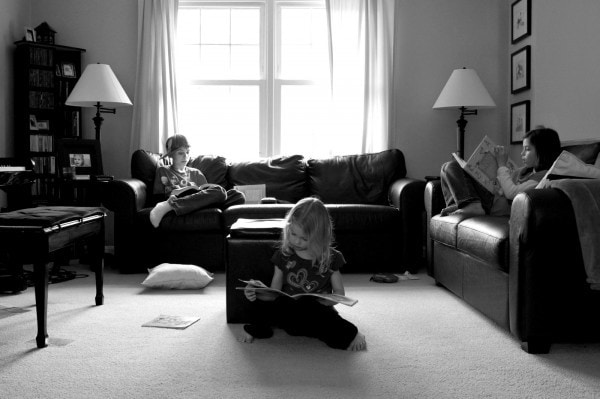
We do school in the bedroom, in the kitchen, in the living room, at the table, on the floor, in the car, on the desk, and any number of other places.
If a designated homeschool room helps you, then great! Go for it.
But if you, like me, do not have space for (or inclination toward) a homeschool room, know that you're going to be fine.
2. Your kids don't have to get dressed to do school
School in pajamas can work great.
School not in pajamas can work great.

Figure out what works for you and your kids and do that.
3. You don't need to prepare lessons for every kid, every day
If you have a class of 20 kids, then yeah, you'll need to do some organizing and planning.
But with just one or two kids in your "class", you don't need to get up and present a lesson every day.
A lot of homeschool curriculum is designed so that the kid can read the directions and do the work on their own (assuming we're talking about kids who can already read).
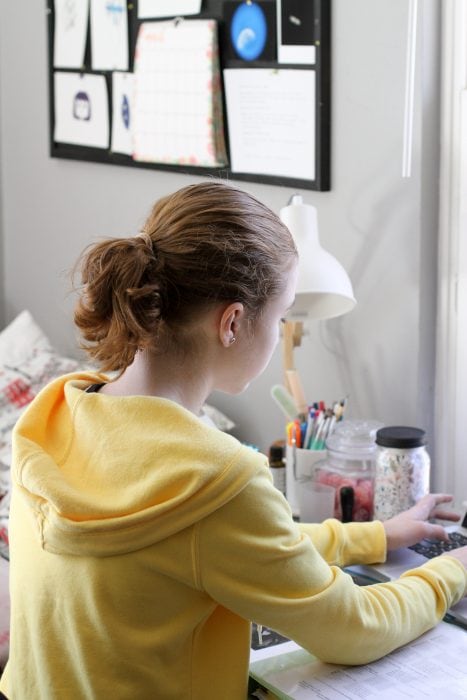
Most homeschooled kids do a lot of independent work, which is one of the main reasons homeschooling is feasible for parents of many kids in many grades.
4. This is not going to take six hours every day
Your kid IS normally at school for six hours, sure.
But your kid is definitely not doing focused school work for six hours.
There's lunch, recess, moving between classes, waiting for other kids, distractions from other kids, and so on.
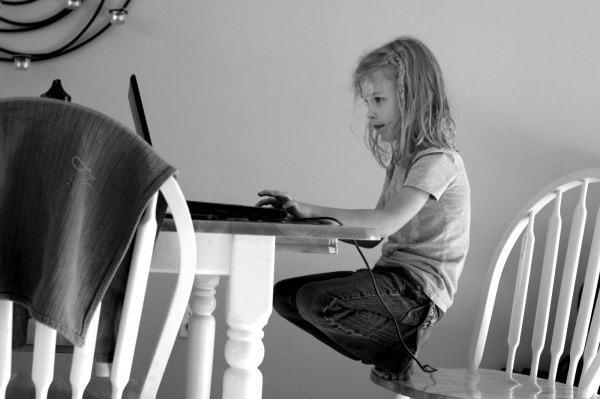
So, that means you should not expect that your child is going to need six hours of focused schoolwork at home.
If your student works hard and gets their daily assignments done in three hours*, there is absolutely no need to panic. It's normal!
If the work is done, that's what matters.
*this is a random number. Early grades, such as kindergarten, do not even require three hours at home.
5. There's not one right curriculum out there
The homeschool market is seriously overwhelming, right? SO MANY CHOICES.
This is great in one sense, but frustrating at the same time.
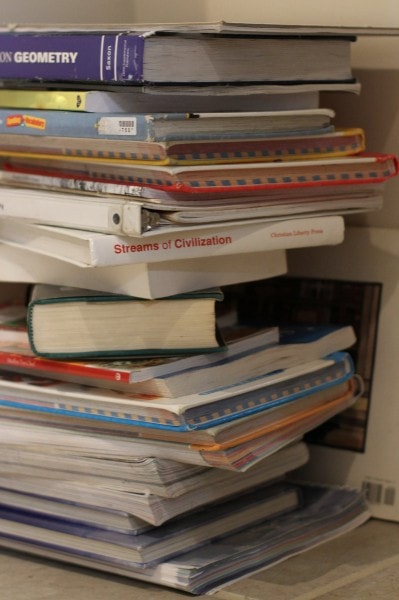
I have a thought that can help, though:
Remember that when you shop, you're not trying to find the one right curriculum out of 3789 bad curriculums.
Instead, you're probably looking at at least 3,000 good curriculums, and any one of those 3,000 are probably going to be fine.
Good enough is good enough, and it's ok to do a reasonable amount of research and then just pick something.
6. You're not stuck with a particular book/course
If you do pick something and you find it to be terrible or just a terrible fit for you, you can change it up, even midyear.
This is not the cheapest thing to do, of course, but it's good to know that it is an option.
And remembering that it's an option will help you feel less stressed about choosing which books to buy.
(On a related note, you can almost always sell non-consumable homeschool curriculum, which will help you recoup some of your cost. I sell mine on eBay and here's how I do it.)
7. You don't need classroom-y items
Kinda related to #1 on this list: some school items really are designed for a classroom experience (blackboards, whiteboards, posters, and so on).
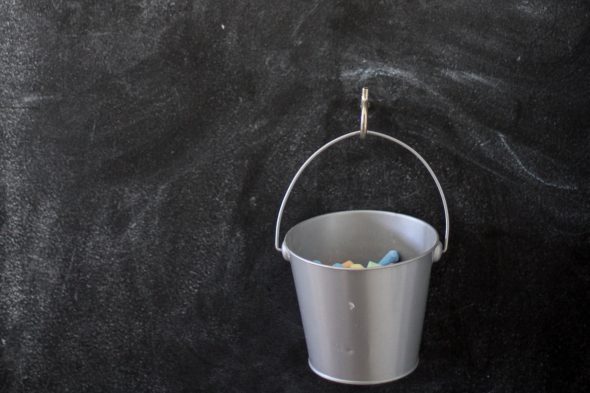
They're not going to harm your homeschool experience, but you're probably not going to find them necessary.
And sometimes, you can just make do with household items since you have a small class.
For instance, when my kids were in early math, I didn't buy coin manipulatives; we just used actual coins! That's not feasible in a classroom, but it totally works at home.
8. You can't make your kids love learning/have a good attitude
No matter how peppy or excited or interesting you are, your kids are going to have a bad attitude sometimes.
I'm not saying this to discourage you, but rather to help you set your expectations properly.

No parent is able to make a kid like every subject every day of the school year. Do your best to set a good tone, but don't consider yourself a failure if your kid isn't enraptured by their education every day.
On a related note, I find it annoying when people won't just let me dislike something. No one likes everything! So as parents, I don't think it's helpful for us to say, "Oh, but quadratic equations are SO FUN."
If your kid doesn't like a subject, telling them it's really fun is probably going to be counter-productive.
I figure this is a great opportunity to teach kids that sometimes, they don't have to like it; they just have to do it.
And that's a great life lesson.
9. You do not have to already know everything your kids are learning
It would be really handy to be well-versed in all of your kids' subjects. But no parent out there is, except for maybe parents of really early grade kids.
You can learn along with your children, or slightly ahead of your children, and it can still be beneficial. You aren't really the teacher; the curriculum is there to guide both you and your student.
For instance, I am not a math expert, but I've gotten all four of my kids through Algebra 1 now, and I've done plenty of refreshing along the way by reading the relevant lessons when my kids are stuck.
I am pretty well-versed in Algebra 1 by now (!!), but I wasn't all brushed up on it to start with.
(I originally did Algebra 1 in 1993. It's been a while.)
10. If you think this will be terrible or wonderful, you are wrong either way
I see parents approaching this homeschooling thing with dread.
And I also see parents with a, "This is going to be such a fun time of learning! Woohoo!" approach.
I think these are both slightly wrong (or maybe they're both right) because like everything else in life, homeschooling is a mix of upsides and downsides.
There will be days that are terrible and days that are wonderful; there will be times when this seems like the best decision in the world and there will be times when you will desperately want to quit.
Both of those feelings are utterly normal. At least, they've been normal for me!

It doesn't need to cost a fortune . I learned that from your kindergarten posts. Most books can be bought (or borrowed) from other home schoolers or purchased on eBay or through thrift books. All around before you buy.
You don't need to own all the books needed for a course. Use the library to your advantage. Some of our favorite books have been library finds. I just grab (or request) a bunch on the subject we are studying.
Great addition. We've done this too.
That school is the only place your child will be able to interact with their peers.
They see other kids at homeschool group activities, scouts, 4H, church groups, their own neighborhood and any other after school activity available to you.
Don't worry about lack of socialization, my daughter went to university in England and made friends from all over the world, homeschooling did not hold her back.
Lack of socialization is a major issue in the COVID era! No scouts, no 4H, no church groups...
If Kristen has tips on hwo to get through this very particular era of homeschooling, I am all ears.
That is so true! Homeschoolers and public schoolers alike are suffering from this problem, so at this time, it feels like there's really no socialization difference between the two groups.
Sonia and Zoe have been doing video calls with friends, and we also have a few friends and cousins that are in our small circle of people we see.
Aside from that, I just have no good ideas! We're all in a difficult spot with this, no matter what type of schooling our family does.
Please check out to see if your area is doing sports or scouts. I know my sons are doing town baseball and soccer and my sons scout troop will be starting back up in person tomorrow. And some scout troops and packs are doing zoom meetings with outdoor activities on weekends.
Agreed. Also it can help kids to learn to play with other kids who aren't necessarily the exact same age. My 2 kids play together so much because they have eachother.
They also play with neighbor kids, even though they're younger.
Awesome post!
Yes to everything you said (and to the comments so far). I might add to #9 that not knowing sometimes gives you the advantage to modeling learning for your children. You can show your kids how to learn about things you don't know--from wondering, to how to find out, to how to have an inquisitive attitude (but not in a fake way--only if you actually are).
As to the dedicated classroom space--you're so right. We managed fine until our church added on to our parsonage. Since then it has been nice that our children have a space to leave the project/book they are working on out at meal time and not have to clear it so that we can use the table to eat. But when I work which each student individually, we sit at our dining table. When I read aloud, I'm in my living room recliner. And although we do have desks for each of our 7 children, they often do their independent work anywhere-- floors, beds, outside-- you name it.
Also, somedays you don't have to do any of your bookish things and you can still be "doing" school. I can't remember how many days we had to go on a shopping trip, and the children learned something-- maybe an audiobook, maybe we reviewed some memory work while driving, maybe we taught the children something math-ish by checking out prices, etc. Learning is so open-ended.
thank you for this! I am a full time working mom with a junior and 5th grader and was feeling bad that the kitchen table was their new "classroom" and no other decorations like I had seen my friends posting on facebook!
A dedicated school room, nicely decorated, is fine. But yep, it is totally not necessary. 🙂
Work that kitchen table, girl!
Don't be afraid to think outside the box and to embrace what works for your family. If your curriculum can be supplemented or sparked by everyday activities, go for it!
I've been loaning movies to a home-schooling friend since March. This started as a way liven up quarantine with movies I thought everyone would enjoy, regardless of age (think Errol Flynn's "Robin Hood"--it's just FUN!!!), but it's since spiraled into something truly fantastic. In addition to getting all five kids to sit still--with no electronics!--for family movie night, the films have prompted discussions and school lessons on a variety of subjects.
Examples: One loaner was "Sinbad the Sailor" from 1947, which has a scene with a lovely call to prayer. Her kids were fascinated by the concept, so that became a lesson on Islam. "Clash of the Titans" (the 1981/only version 😉 naturally led to Greek mythology. If a movie features a historical personage or place, they research the real ones. Since our collection favors older/little-to-no-CGI movies, her kids have also been researching old special effects and turning those into craft projects using what they have on hand, with Mom's help. Their monster make-ups were amazing!
Very practical examples, thank you!
I started to say "Re #6:", then "Re #4-5-6:", but really "Re most of these:"
If you look around a bit, you'll find books that aren't so much curricula as they are about the philosophy of home schooling. Instead of "how to home school," they're about "why to home school." And some of them are radical. Read A. S. Neil or John Holt, and you may discover that you agree with their thoughts. Then you don't need any curriculum at all. Just a willingness to let the child lead and to learn along with the students.
As a grown-up home-schooled kid whose parents went' with John Holt's Unschool model, I think I turned out pretty OK. I bet your kids will too. You can do it.
I just came to say the same thing. When I see people in FB groups saying they just pulled their kids and need curriculum recommendations, I'm always thinking, "Whoa! Slow down! Do some deschooling, research different approaches to homeschooling, and figure out how you really want to approach this."
I would add that if you have multiple kids... one size fits all does NOT apply for curriculum choices!
It helps to know how your kids learn best - though sometimes they have to suck it up and go with what is available - it's OK to use different curriculum for different kids for the same subject.
And I totally second the 'switch mid-year if it isn't working' thing. It's worth it to make things better/more successful for your child!
Lastly - Give yourself and your kids the grace to adjust, make changes, and even just have a bad day.
Blessings on the journey!
We're about 50:50 at the moment for next year being homeschooling or private school. Too much out of the local public schools has me a bit concerned.
"I find it annoying when people won’t just let me dislike something."
This is a pet peeve of mine and my whole life I've been told by teachers, family members, friends and total strangers on the internet that I'm "wrong" because I don't like certain things. I usually get the "Let people enjoy things" meme shared at me like it's a "Checkmate! You have to like X now" (which is usually something trivial like pop culture franchises but sometimes it's more "normal" stuff like how I hate yard work and sports.
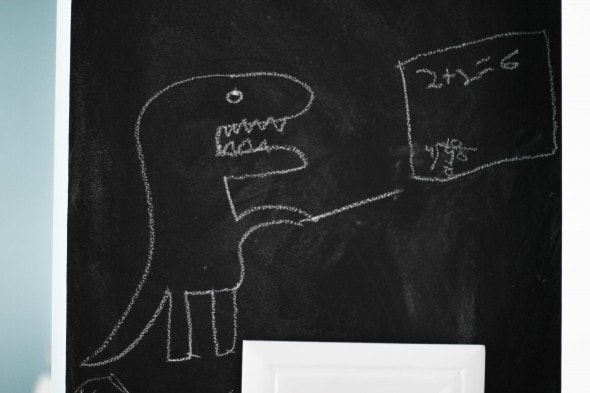
I also forgot all about the dinosaur teacher. Seems like only yesterday you were blogging about teaching the earlier grades like that.
I love this post, it is so much our take on homeschooling as well. Although I am in Canada and do not have some of the reporting requirements that seem to be the norm in the States, my one take away on this journey is that not all learning for some subjects will come from curriculum. My kids have learned more about history and science from outside sources, such as tv series and travel, than any textbook I have found. And because it is often from a more mature source, they have a better understanding of these subjects, as opposed to just learning facts. I do try to monitor, or correct, what I think is a bit less "accurate" than it should be, but there is so much good content out there, that that is not often necessary.
If your children are enrolled in a school district and their teacher is creating the curriculum/lessons, that isn't home schooling, it's distance learning. It will definitely take up your time because you are supervising them and helping them in ways their teacher or an aide normally would in the classroom. As a former online teacher (prior to the pandemic) this frustrates me for extremely petty reasons lol
Oh, for sure! Doing school online through a traditional school system is an entirely different thing than doing regular homeschooling.
It seems like a really hard job for the teachers (particularly grade school teachers) and also for the parents.
Thanks for the this post. We are homeschooling for the first time this year. I am note sure if we will continue next year or send them back once in school Lear is an option. I am enjoying the flexibility of it and the extra time with my kids, but we have had some rough days and meltdowns already. Our school space is any and everywhere. I have all the school stuff in a basket that I move to wherever we end up. Any advice about schooling older children with a toddler and newborn?
The best way I found to navigate that issue was to do the bulk of our work during naptime. I always found that the toddler was much more problematic for school than the newborn, so once the toddler was napping, that's when we really tried to get focused work done.
Hopefully your toddler naps!
If your toddler is awake, could you move schoolwork to wherever the toddler will be happy and busy? The backyard? The deck? A bedroom?
You could also stagger mealtimes a bit; put the toddler in the high chair and let the toddler eat lunch while you work on math with your older kid. And then you and the older kid can eat lunch once the toddler is done.
Hang in there; meltdowns are normal. Even for the mom. 🙂
That’s usually the time that I’m in the pantry eating dark chocolate
Amen to the meltdowns being normal. Unfortunately.
I have no experience with homeschooling a child, but I enjoyed this post. I long thought that homeschooling meant a parent had to dedicate six hours a day to teaching, until one dayin this blog, I saw that no, it doesn't, and why it doesn't. So if someone tells me he or she is thinking of homeschooling for the first time, I will direct that person here!
When my son was in school, we did Mom's Academy every summer to make sure he did not fall behind (he had some learning disabilities). So he'd read a short piece and write a few sentences about it, do a few math problems from leftover worksheets, practice spelling, handwriting (whatever the current need was) and read aloud to me. It never took more than about 20 minutes and took place at our dining table. It was very low-stress. He didn't always enjoy it because he'd rather have been playing, but it kept the first few weeks of each school year from being brain painful for him every year.
Super important to do something over the summer, even if only 10-20 minutes a day. Students who don't have any reading or math practice over the summer lose 25-30% of what they learned the previous year. The effect is more pronounced in Black and Latino communities and communities of color, and educators believe it relates to the academic gap in high school between populations.
Don't know a thing about homeschooling, but that picture of Sonia is just too adorable.
Thanks! I passed on the compliment to her. 😉
She had such a dramatic crying face when she was a preschooler. And she was a bit on the fussy side of things, so we saw her sad face a lot. Good thing it was cute!
I agree. It made me laugh out loud - and in public, too. She looks so cute and pathetic at the same time.
The biggest things I’ve learned over my few years is:
1) Don’t feel bad for taking breaks, you don’t have to follow the public school dates. You have 365 days to get 180 days of school work done.
2) School work can look like anything (especially for younger grades). Reading road signs is reading, spelling. Grocery shopping is reading and math. With old kids. Discuss politics, news and more. This is civics and it’s relational to what is going on in our world today.
3) There is NO behind in homeschooling. You can cater to where the child is without having to worry about pushing them before they are ready. Most (not all) public schoolers aren’t all on the same grade level anyways, even if they are all in the same grade. Some are ahead some are behind and being pushed ahead. Homeschooling provides the opportunity to go at your child’s pace and this is a great thing!
I would like to correct that misconception for new parents of homeschooling kids to confuse school at home and homeschooling , homeschooling is way different then school at home in a sense that it had an open curriculum value .
And please there is not particular time to start homeschooling if you are a morning person ok if you are an evening person it’s ok too , 🙂
#5, so much.
I'm not currently homeschooling, but part of a homeschool group in my area. A lot of parents have been pulling their kids out to homeschool because of Covid, and one parent in particular made me laugh out loud with their first post:
"Just pulled my 2nd grader out, tell me the best homeschool curriculum to use!"
As if there's a homeschool curriculum evaluator somewhere giving all the different curricula a scorecard or something, and all the homeschool parents could tell this parent the exact right program to buy to serve their family knowing nothing other than the age of the child involved.
😀
Someone else may have touched on this, but even after being homeschooled all the way through myself - beginning in the 80's when it definitely wasn't a thing - to now homeschooling my own 4 kiddos, I still have to remind myself to that home education is a "real" full time job, and give myself grace to not get as much done of other household tasks as I think I will. I still mistakenly think that because I'm home, I can get a lot done between subjects! But, the reality is just the opposite, and just like we wouldn't expect a teacher in a brick and mortar building to try to have another full time job during teaching hours, to give ourselves the gift of not trying to shove it in the extra spaces and going crazy when it doesn't work.
Also, I've found many well-meaning people only hear the "home" part of homeschool and think that we have free time running out our ears for extra jobs, social gatherings, phone chats and projects during regular school hours that they wouldn't dream of tapping traditional students or teachers for. It is perfectly acceptable (even good!) to tell others that you're not free until after school, put the phone on do not disturb mode, and let folks leave a voicemail.
I find when I think of it as my full time job and treat it as such, it goes so much better. There are certainly days when we scrap the day's plans, and I LOVE the flexibility to do so, but it makes for less crazy when I make it the priority most of the time.
A hearty "Amen, preach it sistah!" on all of your 10 points. There are definitely days when I'm ready to sit in the corner and cry with my underwear on my head, but most of the time wouldn't trade it for anything!
As usual, good advice. However, the parents who are now working with their children at home because they are not going to on-site classes, are in a very different situation. Especially as this is not really a choice for them as they are putting their child's/children's health/safety first.
I would say that they are schooling at home (with or without help from online teachers, etc at local schools) NOT home schooling. Big difference.
Also, now children who regularly attended school have been at home for months (without schooling) and are not used to being home and now having what may be permanently the way they learn for a year or so.
With that in mind, I would respectfully suggest that some of your suggestions simply do not apply, although they have worked for you. Or will not work well to get children organized and disciplined after months of just "hanging out".
(And I will not even talk about how many parents will honestly tell you they are not even remotely qualified to "teach" their children or even to assist with homework from online assignments that they may or may not be around to understand how they were given.)
Kids who've been home for months now need more rigid and disciplined approach to returning to school and part of that requires them to start acting as if they ARE in school.
First, if there is room, set aside a specific area (or a specific time of day) for the kids to work at. It's like a home office. You really can't be productive if you don't have some place, no matter how small, set up to be used daily (even if it turns back into another space later on).
Second: NO Pajamas. NOOOOO. Kids get dressed. It signals time for them to NOT be sleeping, napping or playing around. Sorry, but I firmly believe in this. We're not talking Sunday dress clothes, but NOT pajamas. PJs are for sleeping. It's a bad signal to kids.
(And yes, I, who have worked from home for decades, off and on, ALWAYS wore work clothes during the work period. Only when I was sick and couldn't work all the day did I wear casual clothes.)
It worked out well because I was always ready for in-person meetings (that were set up on the fly by clients) and it always put me in the mood to focus on WORK. And when dressed for work, I didn't find myself heading for the kitchen to cook or elsewhere to do housework.
Order, routine, discipline. These are even more essential in the absence of regular classroom routines.
Just my humble opinion based on experience. Kids need structure and it comes and is signaled in many forms.
That's what worked for you, and that's great! However, is not necessarily the best for every family or every child. That seemed to be the point of this article, there are no rules that work for everyone. I'm glad you found something that worked for you, but your approach did not work for all of my kids.
Whoa... critical much? She was simply trying to be helpful. She is talking about homeschooling not online learning through the school. Also, who the hell makes kids get dressed to the nines everyday? Someone who have all the time in the world for laundry?! Take your negativity elsewhere.
I agree that children need help learning structure, but very much disagree that the structure must be as you describe. My daughter - a college senior who has never earned less than an A in any class, whether in public school, cyber school, or university here or abroad - wears pajamas for class here at home on a regular basis. There are no surprise video conferences for public school or college students who are learning remotely, so there is no need to worry that she might have to jump into a meeting. She wears a nice top and does her hair when she is "going to class." There is no need for her to sit in less comfortable clothes to learn. There are many families who are struggling mightily to get everything done right now, particularly parents working at home and simultaneously trying to facilitate their children's education. They are doing two jobs at once, with no training, with no extra income, and with no respite. If their children want to wear pajamas, so be it. There are more important issues on which to focus right now.
Oh, I definitely agree that my list is not necessarily applicable to families who are doing virtual school at home. If you have to be on Zoom for six hours and you have to follow dress code rules and you're not picking curriculum, then yeah, totally different scenario.
I wrote this post for people who are doing something more similar to typical homeschooling.
I think the decision about how much structure and formality to include in a homeschool household really should depend on the people in the household. Whatever method works best for each family is what should be chosen.
I personally don't work well in pajamas, but some people accomplish plenty while wearing pajamas.
I think success and hard work can look a lot of different ways and what matters most is the results. Is the work done in a timely, thorough manner? If yes, carry on. If not, maybe consider tweaking clothes/scheduling/routine to make it work better.
I think that if parents are teaching their kids at home without assistance from the school, then they ARE homeschooling, regardless of how they found themselves in that situation.
I agree with you about dress. I really do think that it sets the tone and is motivational to be dressed properly. Not fancy, but just not in sweats or pj's. Those things are made for resting in, and I think even if it is subconscious, we are going to feel more inclined to rest and relax when we wear them. Although I think it is good to be flexible too. Maybe have a "casual Friday" so that once a week wearing pj's/sweatpants is a special occasion to mix things up. Making anything a ritual makes it fun for kids.
I also want to say that just because the masses FEEL and believe that they are "not remotely qualified" to teach their kids, does NOT make it true. In general, I believe that if you know how to read, you are qualified to teach your kids. My mom didn't feel remotely qualified to teach my siblings and I growing up, and she continued to make statements along those lines until we started graduating and getting into college and thriving there. She homeschooled all of us from preschool through high school graduation, none of us set foot in a regular school the whole time. I think most homeschooling parents will tell you that they learn along with their kids. You don't have to know everything ahead of time. If you know how to read (and these days, look up YouTube documentaries and teaching videos) there is no end to what you can learn and teach your kids, or just learn with them as you all go.
I am setting up a "learning room" because we have an extra bedroom and because I need it for myself, otherwise I will be distracted by housework etc. I want to have a space where we can go and settle in and focus on learning for a few hours, and we have that luxury, so I am taking advantage of that. But I think her point here is that you don't need to have that space to learn. When I was growing up, the dining room was the school room. We finished breakfast, cleared the table, and brought a tub of books/notebooks/curriculum to the dining table and all did our work. We usually worked together for an hour or two and then split up and the older ones of us were allowed to take our individual books (math, history, language arts, etc) to our beds and do our work there. And that worked fine. I think her point here is just to encourage people to work with what they have and not to feel discouraged if they don't have an entire room to dedicate to learning.
Yep, your last paragraph is exactly what I was trying to say! 🙂 A dedicated school room is not bad. It's just not necessary for learning, and I hate for parents to feel like they're inadequate at this for not having a dedicated space for homeschooling.
I meant it as encouragement for everyone who has space limitations.
My favorite is that you don't have to do school during "school" hours. Taking a break for an afternoon then doing more "school" during the evening is a viable thing to do.
You are not going to ruin your kid!
Many years ago, I got two pieces of advice: 1.You are the world's leading expert on your child. & 2. Teach the child, not the curriculum. I just went with that for more than a decade, until high school was on the horizon and I panicked. A "retired" homeschooler whose kids were in or through grad school heard me out and said, "Stop worrying about it! Of course, you missed teaching something that they need. They'll figure it out when they have to."
So I (kind of) stopped worrying about ruining their academic lives then. When my first born was admitted to university, I quit worrying (almost completely). Now that my eldest is a junior at a university, I've stopped worrying about self-perceived inadequacies (sort of).
Seriously, though, it's not worry as much as it is passion for my kids to get the very best education that I can provide for them. I missed things. They didn't retain all that I would have liked. The idiosyncrasies of classroom culture were & are largely unfamiliar to them. Those things (and more!) were missed in our homeschool, but my kids are not ruined, and neither am I.
I appreciate your advice and insight -- your honesty is a breath of fresh air. I have always homeschooled my now 5-year- old daughter with ASD. She learns when she's ready -- in pajamas, in dress- up clothes or in her bathing suit. This freedom works for her, and in turn ensures her success! I look forward to reading more from you! And your child is too precious. 🙂
This is actually what I needed today. I’m one of many that chose to do online because of Covid-19.. I was not a teacher before this but because my son has always been inquisitive, I have looked up a lot over the years. It’s been a bit rough this year ( a lot of life changes in a short time and my child is high functioning autistic, brother-in-law and fiancé living with us for now). I’ve had to just figure it out. Put my foot down with brother-in-law and even my husband when they are doing something disruptive to my son’s school schedule. I’ve had to just figure it out as I went along. Hearing these guidelines though helped in that it’s a conformation that it doesn’t have to be perfect and there is a lot of give; it doesn’t have to be as structured. I have also told him that he doesn’t have to like it but it still needs to get done. Thank you for this!
The hardest part about homeschooling is the support network within the home!
You will have negatives come from random people which you expect but you don’t expect it from your own home. If the parents are not supportive of each other than the children will take the side of the parent who agrees with them. That’s been my battle as a mom. Iv been aware of the homeschool platform for nearly 20 years so I am aware of how it works however that isn’t the case with my husband. Things look very much different than the public school schedule therefor it appears as though homeschooled children aren’t learning as much, which is far from the truth.
If the parents can’t be on the same page then you will fail regardless. I believe that the parents should both be well informed before going into homeschooling.
Such a great post. I homeschooled my 4 until the oldest was in 5th grade and they were wonderful years (with some bad days, of course!). I only stopped because my husband became a principal and the school where he took the job wanted his kids enrolled, which kinda makes sense....
Anyhow, I agree with all your points. It reminds me of the "what you really need for a baby" lists, which are generally spot on. Neither a baby nor homeschooling need to break the bank.
Lovely post!
We're doing distance learning 2 days a week and home instruction 3 days a week with a school provided curriculum (cannot say enough good things about this school's curriculum, partly because they believe that education is best when there is direct partnering with parents) with one child, and I am home schooling my two other ones, one of whom is physically disabled and probably on the Specturm.
Morning is not always the best time to get schoolwork done. Do what works for you. We always try to get work done in the morning because that's when I have the most patience to deal with the "I don't want to" moments. But if the kids are super distracted because Dad is still home (happened to us this morning) or it's super nice outside but will be gross in the afternoon, switch it up. It's worth it to be flexible. It's been a rough year all the way around, and we all have to extend lots of grace to one another as we figure out school life again. The kids seem to respond well when there's a respectful give and take to accommodate one another.
I didn't homeschool my kids, but it seems to me that one advantage would be if your child is having difficulty grasping a concept, there are multiple other ways to approach it, and all the time in the world to do so. In a school setting, there is a set curriculum and a timeline. So if your child isn't getting it the way it is taught in the time frame allotted, they not only suffer a poor grade, but they may also lose out on the chance to learn the concept at all.
Another advantage is that some things taught in school are taught because someone thought they should be in the curriculum, but they may not be that important in real life. Not memorizing who is buried in Grant's tomb (just kidding) is not going to mark your child as uneducated for life. A well-rounded, rigorous education is important, but sometimes small things don't really matter all that much.
It also seems to me that you have plenty of time and opportunity to enrich the learning opportunities--public schools are very limited there--with classes often having 40 students, not the 20 you mention.
My kids did well in public school (one now almost done with medical school and one a university sophomore), but if we had been able financially to swing a home school education I would have loved to be able to do it.
Although I am trained as special needs teacher there was no way I would home school my children. I did a lot of work with the two who struggled and both have jobs they love now. My youngest was difficult for anyone to teach because she truly believed she was hopeless. Now she wants to train as a teacher. She currently works as a teacher aide supporting high functioning students on the spectrum! My mind boggles.
I love that you mention that school does not need to take six hours. A motivated child might do five hours one day and two the next. There is so much that happens in the classroom that steals time and more time is lost trying to bring everyone back after an interruption.
That it is alright to call a home ec day(major house cleaning day, saved for Fridays) or plan a field trip with other homeschoolers. Those were for us, and can be ground breaking experiences for other kids.
This is my 8th year homeschooling. For us, we do have to be dressed or school just doesn't happen/happen well. We've never had a dedicated homeschool space (our house just isn't large enough for that). My daughter hates schoolwork. I think she would hate it any way we did school, that's just her personality. So...we just press on through it. I was homeschooled, and my mom would say, "It doesn't have to be fun, it just has to be done!" I don't strive to make things unenjoyable (!) but math is math and if math isn't "fun"...well it just has to be done.
Yes! This idea that everything ought to be fun is just not realistic. There's so much about life as an adult (and also as a child) that is flat-out not fun.
It's called, "schoolwork" not "schoolfun" for a reason, probably. Ha.
It's not that learning can't be fun sometimes. But a lot of times, it is necessary to just put your nose to the grindstone and do the work.
So very well written!! I homeschooled my children and found each of the above to be true. This is really helpful for new homeschoolers. Thank you!
Thank you for this post! I myself had been going back and forth about homeschooling for the last couple years only because my son has said that he thought that he would let enjoy it and I would be great at it. however I was very hesitant and it took a lot of convincing for it to happen the best convincing I got and was covid! last year the school year was quite difficult My son was picked on bullied encouraged to do things he probably knew better not to do but wanted to fit in, his shoes were taken from him and tossed as if they were going to be thrown in the trash only to have my son be made fun of for even being upset that his shoes were taken from him. My son was sick quite often with colds and flues already throughout the year. Towards the end of the year my son had his knee sprained during a lunch break that I was not notified about and it took days to even diagnose because my son denied anything was even wrong because he thought he'd get in trouble since no one at school thought it was a big deal. I had complained to the school several times about the thought that they weren't taking proper care of my child or protecting him the way that I needed him to be protected and he was out of school for a week and a half only to go back to be put out of school due to the illness that was spreading. during the last few months of the school year we were able to get an idea of what homeschooling would be like and decided that we would give it a shot. This has been an interesting shot!? My son is all of the things that you described and learning is not something that he puts high on his agenda. And I have had the last few days where I have been at a point where I am ready to quit! not because I'm not willing to do it but because I just want to make sure that it's something that's actually going to help him be the best version of himself through education as well as his own internal development. Even though the days have been difficult throughout the days there's been moments where I can see the light but I didn't know if that was just something I was kind of building up within myself?! So it was very refreshing to read your article randomly and here's so many things that I needed to hear in order to keep the momentum that I need to make this work! All of your tips are extremely helpful and we need more encouragement for the days weeks and years to come if this is the path that most of us end up on so to have insight that's realistic to the fact that we are human beings and none of us really like to have to learn except for when we really want to learn, makes it really nice to know that I'm on the right path and I'm okay with being a little bit rocky while on it. Thank you again and I hope to read further articles that might be insightful or helpful cuz every mom really does need a little bit of help!
I have loved unschooling my littles who are currently PreK and Kindergarten, and I have an Education degree to teach high school science! My favorite and simultaneously most challenging lesson has been everything counts for school. We do year-round, 3 to 4 day work weeks. Every day we do math and phonics and rotate another subject, science, life skills, social studies, etc. This is our second year homeschooling, and I intend to follow through to graduation. I really appreciate everyone's freely shared wisdom and encouragement!