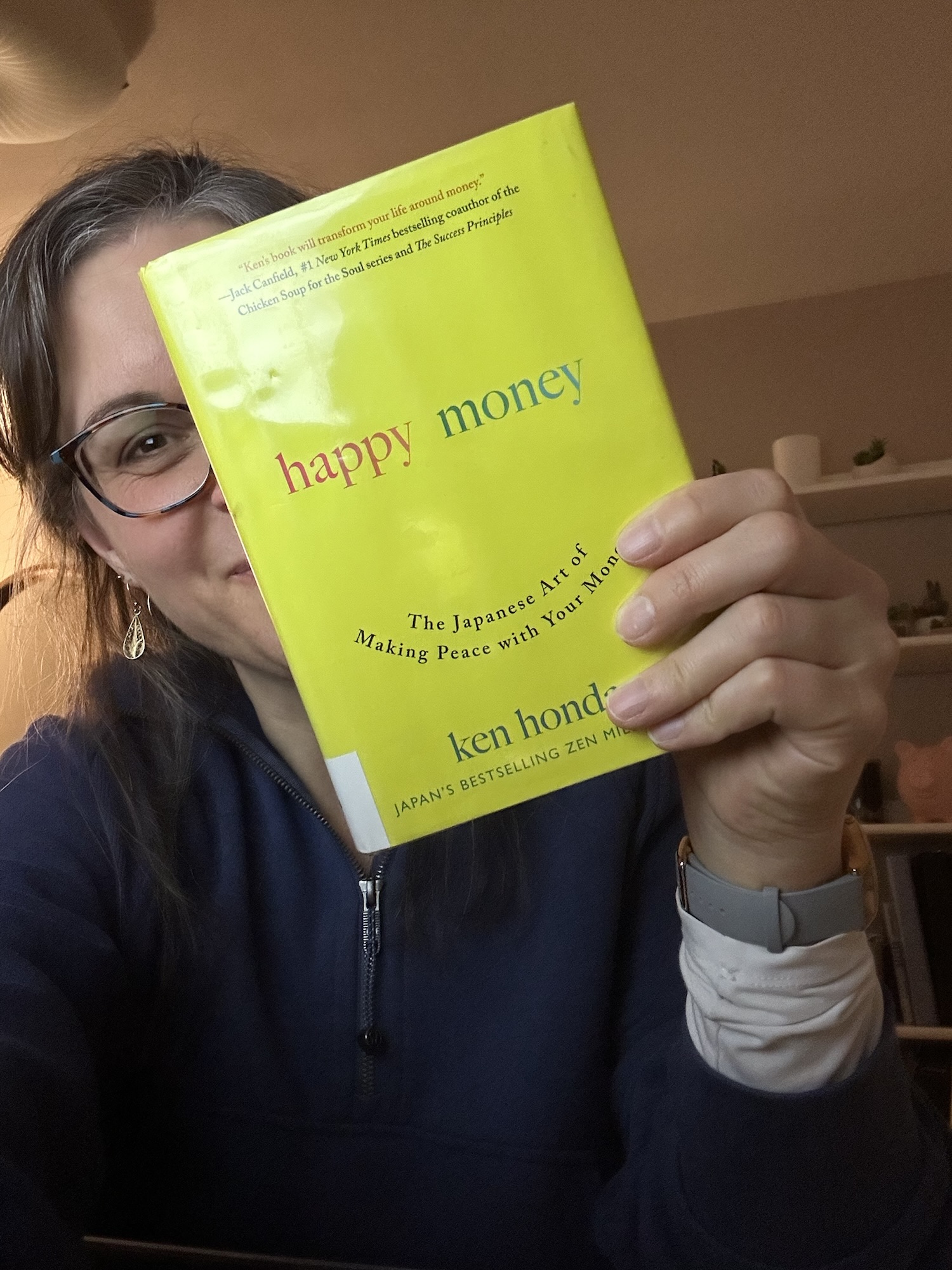
This book made me feel crabby.
I said so on Instagram when I finished it, and promised more details to those who asked.
Ready?

I heard about this book when there was a bit of a brouhaha in the comments on Soulemama's blog (if I recall correctly, it was of the "How do you do everything?" variety.), and someone mentioned this book because the author covered the Soulemama blog.
Because I am a blogger myself, I always find books and articles about blogging/bloggers to be fascinating, so I put it on hold at the library.
When I first started reading the book, I fell mostly into the "This is intriguing!" camp because it's terribly interesting to read what someone outside the blogosphere thinks of us.
But then I started to become increasingly annoyed with the book and the author.
Basically, she's talking about a trend she's observed of women leaving the workplace to start up home businesses or to be super-duper homemakers. Since a lot of these kinds of people blog about it, she ends up talking about bloggers a lot.
In the book, she covers all the problems that she sees with this DIY, homemade, natural-food-eating trend.
(People who opt out are no longer motivated to work for the common good, opting out is privilege-based and selfish, we're letting down other women, people who opt out are mostly women, etc.)

Here's my biggest beef, though: the book is tremendously lacking in research-based evidence.
Are there actually a significant number of people ditching their jobs in favor of home-based businesses? Or does it just seem so because people who do this are so visible on the web?
Is it true that the changes privileged people make have no positive effect on the less privileged?
(The fact that Aldi, a food retailer which is quite the opposite of Whole Foods, now carries far more organic and fresh food than they did ten years ago makers me wonder. I'm pretty sure this cultural change in food demand started with some privileged people.)
The problem is that without research, all of this is just one woman's opinion, based on anecdotal evidence.
(The book is rife with interviews of individuals.)
It reminded me of how some people approach homeschooling: they look at it, see something they think could be a problem, and decide it must be so, regardless of what the evidence says.
For instance: "Wow, homeschoolers take so few tests. They must really do poorly when they take the SATs or transition to a college classroom."
But that's not what research says.
(I understand that that research may not prove homeschoolers do BETTER on tests, because there need to be adjustments for class and whatnot, but I think it does at least show that homeschoolers do not perform poorly on tests.)
Or they see an example of a problematic homeschooler and assume that all homeschoolers are like that.
"I met a homeschooled kid and he was a dorkopotamus. Homeschooling makes kids into social misfits."
(Which, I must point out, is as ridiculous as assuming all public school makes kids into weirdos based on observance of the dorky kid in your middle school class.)
Another problem with the book is that the author didn't seem to be trying terribly hard to be unbiased.
For instance, when profiling a homeschooling family who has a home business she says, "So while the other kids in the county study phonics and long division, these girls process turkeys and help to make soap, lip balm, and jelly."
Because homeschooling is pretty efficient, it may be factually true that the girls are done with their schoolwork and are helping with lip balm at 2:00pm, while other children are at school.

But by phrasing it as she did, she seems to be deliberately trying to make readers think the girls aren't getting schooled in phonics at all and are rather enslaved child laborers (the poor dears!) I don't know the family, but I highly, highly doubt this is the case.
Also, when I got to the end of the book, I was reminded of how feminism sometimes feels as oppressive as what it's fighting.
If feminism is about giving women the freedom to make choices, then why the pushback over choices that don't involve an out-of-the-home career? Why can't we just let each other make varying choices?
Why is it ok for women to choose to hold a full-time job, but not ok for women to start their own businesses?
Why is it ok to be a teacher, but not a homeschooling mom?
Why is it ok to work in a soap-making factory but not ok to have a small soap-making operation at home?
While it's not practical to expect all of us to go home and have a lip balm business (I want my pediatrician to keep practicing! And we do need teachers and police officer and a myriad of other non-home-based workers.), I'm not convinced there's a problem with some of us choosing that route.
I realize I'm making the book sound like a total dud, which it wasn't. It was interestingly-written, some parts of it were good (the chapter about food) and did actually contain some research (the chapter about vaccines), and it did give me lots of food for thought, despite the fact that I disagreed with a lot of what she said.
So.
There you have it: possibly the longest single-book review I've ever written.
____________________________
If you read this book, I am super interested in what you thought! Please do share.
I read it quite awhile ago. I saw myself in a lot of the anecdotes; not so much in the author's viewpoints. I found myself defensive for a large part of the book, because her tone comes through pretty clearly that she is firmly in the NOT domestic camp.
My lifestyle is pretty far to the extreme side of what she thinks is too labor-intensive and unnecessary. I won't go into my own reasons for why I do all these things, but the point is that there are SO MANY reasons and SO MANY varieties of domesticity that that kind of generalizing drives me crazy.
I still enjoyed reading it, but mostly because I enjoy arguing in my head as I read.
Yes-there's something to be said for reading a really opposing viewpoint. Sometimes it helps to solidify and gel what you think.
I haven't read this book, and after reading your review as a professional turned stay-at-home mom, I don't think I will. I get enough judg-ey in my real life! Happy with my selfish decision to opt out!
As you should be, if it's working out for you and your family!
Um....I am definitely adding dorkopotamus to my vocabulary! Thank you!
Also "adorkable"! 🙂 (That one's from my sister.)
My new favorite word! 🙂
whew! I know you feel better now. Never worry what other people think, they do not do it very often. Embrace the day PBH
I haven't read it yet. I hate when someone wants to degrade someone's choices. Women's rights were fought so there would be a choice. Even for us working out of the home moms there is a lot of interaction and moments to teach our kids. It sounds like she doesn't understand why someone would want to be at home. Which in itself is a full-time job. My dad was medically retired (went blind in his 20's). He stayed at home and took care of the house while mom went out and worked. She worked full-time and school full-time for many years to get ahead and it wore her out. My dad had a college degree in electronics, but couldn't work. He kept the house neat and orderly. He had a cleaning schedule. I have no issues debating w people who think the dad should be the only breadwinner. There are pros and cons to both options. These days it's not as easy to have one at home. Regardless it takes a lot of working together and figuring what works for you. Btw I'm a single mom who works outside the home, my daughter goes to school, and I rarely get any help from my ex.
I think this book would make me crabby, too. I don't have a lot of time for crabby.
My experience in leaving a full-time job with a significant commute has been nothing short of awesome. I still have the career, working two days a week from my kitchen table — so I still have the creative outlet and the feelings of accomplishment but without the irritations, like bosses hanging over my shoulder watching my screen, and meeeeeeetings.
(I'm not a homeschooling parent, simply not cut out for teaching, and I'm ever so thankful for my kids' teachers.)
Arguments like this make me a little miffed, too. We have seen female participation in the workforce go up each year. If workforce participation is declining right now, it's among men, because traditionally-male labor positions are disappearing. It seems counter to all evidence to bemoan that women are leaving the workforce when in fact they are working outside the home in rates higher than we've ever seen. I don't think it's statistically true that mothers are choosing to stay home more than they were a decade or two or three ago, but even if they were, it remains that fewer women than ever are having children, so we'd still have a net gain of women working.
I just am not at all convinced by the argument that women staying home while they are raising their kids, for some period of time, is to the detriment of society. Many of the jobs women have are low-paying service jobs. They are not particularly personally fulfilling for many people. And, most jobs don't require such specialized skills that the person doing them aren't replaceable. I worked for years at a bargain bookstore. I hope that my customers enjoyed talking to me and that I was able to help them select books well, but the fact is that when I left, the person who replaced me as able to take over my tasks with no problem. Even in my current job, which does require a graduate degree and some specialized training, there are at least five other instructors at the university where I teach who could take over my classes if I needed them to.
I'm grateful that I have the opportunity to teach part-time (and now online from home), mostly because we could use the money. But, I really am replaceable at my job. I'm the only mom my kids have, though. If it came down to where I was making a more essential and irreplaceable contribution, it's at home, no question. So I think this argument that people make some sort of selfless and necessary contribution when in the workforce but are simply being selfish and frivolous when they are at home is just not true. I'm also wary of appeals to "privilege" in this argument, because the answer to the problem of some women being unable to stay at home with their kids when they want to is not to say that no women should stay at home with their kids even if they can make it work financially, but that we need to figure out how to make it more feasible for women without economic privilege to stay home with their kids if they want to.
Great comment!
Very well said!
I also think it's a bit self-serving and disingenuous to write about "trends" based on either stuff you notice around you or stuff you see online, without bothering to check data. Like, I could argue there is a trend of young educated white families moving from the suburbs to the inner-city and living as urban homesteaders, because, living in a city neighborhood where this is common, I know probably a dozen families who have done just that, but obviously that's not a meaningful trend. But just because it's a "trend" in a 3-mile area in the city where I live does not mean I need to start worrying about what would happen if EVERY young white professional decided to move to Detroit and raise chickens and bees in their yard. Sure, that would have some problematic implications, but since it's not going to happen, it's a non-issue.
Totally agree. And I think the internet is sort of a virtual 3-mile city area. I mean, the internet is vast, but the super visible people who are blogging aren't a lot more statistically significant than your 3-mile neighborhood. They're not really representative of the whole picture.
Reading this, I am reminded of a quote you just stated a few days ago. Paraphrasing it, it was something along the lines of how we are sometimes quick to judge someone else when we don't actually disprove what they are doing, and in fact are perhaps a little jealous, feeling inadequate ourselves, etc. I have to agree with this. I am a full time working mom. My children go to daycare and I am a healthcare provider. I am doing what I feel the Lord has called me to do. Am I jealous of you? Yes. Do I think that you are also fulfilling what the Lord has called you to do? Yes. Just because we differ in what we do, does not mean that one of us has it easier, better, or right. Just different and that's what makes for a well rounded world
So I think that perhaps this author might take a closer look at her own life and see where maybe she is just feeling self inadequacies rather than judging others
Interestingly enough, she does talk about how upon reading homemaking blogs, she feels compelled to do things like make jam, and then feels guilty that she would rather work and pay someone else to do the cooking!
So interesting, and I think that really ties in to your recent blog posts and discussions in the comments. People are DIFFERENT! Everyone has different strengths and different things they enjoy. IT'S FINE 🙂 I absolutely consider myself a feminist, and to me what that means is that every person and family should be able to make the lifestyle choices that work for them--whether that's both parents working, mom running a home-based business, dad homeschooling the kids, or any of the myriad options out there.
I don't homeschool, blog or run a home-based business, but based on your review I have a feeling this book would make me crabby, too. I think the notion that opting out of the workforce equates a lack of commitment to the common good is ludicrous. Women who find a way to juggle childrearing with household responsibilities, sometimes including contributing to the family income, are committed to the common good however they are best able to make this work for the unique needs of their families.
"The problem is that without research, all of this is just one woman’s opinion, based on anecdotal evidence.
(The book is rife with interviews of individuals.)"
This reminds me of a great quote, which I try to always bear in mind: "The plural of anecdote is not data".
I need to remember that great quote!
Opinion as "fact" books make me crabby too. I read The Tightwad Gazette books as a broke newlywed. There were good ideas in them but they made me feel horrible if I didn't want to do something the author's way or give something up the author said you should.
This book hits me because I am a DIYer and foodie. Does the book even consider that more people are creating home based businesses because people want some job security in this job insecure economy? That some people are finding good, quality day care costs put them in the hole in a two income family? There are nonpolitical studies to me up.
Well, she'd say that instead of starting your own business, you should work to make good, quality day care affordable.
Which sounds lovely in theory, but making that happen is a huge, slow job, and most of us aren't wanting to sacrifice what we think is good for our own families in the meantime.
I felt that way about the Tightwad Gazette for a long time also. Her method is to keep a LOT of stuff/pickings/clutter/inputs in her vast amount of storage, and use them plus a great deal of time to create or fix many things. Finally I figured not only does that not work for me, but why:
1. I don't have an extra barn to store my pickings in.
2. I would have to be a stay-at-home to have that amount of time.
3. I don't have all those skill sets, so I'd need even more time to develop them (after which it would take less time).
After that it was easier to me to use some of her ideas and let the rest go.
As they say, chew up the meat, and spit out the bones. 😉
Never heard that one before, I like it.
I am not a blogger and I work outside the home but if most of my crafty ideas wouldn't end up on the pinterest fail page I'd give my notice today. I wonder if this author goes into an office from 9-5 to write her books? Otherwise she really isn't contributing to the "common good" either.
I get so tired of the perception that stay at home mothers are not contributing to society, or their families. My children are grown now, and as much as my husband would like me to be making some money, he is more interested in me being home to take care of the house and cooking and him. Because I am home, I was available to go help my son's family when their baby arrived 9 weeks premature. And I know an awful lot of mother who spend willy nilly, then try to earn money at minimalist jobs, when some good budgeting would benefit their financial situation as much as their jobs, and they would be home with their kids, too. But I suspect that is the point, that they don't really want to be home with their kids. Which is their decision, of course, but don't judge those of us who want to be home with our kids (or even just our husband).
"But I suspect that is the point, that they don’t really want to be home with their kids."
Whoa there! I thought one of the virtues of this post - of this blog, in fact - is not being so judgmental of others' choices. So I'm calling you on this one: on what basis do you form this judgment?
Having been a stay at home mom for 17 years, I can state that yes, there are moms who don't want to be home every day. Just like I didn't want to be at a job all day. Choices. I didn't perceive Vicki F's statement as particularly judgemental, maybe because when I was at home all those years, I encountered many people who questioned my choice, stated that they'd "go crazy" being home all day, would never dream of not contributing to the family's income, etc. they just didn't get it, any more than I got the appeal of getting up and going to an office somewhere when I was needed, and wanted to be, at home. So in other words, Vicki F is probably right, there are many moms who choose their lifestyle. I certainly chose mine, I didn't just find myself at home one day with a bunch of kids. I did quit a job when my oldest was born.
[thoughtful pause] Huh. I read VickiF's statement to emphasize the "with their kids" part, i.e., they didn't want to be with their kids. Which is the judgement I was reacting to. But yes, if this is to be read "at home with their kids [all the time]" then SandyH's interpretation is sensible. And common sense as well, that different persons have different preferences and skill sets.
Maybe a really unfortunate thing is how many men don't really get to make the choice of whether to be stay-at-home parents at all. In addition to the usual pay issues, societal expectation is strong. I worked with one couple who became pregnant. She was asked what ~she~ was going to do after the child was born. ~He~ got no such questions.
Just one point. Although the couple was expecting, "they" did not become pregnant, the woman did. And coping with the changes in her body during and after pregnancy and childbirth should elicit the question she was asked. (Her answer should have been "lounge around recovering for six months while someone waits on me hand and foot".)
Do you automatically ask fathers-to-be if they're going to be SAHDs?
Elaine - pretty much, yes. I ask expectant fathers what their post-birth plans, same as I ask expectant mothers.
And thats a very good point. As long as both you and she realize that there are an awfully lot of women (and men) out there, who would really like to be home with their kids, but simply cannot. period. Good budgeting skills aside. I'm now a middle income empty nester retiree, but there was a time when if I didn't work, we didn't eat and the kids did not have clothing-even using coupons and shopping at yard sales. So to paint all or even most working women with that brush is in my opinion unfair.
I was talking with my husband about this just the other night after reading an article that was being critical of bloggers. Frankly there have been quite a few articles written lately criticizing the blogger. For example one would wonder why someone takes the time to blog about planting, harvesting, putting up and eating from a garden. Or harvesting and processing the most organic, free range meat during hunting season. Especially as if it were a new idea, especially since it was the way of life back in the day.
Perhaps the self proclaimed critics don't realize that it's part of a tradition in that bloggers family. And for that blogger's children who live hundreds of miles away serving in the military, it's a way to share with their kids and let them know step by step how to do the same thing if they have the opportunity. My suggestion would be (which happens to be a blog post I'm working on) to those critics, that may also just be shooting for the wow reaction factor is simple.... don't read the blogs if you feel threatened by the lowly blogger.
Isn't it funny that the word phonics stars with a P but sounds like an F 🙂
having nothing to do with today's blog, I wanted to let you know that I heard a news story about the best places to buy organic food. Aldi & Trader Joes were the only two stores recommended. I really, really want to shop at Aldi's but we don't have any in Los Angeles. I will have to shop at Trader Joes until they move here.
Sweet! Always glad to hear Aldi getting good press.
Good review - small but important point: When talking about kids, please don't throw around labels like dork and Dorkopatamus. I suppose my son would fit that label - socially awkward, chunky, debate and band geek. He's also the most motivated kid you will ever meet despite some special needs, smart as a whip and funny as heck. The world needs a variety of kids, just as it needs women in the corporate and domestic working worlds.
Um, isn't "geek" a label, too? And I think "band geek" is most definitely a stereotype. Just mentioning it because sometimes labels are used with affection rather than malice.
That's how I mean it...I'd never call someone a dork except affectionately.
I don't suppose people who say the stereotypical stuff about homeschoolers mean it affectionately, though, and in my post I was just repeating objections homeschoolers hear all the time.
What I WAS trying to say is that there are dear, nerdy sorts of people both in homeschools and in public schools, and so it clearly is not true that exposure to public school makes nerdy people into...not-nerds (unsure of how to phrase this!) If that were the case, no one in school would be nerdy or have trouble socializing or fitting in.
Points well taken, ladies :).
I have to say I loved how you waded into the homeschool stereotypes. I did public, private and homeschool (Home from grade 7 til finished) and did just fine thanks! People to this day are surprised I homeschooled because I am 'normal' and get along well with others and in social situations. I'd like to ad that I also did better on SAT and ACT test than many of my peers...so much so that I earned a Dean's List academic scholarship my first year of University. Also was self motivated enough to take full Uni course loads and finish a full semester early...saving about $8,000 in tuition and dorm expenses. Oh...and worked and volunteered and had a fun busy social life and graduated with honors. Go Homeschoolers Go! 🙂 (As a disclaimer though...I am a working/professional mom who sends my own kid to public school...it works for us.)
I think I'll stay away too, as anything that gets all lifestyle-judgey tends to make me a bit crabby as well. Some of us want to stay home, some of us want to work, many of us HAVE to work... and then there's the choice to home school or not. I consider myself a feminist in my belief that women should have equal options and equal pay as men. But I don't believe it's anyone's role to judge what a woman decides to do with those options.
What you're talking about specifically is "choice feminism." You believe in choice feminism, this author does not. Most Gen X and younger women are choice feminists, whereas a large subset of previous generations are not.
There are a lot of different definitions of feminism-- don't throw out the general term feminist just because some people aren't choice feminists.
Wasn't that what feminism was supposed to be all about? ( I remember when it was called "Women's Lib") the opportunity to make choices. Then it changed, women who chose a domestic path were disregarded, or worse, seen as counter to the cause.
Totally! I try to explain this all the time... "I'm a feminist, but here let me explain to you what that means to me!" Now I have a term for it, thanks 🙂
For what it's worth, this gal used to blog and her blog is still up. It's here and it may be worthwhile to read that as well. I find her very judgy, however, she made some good points for me when on the blog. I especially like her take on Michael Pollan (no offense to anyone, but she's right-he thinks everyone shold cook, all the time). On the other hand as someone who was a stay at home spouse without kids at home, I find her take on that very judgy-along with the assumption that someone becomes "boring because they don't work"
http://newdomesticity.com/
That said, I think she makes good points in two areas. First, being able to stay at home is a privilege that many, many families cannot afford, and I think that's something many bloggers, especially mommy bloggers fail to grasp. It's not always about "giving up the lattes". Ive been a single parent and a wife in my lifetime where staying at home would have put us in poverty. So I do think it behooves the stay at homes, and the "I make money on etsy" group to realize that in this day and age that will never be possible for a large amount of the population, and that yes, perhaps some of their energies should be used to address that fact.
Sure-it would be just as wrong-headed for the Etsy/SAHM group to expect everyone else to operate that way.
I personally would be quite satisfied if we just had a more live and let live kind of attitude toward everyone's choices!
I agree that it is a privilege to be able to make the choice to stay home, but it is one that comes with tremendous sacrifices for some women. Conversely, there are some women who stay home with their kids not out of choice or privilege (although in my mind having more time with your kids is always a form of privilege), but because it would actually cost them money to go to work and pay for childcare, as a previous commenter pointed out. When my son was a baby, the only way I would have been able to stay home with him would be for us to default on our very modest mortgage. Now that I am home almost fulltime (which has required much sacrifice, but even so would not have been possible a few years ago), I don't take this privilege for granted, and it is worth every sacrifice and compromise I have had to make. But I still hesitate to refer to women in my demographic as privileged, even though as I said I do consider it a privilege to have extra time with my son. It's the mothers who are able to stay at home easily who I would be more likely to view as a privileged demographic.
Wow... I have not read this book, but I have to admit that I have a hard time relating to the author's point of view as you describe it. I have just never understood what's so "fulfilling" about having a job - personally I hated it!
I did everything I could to choose a "career" that was "meaningful" and "making a contribution" (sorry - lots of quotes there, but in hindsight that's how I see it.) So for 16 years I ran a non-profit music school. By the end of it I was soooo tired of dealing with other people's agendas and schedules and issues, and general BS - and I even started to question whether we were doing anything good or just creating another activity that parents and children felt obligated to cram into their already over-packed lives.
At that point I quit to open my own home-based business. No husband, no kids... just me supporting myself. I have to say that I find self-sufficiency infinitely more fulfilling than being tethered to an organization - even an artsy non-profit do-gooder one! I can only imagine how soul-crushing it must be to work in the service of a big corporation whose only goal was to amass money!
I now live on significantly less money than before (which wasn't a lot to begin with... non-profit music schools aren't exactly um... profitable!) So I'm having a hard time trying to understand how my decision to opt out equates to privilege and selfishness!
I dunno... I'm sorry to rant, but I just have a really hard time with the idea that slaving away in support of the corporatocracy is some sort of goal to which we all should aspire.
Yes! Being a cog in someone else's machine isn't inherently good, and often can be counterproductive depending on your values. Every so often, I have to step away from books like these and dust off some bell hooks. Her books are dense, but when she critiques privilege, she gets to the meat of things, unlike this one.
EcoCatLady: this epitomizes the way I feel about working outside the home:
"being tethered to an organization – even an artsy non-profit do-gooder one! I can only imagine how soul-crushing it must be to work in the service of a big corporation whose only goal was to amass money! ". Every job I have ever had has had so much politics and hassles that it was definitely soul crushing, even working in a helping profession. Not that there isn't politics involved with stay-at-home motherhood, but the extra autonomy makes it easier to deal with.
EcoCatLady - a fulfilling job means that it fulfills you (the generic "you"), rather than it's good for the world.
So I judge that the non-profit music school was not a fulfilling job for you, and your current business is. Another example: my friend L is highly satisfied being a SAH mom and homeschooling one of her two children. This in contrast with another friend felt her skills and preferences were being squashed doing the same thing.
It all depends on the person. The issue comes up most often in the context of children but it's not limited to that situation.
It's lovely to hear that you found (created, really) something that suits you. Brava.
I think the reason feminism pushes back against women making choices to work within the home goes back to two ideas. The first is that since the industrial revolution, women who worked outside of the home weren't necessarily competing with men for professional occupations like they are today. Therefore, having women choose to work in the home feels like a "step back" culturally.
The second thing is that private work, the kind that happens in the domestic sphere has been depreciated and seen as "less than" because it doesn't happen publicly to produce an obvious contribution to the public economy. As in, if you stay home and work for "free" you are refusing to be a cog in the corporate economy and therefore what you do has no real "value". For instance, if you care for your aging mother for "free", thereby saving her thousands of dollars a year by keeping her out of assisted living, that saved money is less tangible than a paycheck working as a CPA at a senior living facility which would in a obvious way, contribute to the economy. Personally, I feel that this attitude is more anti-feminist than anything since it devalues the work traditionally done by women which has focused on caring for families and communities since time began.
If you're looking to read a book with far more research and a completely different viewpoint, you should check out Shannon Hayes' book Radical Homemakers. It's an excellent take on the revival of the choice of domesticity, homemaking, and homesteading. I think you would enjoy it. I checked it out through my library's interlibrary loan system, and it came from a local university.
I do enjoy Shannon Hayes' writing and blog. Her latest post, which is an excerpt from her upcoming book _Homespun Mom Comes Unraveled_, speaks directly to this topic:
http://www.shannonhayes.org/fired-rejected-by-society-or-by-the-economy/
Hear, hear, Kristen! You manage to say what is on my mind so very well! As a past homeschooling mom I can attest that the pressure was pretty intense from non-homeschooling parents. They wouldn't be very direct about it but their questions were mostly intended to undermind homeschooling.
I also do not find many of my friends who will agree with me when I say that moms who choose to stay at home are making a good choice for their family.
Preach it, Kristen! I love your thoughts on this one. Thank you so much for sharing so honestly!
"feminism sometimes feels as oppressive as what it’s fighting.
If feminism is about giving women the freedom to make choices, then why the pushback over choices that don’t involve an out-of-the-home career? Why can’t we just let each other make varying choices?
Why is it ok for women to choose to hold a full-time job, but not ok for women to start their own businesses?
Why is it ok to be a teacher, but not a homeschooling mom?
Why is it ok to work in a soap-making factory but not ok to have a small soap-making operation at home?
I read it a few months back, and I had a lot of the same responses you did, especially that the ratio of data to interviews was definitely disappointing. It's a lot easier to find stories to fit your conclusions when you're doing interviews like these, while it's harder to be judgmental when you have objective data. And I say this as someone who likes qualitative studies! But this was a NYT trend piece that swelled up to book size, not research.
And it's always frustrating when I see an author claiming a feminist stance, and then using it to take a really judgy attitude towards people who are "doing it wrong." I agree that the author we need to work on things like affordable child care, more flexible and part-time job options, and paternity (and maternity!) leave. But the reason to work on that is so that *more* people will have *more* options about what to do around family and work obligations, and so that those options won't be as strongly gender-specific as they are now. The goal isn't for everyone to be shunted down the same path.
All of the things she seems to dislike are things ALL people knew how to do 100 years ago, men or women.
I really have a problem being dependent on others for things I can do myself.
Thank you for your excellent thoughts on this book!
Isn't bringing up four children to be fine, generous, hardworking citizens (of whatever country they live in) contributing to the 'common good'? I would argue that it is.
J x
(or any number, not necessarily four)
🙂
Haha! No, no, four is the right number. Any more or less and you are clearly doing it WRONG.;)
LOL!
I have the fact that women are leaving the corporate world and coming back to the home to take care of their families. We are women still work hard for everything that we get. I do not think that our predecessors would be upset with how we as women are working and taking care of our families if anything I think they would be proud as hell!!
Good post.
I am offended by the idea that participating in the paid, outside the home workforce is the only way to contribute to the betterment of society. I left the workforce to stay home with my children. As they have become older, I have been able to spend more time campaigning for political campaigns and working for enviromental issues I believe in.. I had very little time for this when I was in the workforce
Sadly, our economy is 70 percent consumer driven. A great many jobs do not contribute to the betterment of society.
The example of the woman whose homeschooled children participated in the lip balm business was interesting. They are getting real world experience in running a business. I had a small home based business for three years and was surprised by how much my children learned
Here's an interesting bit of history for you, illustrating the value of domestic work ... as long as married women weren't doing it.
Even into the 1980s, an Ambassador's wife (and the spouse was always a wife) was expected to serve as the Embassy hostess: arranging diplomatic events, parties, being social secretary, etc. She was not paid for this. HOWEVER, an unmarried Ambassador received an extra allowance to hire someone to meet these requirements.
Another good post with very interesting comments and conversation.
I have to tell you Kristin, that I had a pretty negative and stereotyped view of homeschoolers until I started reading your blog. It was been educational and I have changed a lot of my views because of it.
Aww, I'm so glad we were able to dispel some of the stereotypes. Yay!
I admire your patience at being a homeschooling Mom. I could never have done it! However, about 20 years ago my then 12 year old son had to be off school for three weeks. Each week his Grade 7 teacher gave us all the school work he had missed. On Saturday mornings he sat down (whining and unwilling!) and completed all the work in about 3 - 4 hours! I was amazed. It certainly wasn't an ideal situation and I'm sure the teachers would have taught him much better than I did. However, it was a real eye opener to realize that so much of school life is social. Its obviously an important part of their curriculum. But its not all work and no play at school either!
Mr. FG had a similar experience when he had mono as a kid...his work was done in a few hours each day at home.
It just takes a lot longer to do school when you have a roomful of kids rather than a few.
I haven't read this book. I did read Shannon Hayes' Radical Homemakers a few years ago, and had a very negative reaction to that, which is writing about this alleged trend from the opposite perspective (she's all for it). But largely, you're right that anecdotes aren't data. Just because a few women that author X has spoken to have done Y doesn't mean that Y is the wave of the future. I write a lot of trend stories. I know how this formula works! Three anecdotes plus some statistic (which need not reveal the whole picture) and you've got a trend piece.
Also, home-based businesses and bloggers are a very big and varied group. If you asked me to describe myself I might call myself a full-time working mom. But I guess technically I run a home-based business and I blog. Sometimes I blog about my garden and my kids. Would I wind up in this category? Hard to know!
I heard that her book is also remarkably lacking in data. Perhaps I should read it, just so I've read an un-researched book from both sides. Ha.
Your thoughts about the book and the hipster book cover make me never want to read this book! Don't care for opinion based books with NO facts to back them up!
Unlike some commenters, I now want to read this book, just to see for myself what was said.
Like some commenters, I was home for three years with two very young children, then back to work. I was raised by a SAHM, but my aunts and grandmother all worked outside the home. I never thought it was odd that they worked at outside jobs, or that my mother stayed home with the kids. I guess I got the best of both role models. I have never criticized a woman for working outside the home or staying home because of these dear women. For some women, it's cheaper to stay home than pay childcare that eats one's paycheck. For some, it's much cheaper to pay for childcare while working a job. For some, simply the desire to work or stay at home makes the choice. It all depends on the woman and her circumstances. To criticize either choice without knowing circumstances, or as a generalization, just seems silly to me. I have to read this book now! I love to poke holes in arguments, as Kristen has done so well here, and I think this book may give me the opportunity to do a little on my own.