
By popular request: How to Slice Homemade Bread
After I posted my sandwich bread recipe yesterday, a great many of you wondered how I slice my bread so thin (or thinly? Is that even a word??)
Instead of answering this question in the comments, I thought I'd just devote a little post to the topic.
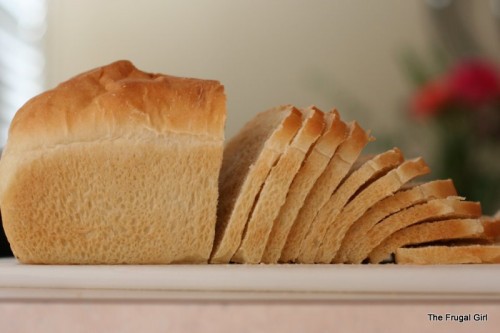
Just so you know, I don't actually normally slice my bread like I did in that picture. That evening, I was using the bread to make sandwiches for dinner and these particular sandwiches require three slices of bread each. So, in that case, thin slices were definitely in order.
Generally speaking, though, I like to cut nice, generous slices of my homemade bread, because we tend to eat it open-faced and not as a real sandwich.
But!
You all wanted to know how to cut thin slices, so that's what I'll talk about.
In order to properly slice bread, there are two things you need: a good bread knife, and proper slicing technique.
The Knife
If you are going to be slicing homemade bread with any regularity, you really, really need to obtain a good bread knife. A dull knife with shallow serrations (or worse, with none!), is just not going to cut it. (ha ha ha.) Ahem.
Here's the knife that I use.
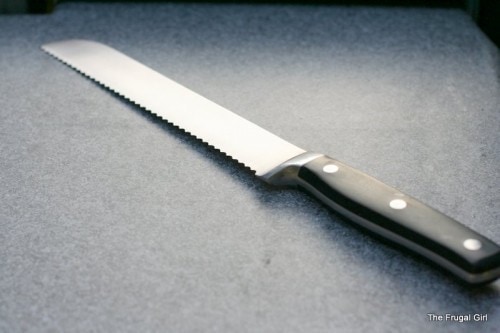
See the lovely, deep serrations? They're really, really important. Do not skimp and buy a knife with chintzy shallow serrations.
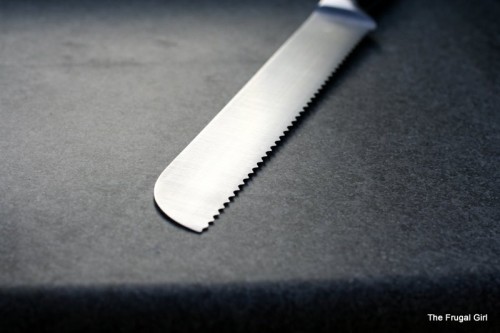
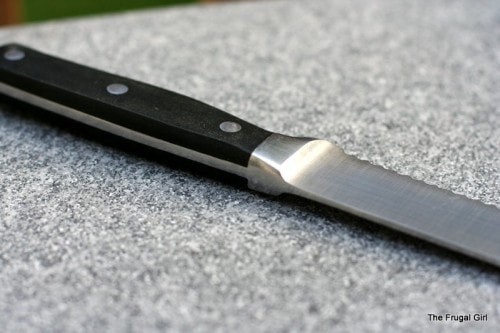
Most of you probably know this already, but a good knife has a blade that runs all the way down into the handle. Cheaper knives have a shorter blade that extends only partway into the handle and thus are not as sturdy. This is just an aside, though...the serrations are what REALLY matter.
If you don't want to fork over a fistful of cash for a bread knife, though, Cook's Illustrated has ranked the Victorinox Bread Knife a best buy, and it will only set you back about $30.
If you've been struggling to cut your homemade bread with an inferior knife, that will be a well-spent $30. Trust me.
Technique
Now, about technique. When you slice bread, you should use very little downward pressure. Instead, focus your energy on sawing lightly back and forth.
If your knife is sharp, serrated, and of a decent weight, it should make its way down through your loaf with almost nothing but a back and forth motion from you.
The only time you'll want to push down with much energy is when you're almost through the loaf, as the bottom crust tends to be slightly tougher to slice.
Since homemade bread tends to be soft, exerting a lot of downward pressure will just squish the bread instead of cutting it.
Speaking of soft bread, do not try to get thin slices from a loaf of hot or warm bread. It's always especially prone to being squashed when it's warm and fresh, so if you want sandwich-worthy slices, be patient and wait until your bread is thoroughly cooled.
Troubleshooting
If you have a good knife, you're using the proper slicing technique and you're still having trouble turning out respectable slices, the problem might be with the bread itself.
Remember that in my post about gluten, I mentioned that this protein provides structure for your bread. Breads with little gluten will be prone to crumbling, and bread with a lot of gluten will be more bouncy and resilient.
If you have not developed the gluten in your bread properly (this is done by mixing and kneading), your bread will not be strong enough to hold itself together when cut into thin slices.
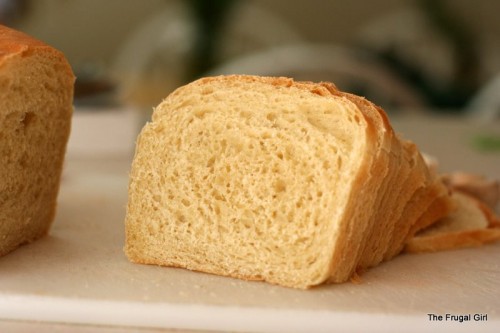
In case you'd like to see what the inside of the sandwich bread should look like, here's a picture.
I should probably add that slicing homemade bread takes some practice, just like making bread does, so don't despair if you can't manage to turn out perfectly thin slices right away.
Hopefully that answers your questions! However, if I missed something or if you're having a bread/slicing problem that I didn't address here, ask away, and I'll try to help.
i have that knife! it's great. but it's really really hard to wait for the bread to completely cool before slicing and eating it (says she who mangled a loaf of bread this morning because she just couldn't wait to have the end - the best part - slathered in butter). 🙂
lol! I certainly have done that a good number of times myself. I'm not sure there's any greater culinary pleasure than a fresh slice of bread with real butter on it.
I like to top mine with butter and honey!
Great post! I've been meaning to get a 'real' bread knife.
I need a real bread knife. BTW, how do you store your bread?
I store mine in plastic bags...I just shake them out and reuse them until they eventually get a hole.
thank you so much! i actually have a bread knife but didn't realize i should saw slowly and carefully without squishing down too much. i'll hafta give this a try.
Yeah the primary for slicing bread should be back and forth instead of downward pressure. Obviously you will need a slight amount of downward pressure but it should be slight. Focus on using the whole length of the blade and you will see that doing that almost automatically pulls you into the sawing motion instead of trying to chop straight down through your bread.
A real bread knife does make a world of difference! We love our Warther's bread knife. My husband even takes it to work when they have a big morning meeting and he needs to cut bakery. Thanks for sharing!
A hot knife helps to cut hot bread, I'm told. I tend to rip it and eat it, myself.
I have the Victorinox knife also, from Amazon . Really great knife.
I will give another tip, though; as a sometime-caterer to whom perfect slices are a necessity: use an electric knife. You can get THIN slices with no effort, no crumbling or squishing, even when warm. I go ahead and slice the whole loaf lickety-split before freezing.
What knife have you shown above?
I honestly don't know what brand it is! There are no markings on it, unfortunately. But if you look for a knife with deep serrations and with a blade that extends into the handle, you should be good to go. Maybe try the Victorinox one I linked to in the post?
Any thoughts on bread machines? I use one, it takes maybe 5 minutes to assemble the ingredients, throw them in and turn it on. Then it does it's thing - mixes, rises, mixes, rises, cooks or whatever and about 2 1/2hours later it beeps to tell me my bread is ready! I don't even have to wash it! Bread comes out hot and smelling delicious. Sometimes I have that first warm slice with butter -usually! Sometimes I put on some jam (home-made fig jam anyone? With figs from my garden!) and sometimes some blue cheese. Hey variety is the spice of life.:)
I think bread machines can be really useful, especially for smaller households. But for the six of us, one loaf at a time is sort of inconvenient!
Sometimes it helps to lay the loaf on it's side for slicing.
I see that widely spaced serrations provide cleaner cuts. This is applicable to both pointed serrations and wavy grooves.
I bought 2 electric slicing knives for $4.00 each at Goodwill. I bought 2 in case 1 failed quickly. Had both for some time, still working. I know the "real" chefs look down their noses at electric knives, but I love mine. Also very useful as 1 tool in turkey carving, and making thin slices of other roasts. Always slice bread from the side, due to the gluten structure created in rising bread.
Hello Kristen. I have a challenge that is shared by a few bakers. I am left handed and serrated knives are "right handed'. They are designed to cut from the serrated side and lefties apply pressure no matter how lightly from the wrong side. That makes very irregular slices. Is there such a thing as a left handed serrated knife or another suggestion? I live in Toronto and need a Canadian source.
Ooh man, this sounds like a question for King Arthur! https://www.kingarthurbaking.com/bakers-hotline
I'm left-handed, but oddly, I use my right hand for knives.
Some really great tips in your article. How do you keep the slices the same thickness top to bottom? Usually mine come out thin on top & thicker on bottom or vice versa but rarely the same even, thickness.
For me, that's just been a matter of practice. And even after lots of practice, my slices are not always perfectly even.