
Is $1000 enough for an emergency fund?
When I posted about our almost-$1000.00 septic pump repair bill, I wrote that I was so grateful to have money put away for such situations, and in the comments on that post, we started talking about emergency funds.
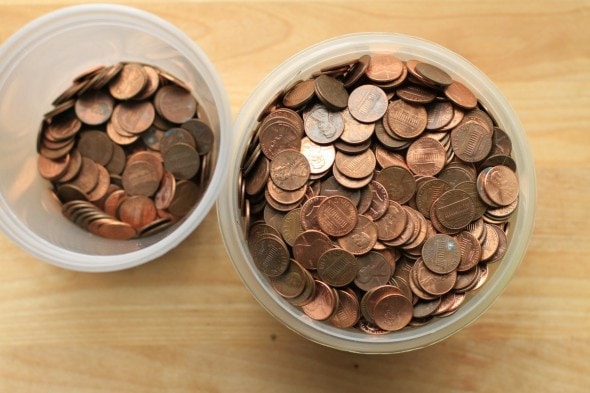
Many personal finance gurus suggest saving up a $1000 emergency fund, and some of you were wondering if that's enough.
(I am not a personal finance guru, so take what I'm going to say with a grain of salt!)
Although I think $1000 is a marvelous place to start, especially if you're in a situation where you're trying to pay off large debts, I would personally not be comfortable with a cushion that small, especially as a homeowner.
I say this based on personal experience because in the two homes we have not rented, the heat pump has gone up.
(We have very unfortunate luck with heat pumps, apparently.)
If you've ever gone through that, you know that a dead heat pump is a pretty darn pricey "unexpected" expense.
And a $1000 emergency fund doesn't come close to covering it. Even the heat pump for our townhouse cost us over $3000.
Thankfully, despite our not-so-high-income, we'd managed to sock away a little over $3,000 in our savings account and so we weathered that expense without incurring any debt.
So, how much do I think is enough for an emergency fund?
Well, 3-6 months of expenses is pretty ideal to me, but if you can't do that, I think getting as close as possible is wise.
(Note that I'm talking about 3-6 months of expenses, not 3-6 months of income. I calculated ours by adding up the bare minimum we'd need to spend to get by if we suddenly lost all of our income.)
Our goal has always been to get 3-6 months of living expenses in the bank, but during Mr. FG's warehousing days, we never quite managed to get there. We did always manage to save something, though, and while it wouldn't have been enough to sustain us through 6 months of unemployment, it was enough to keep us from having to use any form of debt to pay for expenses that popped up.
So, I guess my recommendation is to do your best to get to that 3-6 month level, but realize that any emergency fund is better than none and don't give up if you can't seem to get to the 3-6 month spot.
On that note: I have a whole post rattling around in my head about this, but for now I'll just say that if you haven't got a lot of money to work with, don't beat yourself up about not being able to put a $10,000 emergency fund away. Just do the best you can with what you've got, and know that small amounts of saving do add up and they do make a difference. Mr. FG and I managed to save up several thousand dollars when we were living on $35,000 and it all came in little bits and pieces.
__________________
I'm curious to hear your thoughts on this...how much do you think is enough for an emergency fund?
I think that's why Dave says that you shouldn't buy a house until you're out of debt. If you don't own a house, most emergencies can be covered by $1,000. Of course, if you already own a house and have debt, it doesn't help to know what you SHOULD have done. 🙂 So maybe save up $2,500 -$3,000 if you own a house, and THEN start attacking your debt. Love your blog!
That's a good way of looking at it...save up enough for a heat pump and then pay off the debt.
But a lot of people already own homes when they start his plan and he doesn't change the recommendation for them, you know? This is one problem I have with DR's plan - I just think that $1000 number is really out of date! Even as renters, we frequently experienced pricey car problems (not maintenance issues, I'm talking things like the transmission giving out on the highway, costing $1800 to replace). And as homeowners, we've experienced several $2,000 - $4,000 emergencies (furnace goes out, retaining wall slides into the ravine, etc etc). The problem is that if you've been throwing all the money at your debt and only leaving $1,000 to deal with emergencies, you are left without a lot of choices in those situations and may end up making a short-term decision that doesn't help you in the long run (like patching up a home problem with a "band-aid" solution instead of investing in a good replacement or professional fix, for example, or having to borrow money from parents or use a credit card because you blew through it.)
We are in debt-paying-off mode but we will be here for at least 2 more years and I am totally uncomfortable with the idea of having less than $3,000 set aside for any extended period of time. $5,000 feels better to me. And then of course, when the debt's paid off, 6 months of expenses would be ideal.
I do understand DR (and other financial guru's) reasoning behind the $1000 number - MOST people don't even have that much saved, so it's a step in the right direction, and keeping yourself on the edge a little can be a motivator to get your debt wiped out. But I think you have to know yourself. I am not particularly motivated by financial stress and my husband finds it completely paralyzing. Plus, we have five kids, two who are teens, and I'm finding that the odds for expensive emergencies just keep going up.
Yeah...it just takes, so, so little to wipe out $1000. Which is discouraging, to be sure, considering how hard it is to save up $1000.
But I think once you have that first thousand saved, it's good to keep pressing on until you've got a better nest egg going.
"not maintenance issues, I’m talking things like the transmission giving out on the highway, costing $1800 to replace"
I'd like to use this an example of a "Life Happens" event? It's perfect - while you can't predict exactly what the car problem will be or when it'll happen, it is exactly the sort of thing you just know will happen eventually.
As to your other point - I agree, $1000 is a starting point, a baby step, something ambitious enough to be worth aiming for, but reasonable enough to not to be discouraging. Because if you told someone tens of thousands of dollars in debt that they should save $18,000, their reaction would likely be "What the heck are you smoking?!?"
So interesting that this topic came up. My niece will be getting married in April--she and her new husband will want to purchase a home soon after the wedding and she asked the same question about how much they should allocate for emergencies. Without even thinking about it, I recommended $5000 because, like Meagan, we have had sudden expenses come up and have needed that cushion. My niece is at the point in life when it is easier to save up that kind of money--it would be SO nice if all young people (maybe high school or early college age?) were required to take a real-life course in money management but I suppose even then many wouldn't follow the guidelines. The allure of a paycheck is too strong.
How do you receive $22 back from purchasing Frozen using TopCashBack?
If you buy it through the link I posted (you'll be prompted to create an account), the cash back will arrive right in your TopCashBack account.
the link isn't working for me
I'd love to take advantage of this "Frozen" deal but the link isn't working for me either. Any help would be appreciated!
I just tried fixing it...can you give it a try now to see if it works?
I also just tried your link for the "Frozen" deal. The only online deal I saw was for Gain dryer sheets.
That was over on Friday or Saturday, I believe. So sorry you missed it!
Yes, Dave Ramsey says save up $1000 only while you're paying off debt which on average takes no more than 18-24 months and then save your 3-6 month expenses emergency fund. Some people like to save up a little more first, though. (My husband has facilitated many Financial Peace classes.) Thanks for bringing it up in your blog, I know many people whose lives have been changed by having that 3-6 month emergency fund!
I agree that $1,000 is not enough. We don't own a home yet, but we do have 40% of our monthly income as variable income from my freelance worker. In the case of variable income, a bigger emergency fund is also essential.
Right now we have about a one month cushion, and we'd like to build it up to at least a two month cushion by the end of the year, but it's slow going. 🙂
I think if you can do it 3-6 months is a good start - Suze Orman recommends a 3 month "stockpile" where you can cover all of your bills/expenses should anything happen. When I bought my house 6 years ago, EVERYTHING started breaking (don't you just love how that happens?) - big ticket items like the oil tank, furnace, sewer pipe - I practically cried every day. Luckily I had a nice cushion I had saved prior to purchasing and my parents helped me out, too. If I didn't have that, I'd probably be sitting in bankruptcy right now eating Ramen noodles for every meal. Saving is hard, especially when you see something on the rack that you've convinced yourself you just HAVE to have but, I'd rather go without a new purse than not have an emergency fund.
I use Capital One 360 also and I love the automatic spending plan. It deducts $ from my checking biweekly so I'm saving without even realizing.
I've been watching the Suze Orman show for years and have several of her books. She says it used to be that 3-6 months worth of expenses saved as an emergency fund was enough, but since the crash of '08, she recommends 8 months, minimum. On her segment "can I afford it", she routinely denies peeps if they don't have that 8 months, or if the thing they want to buy would bring them below the 8 months. Her advice on saving it is the same as Kristen's - start today, little by little, trend upward.
I definitely think that $1k is just not enough. Aside from house or car emergencies, a health emergency can eat that up in a blink.
Ditto on Suze Orman recommending a minimum of an 8 month emergency fund. The housing downturn/financial crisis made her re-evaluate her stance on a number of issues. Up until the housing bubble burst, she preached that mortgage debt was a fantastic way for people to leverage themselves. She spoke of leverage as if there was no downside. Now, she realizes that she was wrong and has a much more conservative stance on home-buying.
Hi Kristen- I'm new to the site and it's wonderful. To answer your question...heavens NO! $1,000 is so not enough. Over the past several years, my husband has earned in excess of 6-figures. We always lived below our means (ie I drive a paid for 10 year old vehicle) and I'm really frugal. We carried NO debt. However, with 3 teenagers there are always expenses. My husband was downsized out of a job last year. We have lived out of savings for 8 months while incurring no debt. Thank the Lord that he goes back to "real" work on Monday (the savings wasn't going to last forever). 3-6 months of expenses is a great place to start, but sometimes not enough these days. We have learned that there is no such thing as job security, age discrimination is alive and well (although they will never admit to it), and God is good and faithful. It's crazy to not live below your means these days, no matter how much or little you make. It is also good to have numerous streams of income (as you pointed out in another article). We both got small retail jobs, my husband and son started a lawn business, and the husband also started tutoring college students in Accounting. He plans on keeping all these going on the evenings and weekends even after starting the "real" job. There are some great websites to help get started (ie Thumbtack and Wyzant). One never knows. Thanks and God bless.
Oh, I'm so glad to hear that your husband is back at work. Yay!
Good for you for making it through this period of unemployment without racking up any debt.
I dont' think $1000 is enough but DR calls it a starter emergency fund and it does help with the smaller emergencies - but a lot of stuff shouldn't be an emergency but a planned event. and a lot of these things caught me at once - brakes, tires, vet bill(older dog so I should have expected) along with other emergencies like power steering going out (car was only a few years old and should have planned for tires but didn't plan for power steering as that's never gone out in any vehicle I've owned except this one...) and another year I had the a/c go out (the outside part) then about 4 yrs later the inside part went out and in the winter the furnace needed a repair...
since it's just me and I'm the only source of income for myself I want a year's emergency fund for my own piece of mind. I consider 6 months of it 'don't touch unless major' and the other I want to replace as I can
I'm a saver by nature so I've never gotten to the point of having enough in a savings account. But I do aim for us to have six months of expenses (we run a small business, so our income in variable) plus the cash for our next car.
This may sound weird, but I have two emergency funds. The first is a true emergency fund; I keep somewhere between $1-3000 in it at a time. It's for unexpected things like a plane ticket when my grandmother died, the time I actually needed all four new tires and not the 2 that I had budgeted for, medical expenses I didn't plan for, that sort of thing. The other is my "if I lose my job" fund. I calculated what I would need for 6 months of living expenses living the way I currently do, and then saved up that much (took me about 2 years). I know that I can cut a lot of expenses and stretch that money out to 8 or 9 months if things get really bad. That money sits in my CapitalOne 360 account (which I love too!) collecting interest, never getting touched.
Not weird at all to me. But I'm the same person who, as a kid, had my 3 banks my mom set up for me (tithing, savings, spending) and decided I needed an emergency fund as well ... for all those emergency financial situations that come up for 8-year-olds??? 🙂
No, $1000 is definitely not a sufficient emergency fund. I love finances, and honestly don't know a single financial guru who states that $1000 EF is sufficient (other than to get things started). I think 3-6 months of expenses is the most popular figure given. So glad you brought the subject up, though. Many people balk at the idea of saving amount of money, but imagine how solid we could be as a country if people took it seriously? =)
As a twenty-something reader, I can attest that saving is hard on a modest income. However, it feels great to have an unexpected expenses account (car/home repairs), a "true" emergency fund of 6 months living expenses, and no debt. I just finished my PhD and my husband is a nurse so it definitely took living below our means to get there. With our first baby on the way and possible relocation on the horizon, having that money there adds a lot of security. For selfish reasons, I'd be interested in a post on how you saved money when your kids where babies. It seems baby costs can get out of control in a hurry. My husband and I keep reminding ourselves that babies really, truly need little more than food, clothing, and love in their 1st year.
Good for you for having an emergency fund. Your comment about having a baby caught my eye--we went from 2 full-time incomes for 2 adults (my income was by far higher than my husband's) to 1 full-time income (my husband's) and I worked every other Saturday to keep up my professional skills, so I understand the anxiety about money. I found that people want to be so helpful when you start your family--we bought several items second-hand (crib, pack-n-play, high chair) and between baby showers and hand-me-downs, we were well supplied. I would suggest that, as much as possible, choose baby gear and nursery colors that are not gender specific so you can continue using the same items as your family grows. My kids outgrew their 0-3 month clothing REALLY quickly--you can't control what you receive as gifts, but I would minimize buying in smaller sizes. Breast-feeding of course is cheaper (but not always possible!) ... the next biggest expense was diapers. I would research info on that now, as well as making your own baby food, as those are areas in which you will notice the greatest amount of expenditures. And garage sale/resale baby toys are just fine--baby doesn't know the difference--just make sure there are no small parts or other dangers. I would put the money into a good crib mattress (avoid SIDS!) but you may be able to skip the high chair if you get a booster seat with a detachable tray. Chances are, you have friends who are a little ahead of you with their child-rearing--if they are like me, they will be happy to unload their baby treasures on you because they will need to make room for items for older children. What an exciting time for you. I wish you well.
I totally agree that $1,000 emergency is not enough with your own home. Saving as much as you can in the event you are truly struggling to save 3 to 6 months' worth of expenses is far better than having nothing at all. I grew up pretty frugal but once I had a taste of a fuller wallet, I became more extravagant. Once the economy started tanking and my income decreased, we had a heck of a time curbing the spending. Thank you for what you do, we are slowing getting back on track! 🙂
We are Dave Ramsey fans, and $1000 isn't enough. Ideally, we keep a 1 year fund.
If you own a vehicle or a home, $1000 may not even begin to cover a repair.
If you have a family, that won't even begin to cover deductibles should the family be injured or sick.
But, its a good start.
Since not everyone's situation is the same- there isn't one amount that is right. I see 2 sides.
Since statistics say that most of us wouldn't be able to come up with $1000 in short order for an emergency, I think that if you are starting from nothing $1000 can be a very hard goal to accomplish. Since it will keep you out of most trouble and change your habits, it can be acceptable for a short term starter plan. I also think it is a confidence booster, and once that first goal is accomplished hopefully you can have courage to start paying off debt more aggressively. You of course can't just assume since you have $1000 you don't need to be doing anything else. You will need to use it at sometime, then you will need to replace it 🙂
So what if you do have money sitting there? But you still have debt? It can be a leap of faith to use your savings for debt. $1000 probably isn't going to be enough for you to be comfortable. We are are a 1 income family, and it is commission based, and some months don't pay the bills. Most do, and more than make up for the sparse months. When we went into the DR plan last year, we had a 4 month cushion but were paying on student loan debt. We dropped our savings to a 1 month cushion so we could cover the sparse months (and could cover our home and auto deductible), then started paying off loans. The way we looked at is is -we can for sure owe someone money, or we can pay off what we can and take the chance that we may have to owe someone later. It paid off! Loans are paid off, and we are back to 6 months of expenses in the bank. We are on track to pay cash for a vehicle hopefully by the end of the year.
Sorry- I meant to comment on the story in general- not reply! 🙂
$1000 is a good start and better than nothing. We had six months expenses set aside and they are gone now due to medical expenses but have stayed debt free. I am not expected to ever go back to work and we are working on rebuilding our cushion one dollar at a a time. We have about one months expenses now which is better than six months ago- the time we were living paycheck to paycheck was scary.
I have so often heard that a good amount to have in an emergency fund is 3-6 months of living expenses as well as many others have mentioned here. I'm sure it sounds overwhelming to some, but it's never too late to get started!
I am thankful that my husband and I were both taught all our lives that saving money is so important!
Looking at the photos you posted, of the coins, reminds me of when we recently rolled the loose coins from our "chicken money" jar. It was amazing how quickly it added up! What looked like so little, amounted to way more than we'd ever thought!
Maybe a start but nowhere near enough. Just my humble opinion. Am I at the point where we have enough in the EF? Nope, not close but working on it.
Five years ago, in the space of a few months, my dog needed emergency surgery which cost over a thousand dollars. The car needed hundreds of dollars worth of repairs, my father in law had unexpected heart surgery and we drove out of state to be with him. Plus a few other minor emergencies happened!L
On top of that, our roof collapsed. By now the emergency fund was depleted. This was in2009, in the midst of the recession. I live in Florida, and the equity in my house dropped in half. I could not get a home equity loan. I was able to take the 18,000 out of a mutual fund, but it was 30,000 of shares I had bought.
Our financial adviser (who is free through hubby's work) tells us our emergency fund needs to be where we think it needs to be and then add a thousand. He says add up everything you may think you need to buy as an emergency, new tires, new furnace, hospital charges, etc. Then add 1000. He says it's impossible to actually know your number but it is possible to constantly be thinking about those things. He advises that's it's more important to set up a budget for your debt then to constantly be worrying about paying it off. When you get a raise or extra money, then you start thinking about extra. So when we save 10 bucks from using less electricity, it doesn't go to the student loan bills, it goes to savings. However, when my husband got a 4% raise this year, 2% more went to loans and 2% went to savings. The DR plan is out of date like someone mentioned above.
I was going to comment this exact thing. We figured out our "baby" EF by considering insurance deductibles, ER visit, and/or Vet trip. We figure that $5000 was about the right amount. The once we paid off all debt we moved to 6 months of expenses. Now that my hubs is laid off we are glad to have it, but fortunately it is not necessary at this time. Because we paid off all of the debt our expenses are almost half of what they were and my income can cover it. So we were very lucky. Since we are down to one income I use the "extra" money into savings approach. If I budget $95 for our energy costs and its only $85 the $10 goes into savings.
When facing the decision of buying a house and having our 1st child, we saught the help of a financial advisor ... a profesisonal. His advice to us was to not purchase a home unless after doing so we'd have between 3-6 months of EXPENSES saved up. He said ideally we should have 6-12. We have continued to ensure that we have at least 3-6 months of liquid assets under our belt in case of emergencies. We are a dual income household and hopefull neighter of us are faced with an unexpected job loss ... let alone us both at the same time. But I thought I'd share this advice from a pro which agrees with your post.
Just a general addition to this discussion - I don't personally know any financial gurus who say $1000 is enough for a lifelong EF, but just a "getting started while you get out of debt" EF. I still don't think it's nearly enough but it's definitely better than nothing, and seems like a manageable number to shoot for when you're saving up slowly.
I was wondering the same thing. I don't know any that recommend only $1000 either (other than as a stepping stone), so I was wondering who they were.
On my own experience, $1,000 is not enough as emergency fund, though it will help just in case something happens. Few finance gurus suggest to save at least 6 months of your expenses to make sure you're covered if bad things happen like lay-off or can't work due to accidents,sickness,etc.For many, it's hard to save that kind of money for some valid or stupid reasons. We're in debt and taking one step at a time to get there.Hopefully!
I think the right size for an emergency fund depends on several factors.
1) Most importantly, it depends on what you are calling an emergency. Car repairs and house repairs are predictable and recurring expenses. They are non-regular, but since you know that eventually you are going to have to fix your car and your house, ideally you should be budgeting for that. I think this is the biggest thing that screws people up with budgeting, not setting aside money for non-regular but recurring expenses.
2) If you have debt, is the debt at 20% interest? Or 5%? If you have a lot of high interest debt, I would treat that as the emergency and start with a $1000 emergency fund. If your debt is at a lower interest rate, you might want a larger emergency fund before you start paying down the debt.
3) If you are single or a couple with two incomes and no kids, $1000 is probably fine. If you have a family relying on one income, and/or your job is precarious, a bigger emergency fund is probably necessary.
That's a good point, Tarynkay, that a lot of what we register as "emergencies" are actually expenses that could/should have been budgeted for. Again I think sometimes it's understanding yourself and your tendencies. To me it just complicates things to have a bunch of different sinking funds that I might or might not need to use, especially when I'm not sure how much I might need to use them (is this the year I get by with nothing but a tire rotation, or is this the year the brakes give out?) Unless you have, say, a 20-year maintenance record to go by and average out, it's still a lot of guesswork (and not even really then, since there are always surprises.) At some point it starts to feel like you're just moving money around to avoid calling it "savings" or "emergency fund" when really, that's how it might wind up functioning anyway. I'd rather have a bigger pot, and just make it clear to myself what it's FOR (unexpected repairs, medical bills, etc) and what it's NOT (vacations, a new sofa, etc.)
Statistically, people spend about 20% more on purchases when they use credit cards as opposed to cash. This seemed rather academic to me until my husband decided we should stop using credit cards. We had been very responsible with our use -- paying off the balance each month. In addition, we had not other debt (the last of our debt, our mortgage, had just been paid off). I was a bit reluctant (the cash back rewards were appealing to me), but agreed to see what would happen if we did. In the end, I love it!! No credit card bill to figure out how to pay each month. The bigger factor, however, is that we do have more available cash in our bank account each month -- the result of spending less.
What does all this have to do with saving? For those who are serious about saving for an emergency fund ($1000 is a good start, but eventually needs to be in the 3-6 months of expenses range for real financial security), one means of having more available cash each month might be to stop using credit cards and instead use cash. Total purchases are likely to go down and the difference can be transferred to the emergency savings account.
You have got to be kidding, a $1,000 emergency fund if you are a homeowner? A couple of months ago both of the sump pumps in our basement went up. There was no damage but it cost $600 to get them replaced.
Then our furnace went up. It was only almost 6 years old, and had a 5 year warranty! Replacement cost was $16,000. I did manage to negotiate that down to $9,000. But that goes to show that even in a house that is only 6 years old you need a substantial emergency fund.
Add to that a transmission that went up and had to be replaced last year - that went up too after 7 months - it had a 6 month warranty! (How do these manufacturers manage to time their warranties so accurately? 🙂 )
David asked how they time their warranties so accurately? The math is actually pretty easy. Some college stats classes use that as an exercise. You start with a largish set of maintenance data (even for new products these can be extrapolated from older models) and costs for each. Then apply introductory calculus to find the tipping point. Use that point or maybe add a month and presto! You have your cost-efficient warranty period.
Which is why some people use the length of the warranty period to judge the quality of the product.
For my husband and myself, we think of our emergency savings in two categories. 1) home/car/medical emergencies and 2) loss of income.
For home/car/medical emergencies our goal is to have $3500 in very liquid assets (savings account/CDs). Our experience has been that just as the car needs a major repair, we also have a major home repair necessary, and an unexpected medical situation.
For loss of income, we believe 9-12 months of expenses fits us best. We're slightly older, and at this stage in life, landing a new job at our current income level takes longer than when we were in our 20s and 30s, and looking for entry level positions.
$1000?! I get anxious if we get below $10k! I think that amount works for us as we'd be able to buy a used car if one of ours broke down (as ours are prone to do). $1000 wouldn't even cover emergency vet bills. However, we are fortunate to have no debt other than our house and try to live as meagerly as possible to keep that account growing. Ideally, I'd like to have $20k at all times, even after buying a house.
I think an emergency fund should be the price of replacing your car without going into debt to do it - that's a wide range depending on what kind of car you drive. For my family, we drive small, used cars so it would be 10 to 15 thousand for us. Even though we paid off our mortgage when our son was 6 yrs old & we were in our mid30's & we paid off the rest of our debt just a few yrs later - we didn't have that much ready cash until yrs later. And it fluctuates depending on what we're doing. If we plan for a big expense we save the amount we need plus at least $5000, then start building up again.
Because we're mortgage/debt free our living expenses are much, much lower & that amount would last us a long time.
I agree that every situation is different and $1000 is certainly not enough, but a starting point. In my case, there was a point in time where I had a nice cushy emergency fund. For various reasons, that emergency fund eventually evaporated and I've never been able to build it back up to a point where I feel comfortable. I'm a single mom to two and the sole provider. A few years ago I decided to go back to school to get my masters in nursing. I'm now a NP. I'm happy in my job but my income hasn't really gone up from when I was a staff nurse. And now I'm paying off student loan debt. My car is 15 yrs old and really needs to be replaced. It needs some repairs and the repairs will cost more than the car is worth. I still pay after school care costs and summer day care costs (summer costs are essentially equal to a second mortgage payment). Believe me, we live frugally. So, I contribute to my emergency fund as much as I can, seems an emergency pops up to wipe out my EF about once a year. Still, I'm fully convinced that things will settle eventually and I'll pay off my debt and build up my EF to where I'm comfortable again.
To be comfortable, our emergency fund has 6 months (and possibly up to 8 if we are really frugal) of living expenses. My husband has a secure job, so we questioned needing this much saved. Then federal employees went a month without pay this autumn. All of my husband's coworkers were panicking, and we didn't have to bat an eye because we had money to live off and could replenish our emergency fund when we were back paid. It was a real lesson in the importance of saving for a rainy day no matter how secure we think our life is.
That said, we have several other CapitalOne360 savings accounts inspired by your blog. Some are ones you've recommended like a Christmas account. Others are for predictable future expenses like clothing and car repairs. Others are to avoid future debt like our new car fund where we put a "car payment" every month.
$1000 is a great start for an emergency account, but it is nowhere near enough in the long term. In addition, I recommend saving for expenses that aren't true emergencies as part of monthly budgeting.
1296 in 2 years!!!
I think for newbees starting out with no savings $1000 is a good goal. But my husband and I try to have aleast 6 months of income saved. I know most here are saying expenses, but a few years back her lost his job. For 18 months it was my income only. The only debt we had was our home, but when he lost his job it was like every appliance, car etc relized it & broke down. At the time we only had about 2 months expenses $$$ saved & that went very quickly. I think for most people it should be what you are comfortable with.
A $1,000 is a good start but with the current job market, I wouldn't be comfortable with anything less than 6-9 months of expenses. Even still, I would consider having a few sinking funds.
This is unrelated to an emergency fund, but I'm not sure where else to put this question:
Kristen, I love your Food Waste Friday posts. I do really well with using up food weekly, but I'm at my wits' end with bips and bobs left in condiment bottles.... 2 tablespoons of Korean barbeque sauce, a half-cup of horseradish mustard, a wee bit of lime paste, a million other things. These little treats can really brighten up an otherwise boring dinner dish, but then there's the odd bit leftover. Any ideas?
As a single person I would be comfortable with a 6 to 8 month emergency fund. If I was part of a couple then 3 months would be fine unless we both worked for the same company. What are the chances we would both be unemployed at the same time?
I am aggressively trying to end debt so I only have a few hundred dollars set aside. I will start to increase that this summer when my HELOC is finally gone.
You mentioned Wolverine in Rockford MI as making shoes. I live close by and believe all are imported.
For a low cost sandal made in the USA try http://www.kinosandalfactory.com/
made in key west florida.
I like Marshalls for good quality name brands-it's better in the shoe department than TJMaxx. And as I said before the clearance rack at Macys 75% at end of season.
With regard to the Dave Ramsey's Babystep #1 being $1000...yes, mathematically that will probably not be enough. But those who follow Dave will know his plan is much more about behavior than about mathematics. For someone who has always lived paycheck to paycheck with huge amounts of debt, saving $1000 is a HUGE task, yet attainable. It is like someone who never works out to run around the block. No, not really fantastic in the grand scheme of things, but we've all got to start somewhere!
As far as a "big" emergency fund goes, I think the 3-6 month of expenses is reasonable. One reason: if someone would become disabled, that is usually the amount of time before disability insurance kicks in. Yes, sometimes that might not be enough, but if things got desperate a person would probably resort to other financial strategies - like finding part time jobs, selling stuff, moving in with family or liquidating other assets. I think it is impossible to plan for the "worst case scenario" but 3-6 months is reasonable. Also, this is the amount of cash reserves - certainly a person should also have investments also. Any more than this in cash and you're missing out on better returns and not keeping up with inflation.
When I first started paying off debt, I took DR's advice and saved up 1000 first. Is it enough in the grand scheme of things? No. it's a baby step but it contributed to a profound change in the way I view money. Having been a natural born spender living paycheck to paycheck, it was like magic the first few times something happened and I actually had money in the bank to cover it. Since then I have accumulated and spent savings as life has happened. Twice I have been caught without enough savings for car and home repairs but was able to pay the difference using 0% interest credit card offers. Since I had paid off previous credit card debt by then, I easily paid them off within the promotional period.
I just found your site. Wonderful tips and info.
A question I have, is why Capital one 360? I read a few reviews of it, that implied difficulty getting money out. ( most of which were recent deposits, I believe)
What are the benefits of C O 360, as opposed to a savings account?
Thank you for the info already presented, and for info yet to come!!
Also, back on topic, we have one month for emergencies, and are aggressively paying off debt. After debt paid off, will concentrate on 3 months as a goal, then on to 6 months. (Smaller goals work well for me)
Well, I actually like that it's a little difficult to get money out...you have to wait a few days for it to be transferred to your local checking account. That makes it less tempting to pull it out for unimportant things.
I also like that I can open a bunch of different accounts for all the different targeted saving goals/categories we have.
That is SO awesome that you guys are working on building up a good savings fund and that you're paying off debt. Keep up the good work!
we have 6 months emergency funds saved and its still not enuf!! i save lots of money just by staying home. my goal for the day is not 2 spend 1 penny. and it worx!
I know Dave Ramsey says it should be $1,000, but I disagree! I believe that your EF should be twice your largest insurance deductible. That way, should things go terribly wrong, you know you are covered. What is point of having a $1,000 EF when your home insurance deductible is $2,000 +? An insurance claim would leave you scrambling to come up with the extra for the deductible!
Ultimately, you save the best you can and leave the rest to God.
It really depends on the individual situation. In my opinion, a reserve fund that could cover 3 months of expenses should be the very minimum and should be viewed as a starting point. If you lose your job and only have $1,000 saved, you're in big trouble. If you have 3 months of savings, it may give you time to find a new job, but may still be insufficient.
If you're in a two-income household, 4-8 months of expenses is ideal because the loss of one income won't eliminate all of your cash inflows (depending on how lopsided each salary is). If you are single or the sole breadwinner, a minimum of 9-12 months of savings should be your goal.
If we have learned anything from the recent financial meltdown, a solid work history, diploma from a big name university, and great references don't make a person immune from extended periods of unemployment.
I'm late to reading all this! I agree $1000 isn't enough savings, but I think also Dave Ramsey, Suze Orman are out of touch with the income and necessities of American life. As are our political representatives...
$6000 is a typical health insurance out-of-pocket for example. So that needs to be accessible as well as the other savings.
I have found more and more the numbers simply don't add up to do everything we're supposed to for financial security, for example do I purchase health insurance or pension- it's not possible to do both any more!
I saved up $2000 before paying down debts. I am not a home owner, or a car owner. I just felt better about this. It's not a whole lot more, but it made me feel just a little bit safer. My expenses are really low too. My boyfriend's job is a little more unstable so I recommended 3.5k for him. He is currently building up his fund by saving $700 a month. My boyfriend is not a home owner and is an auto mechanic. lol