
Monday Q&A | The downsides of homeschooling
 Every Monday, I answer a few of the questions that my readers send me. If you have a question you'd like me to answer in a future Q&A post, just leave me a comment here or email me (thefrugalgirl [at] gmail [dot] com) and put Q&A in the subject line. I look forward to hearing from you!
In the past, I've shared a photographic peek into our homeschooling days and I've also shared why I homeschool my kids. And a while back, someone (I forget exactly who!) left a comment or wrote an email asking what I think are the downsides of homeschooling, since I've posted about what I view as its advantages.
So, I thought I'd talk about that for today's Q&A post.
First, I'd like to say that no educational method is perfect, and so the fact that I see any downsides to homeschooling doesn't mean I think homeschooling is terrible. It just means that I've looked at the advantages and disadvantages of all the educational options, and I think the disadvantages of homeschooling are better for our family than the disadvantages of the other methods.
That was an awkward sentence, but hopefully you get what I'm saying.
Homeschooling is a lot of work for the parents, and typically, most of that work falls on the mom (though there are certainly some dads who homeschool full-time while the mom works outside the home.)
Sometimes, people looking in from the outside think, "Oh, wow! That must be luxurious to be able to stay home all week. I'd get so much done if I was a homeschooling mom."
And I suppose that would be true were it not for the fact that homeschooling moms have to, um, homeschool. It would be awesome if I could spend my days getting caught up on stuff around here, but the fact is that school takes up a lot of the hours of my day.
While I am very convinced that homeschooling is the right choice for our family, I have no doubt that I'd have a lot more free time on my hands if I stayed home and sent them off to school.
And I will not lie...some days, homeschooling is really exhausting. But the advantages I see for my children keep me going when the going gets rough. It's not about me, it's not about me, it's not about me (so I remind myself!)
Homeschooling makes it a little hard to keep the house clean, because the heaviest mess-makers (the offspring) are home all.of.the.time. It's sort of like shoveling snow in a constant snowstorm.
Homeschooling can be difficult for introverts, like myself, because again, there are people around all the time (which means I have to build some alone time into my days). It can also be a little tough for extroverts, but extroverted homeschooling moms can often remedy that by being involved with a homeschooling community.
Homeschooling is a lot of responsibility. Of course, parents of traditionally schooled children still need to be very involved in their children's educations, but in a traditional school, you don't have to be responsible for quite as much.
Homeschooling isn't free. Of course, I do manage to do it pretty frugally, but it's still more than $0 per kid. And if you count the loss of income from one parent staying home, the cost is more significant.
Homeschooling requires a lot of patience and self-discipline. Not everyone is well-equipped for the task, which is part of the reason I do not believe that homeschooling is a good fit for every family.
People ask homeschoolers about socialization approximately 289.5 times per year. That's a joke, but seriously, people do question/criticize homeschooling because it's different. Even though there is plenty of evidence to the contrary, some people will still insist on thinking that homeschooling turns out social misfits who cannot get into college, succeed in college, play sports, get a job, or be active in their communities.
Homeschooling could be hard for families with one child. Since there are four kids in our home, no one is ever really lacking for a playmate or companion, my kids have to learn to relate to other kids every day, and it's kind of hard to be lonely. I could see where homeschool days with just one parent and one child could start to drag a bit, though, and I'd imagine that the parent of an only child would want to make a point of participating in a fair number of group activities.
Ok! That's not an exhaustive list, and someone who is opposed to homeschooling could probably come up with a longer list. 😉 But those are the main difficulties I see with homeschooling.
_____________________________
Agree? Disagree? Discuss!
______________________________
Joshua's 365 post: I am addicted to editing software.

Great list
I am also convinced that homeschooling is right for us, but there are days...
I have never regretted it, though.
I'm really interested that you said you're an introvert, and wondering how you dealt with that when your kids were younger and didn't understand you needed alone time. I'm definitely an introvert (and loving living alone!), and I don't know how I will handle having a family, sometime in the distant future.
Well, my saving grace has always been that little children need more sleep than adults do, so I've always had some down time when they were in bed (or when I just had two kids, when they both napped in the afternoon.)
I don't mind being around people for a lot of the day, it's just that I do better when I have a bit of alone time to recharge.
Yes, naps are paramount here, too. My 5 year old still naps at least 3 days a week, and my 3 year old takes a nap every day for a couple of hours. That time is precious and I's work everything else around it rather than disrupt those couple of hours in the afternoon. Everyone is happier for it.
I'm an introvert also, and I found it VERY difficult when my kids were younger. Some days I thought I could possibly go insane with all the chatter. I was very thankful for naps and early bedtimes, like Kristen said. Now that they're older, they tend to entertain themselves more, so I end with lots more quiet time.
Honestly, it takes a lot or work to be patient when you're an introvert, or it did for me.
Thanks everyone for your replies 🙂
Ahh the socialization question. My wife and I don't even have kids and we're already thinking homeschooling as an option and we get the socialization thing every stinking time! Ugh!
I am totally guilty of asking this (before I started reading this blog, eons ago at least!). I went to public school, and was very active in the sports teams. The great thing about our school district was that homeschooling families could sign up for the school's sports teams, too, by proving they were within the district. So we had a homeschooled boy on our team in middle school.... and he was exactly the type of unsocialized stereotype that people ask about. All it takes is knowing ONE person, and you have this notion in your head that all homeschooled children are like that. 🙁 I'm sure other people have had similar experiences...or heard similar stories. It's alot easier to believe the bad than the good! It's like..social gossip. It's awful 🙁
And it's so interesting that it happens like that because heaven knows there are some dorky, not-socially-skilled kids in public school, but no one thinks, "Wow, those public-schooled kids are so unsocialized!" based on one person or a couple of people.
I for one was one of those kids who didn't get a lot of socialization in. Heck, the only socialization I got until high school was constantly being picked on!
Isn't that the truth. My kids have had fun wearing these shirts they got for Christmas.
http://www.practicingfrugal.com/2012/12/happy-new-year-2013/
Because most people think of weird, unsocialized, denim dress wearing kids when they think of homeschooled kids.
I homeschool my 14 year old son. He's involved in several teams, judo, rugby as well as Scouts and Army cadets. People say 'I didn't know he's home educated! But he acts normal...' :-/
I don't think going to school means the child is automatically socialized. Remember there is a lot of bullying and other outside influences in public schools. I think if I would have been able to be homeschooled as a child I would have enjoyed it a lot more. I'm thinking about switching my kids to homeschooling because my daughter has trouble with bullying at school
I think your 289.5 estimate may be low 🙂
I always encourage people who question the social aspect of homeschooling that it is better for our children to learn to socialize from adults rather than from other children. I cannot expect someone with as little experience as my own children to be able to teach them how to exercise proper behavior in that situation. Learning to socialize from adults offers our children a more satisfying experience when interacting with other children.
As for the other downsides... Amen! God continues to remind/reteach me that this is a season in my life where my house may not be as clean and organized as I would like, but the rewards are great and ABSOLUTELY worth it. This time with our children in our home is short. What a blessing it is to spend each day with them, even it means dirty floors.
Loved this post! Thank you for sharing. I was home schooled through 8th grade (I was one of eight children), but I do not have any desire to homeschool my own three children. I know that homeschooling is not right for our military family living overseas. Thank you for emphasizing the fact that homeschooling is not the right answer for every family! 🙂
I was happy to see your list. I homeschooled years ago (kids are now 26 and 31). The socialization question was big then also. My experience was that my kids did better with all age groups (adults and kids) before they went to regular school (divorce forced this). Once they hit the regular school system all their interactions were with their own age group and they became less comfortable with adults and people outside their group. I also found out that they lost some of their ability to entertain themselves once they were in a situation that told them what to do every minute of the day. Beth
I think the socialization question is an interesting one, although I'm sure home schoolers get sick of he question just like young marrieds with "when will you have kids" and high school seniors with "what collages are you looking at" and stay at home moms with "how do you keep busy all day" . . .
Kristen, are you aware of any non biased research on the subject? Of course my teacher friends swear all home school kids are antisocial (although I am sure I would want to run screaming from a lot of classrooms today if I was new too!) and my home school friends say socialization is unnecessary. Logic tells me that as long as your kids talk to other adults and children on a regular basis they wouldn't benefit much more by being in a classroom of their peers. They might be a bit innocent if they are introduced to a middle school classroom, but that seems like a good thing. Sorry to ramble on--seems like an interesting research question and one that few educational researchers might have tackled in an unbiased way.
Here's information about a study done by NHERI. I'm not sure you'd count it as unbiased, but on the other hand, if it was funded by an agency that wasn't supportive of homeschooling, that wouldn't be particularly unbiased either.
Anecdotally, I know of so many homeschool graduates who are doing just fine in the real world...getting accepted into great colleges, doing well there, graduating, starting businesses, having families, and being involved in their communities. For example, on my side of the family, one guy owns his own government contracting business, one manages the east coast IT department for a worldwide restaurant, one manages a hotel for a nation hotel company, and one was a critical care nurse. And of course, I know my own story as a homeschool graduate, and I don't feel like I was at all socially stunted by the experience...I did well at college, made friends in my classes and at work, ran my own business for 20 years, I make friends in the neighborhood, and feel all around very normal. 🙂
And yes to what you said...when you homeschool, it's not as if your neighbors, church people, and extended family suddenly fall off the face of the earth. There are plenty of places you can be with other people besides school. And then of course there's the point that the point of school is to learn, not to socialize.
Homeschooling intrigues me. I like the idea, but it isn't something that is common in the UK (there are homeschoolers, but typically kids 'go' to school). Quite rightly every system has pros and cons - as with much else in life - there is no 'right' way to do anything, only 'your' way. The home-school posts at FG I devour, because they give me ideas on how to complement my children's state education. The only slight issue I have as a non-homeschooler is that after 6 hours of schooling, the interest can wane, and after all they need playtime. But I try and make it interesting. We did a hunt around the village on Saturday looking for numbers, words etc... which again I guess if you homeschool you could incorporate non-desk-sitting methods into how you teach. Oh and also I love the fact that homeschool Mom's are themselves learning. There is so much I have forgotten or didn't know in the first place. So much so we have started a "?" book here. Every question they ask me that I don't know the answer to (which is a lot!) we write in there and research together to find the answer. Keep the homeschool posts coming - purlease!
p.s I have never thought "Oh, wow! That must be luxurious to be able to stay home all week. I'd get so much done if I was a homeschooling mom." rather the contrary - how do you do it all?
We are in the UK and homeschooling. Look up HE-UK for more information. All the counties have groups you can contact for 'interested' visits. Homeschooling is growing by leaps and bounds here.
I'm single with no kids, so I have zero experience with homeschooling. I'm curious, though, do you or others who follow this blog, homeschool their children year-round? It seems so popular and beneficial in other countries and wondered if it would be easier to implement here in the US in a homeschool setting. (I do know there are many parents who do take every opportunity as a teaching moment for their kids regardless of the day and time - and I admire them for it!) Thoughts?
Most people I know go with the regular school year, but I have one friend who starts in Jan and finishes in the late fall/early winter and they have December off instead of summer.
Thanks for the reply. That's an interesting approach, having the break in the winter.
I don't do year round, simply because *I* really need a break once summer rolls around. Also, I like to have extra time to get out and do outdoor things that we can't do in the colder months...trying to do that stuff on top of school would be hard.
I can imagine that Moms/teachers would need a break as much as the kids! I'm sure you're still including your kids in those outdoor activities though, so teaching (though perhaps more informal) continues. Thanks for your response.
Yep! And we do a lot of library visiting and reading during the summer too.
I'm working on my summer list of things to read/listen to already. It's getting to be quite the list.
Once you get into 'home' schooling, you realise that there are a lot of fun and/or interesting things to do that promote learning through documentaries, books, magazines, trips to museums, historical and cultural sites, etc.
Last summer on the way to (and from) dropping my son off at a week's adventure camp for kids, we plotted different routes through historical ruins (castles, priories and abbeys) and stopped at a few other touristy stops (waterfalls, an animal farm, etc) and had fabulous adventures there and back exploring these. They were very long day trips each way, but we made tons of memories and learned loads!
You're making the most of all the opportunities that you have around you. Educational and fun for both you and your son. My Dad loved stopping at all of the historical sites along the way whenever we went on vacation (driving, of course). I always rolled my eyes, but I still remember those sites 30 years later.
We homeschool on our own schedule....we continue some subjects through the summer and then take most of our vacations when the public schools are in session. We do not take a Christmas break (other than the holiday itself) or spring break etc. but instead we take 2 - 3 days off for birthdays (February & October) and usually plan educational field trips/activities. We also take days off here and there when the weather is nice or some other activity is scheduled. This schedule allows for shorter breaks throughout the year and still have time for summer activities, gardening etc. My son has a hard time getting back into schoolwork if we take longer breaks.
That sounds like a great plan to me and it sounds like it's best for your son as well. Win-win!
We take frequent breaks throughout the year, so there is some schooling that goes on during the summer. It works out for us to do some school during the summer, because it gets so hot here. There are certain times of the day when it's just too hot to be outside, and schoolwork fills some of that time.
I've lived in places where it's too hot or too cold to do anything outside! It makes perfect sense that you'd study during those "extreme" times and then you enjoy the outdoors when the temps are more moderate.
We go year-round-ish ; )
We'd both get bored silly if we did no school in the summer - so we do school-lite in the summer, and thru the winter we follow a more rigorous course. We're free to take the occasional long weekend when we feel the need, or take a week off for a relative's wedding. When we travel we do less (formal) school, but usually have some school materials along for boring stretches in airplanes, airports & hotels. But we also let the destination serve as an informal school - learning about everything from language to history to geography to food.
When I travel, I always research the area for all of the things you mentioned. I've learned geography and culture far better as a traveler than I ever did as a student in school. I'd guess that your kids will be life-long learners as a result of these projects.
AMEN to everything you said!! I too am a homeschooling mom of four and I totally agree with everything you said. It makes me feel a little bit better hearing it come from someone else too!! Thanks!!!!!
I think the clean house is one of our biggest issues. Even though we straighten every afternoon before dinner and I am trying to get better about doing SOME cleaning every day, the house is always a work in progress. I think alot of that has to do with all the STUFF you need for homeschooling. Lots of extra books and activities that might not be around if your kids were in school all day. Plus the fact that the kids are there all day and are constantly getting things out to do.
The financial aspect is also a consideration for us. I have been working very part time since the children were born, but with the addition of a third child this last fall, we are trying to decide if we can still make it on essentially one income. This is a constant source of discussion lately.
Just like not every parent is cut out to home school, some kids just do better in non home school situations. It really depends. My sons are both autistic, my middle one needs one to one care every minute he is awake. They both thrive in our public schools, and their teachers and aids and therapists LOVE them! For them going to school is fun and it gives them definite boundaries for study and play time. Home is home, and school is school.
I also know that given my kids intense care requirements, if they were home all day every day I would not get anything done. NOTHING. Because they need constant supervision and care. It is exhausting and by having them go to school, I can do what I need to do here so that when they get home I can be the mom they need me to be.
I think that's very understandable...I can see how having autistic children home all day every day would make a person go completely nuts.
I found myself saying, "Yup, check, ditto, mm hmm, yes, double check," throughout that list.
A couple things I have to highlight would be that I don't think sending kids to school would be necessarily less expensive, depending on how fortitudinous the parents are when it comes to resisting cultural trends (fashion, electronics, extra-curriculars) their children may become caught up in (not necessarily bad things, but just things that make them want to be culturally relevant, but also things that can be expensive).
I'm also an introverted homeschooling mom who craves solitude. I could go all day without a soul "bothering" me. 🙂 So I have to work hard at finding some quiet time. It involves a lot of sacrifice on my part, in accepting and embracing all of time I spend with these 4 people I have home with me all the time. But I try to balance it out with some alone time, and I make sure to consciously turn ordinary times of relative quiet into productive "downtime". For instance, I take my oldest son to swimming a few evenings a week (husband stays home with the other three) and just sit by myself on the observation deck for an hour. I soak up this time like a sponge. I talk to the other moms sometimes too, but otherwise, I'm just there by myself. Occasionally, I take a few hours on a Saturday and go to a coffee shop to be alone and plan my week, pray and get focused.
And last but not least: I feel like the social issue is a non-issue, especially nowadays. There are so many resources for homeschool families. Town or private sports teams, homeschool co-ops, activity days, online classes. The parents just have to be aware of keeping balance so that their children can have plenty of social opportunities, and allow them to navigate real life situations with their help and guidance. I personally feel like this arrangement is preferable to the constant, day in, day out social onslaught many kids are in every single day, made worse by social networking and such.
That is my opinion, which may not be popular, but the older I've gotten, the more I've seen that homeschool kids should not be seen as "weird" and "unsocialized". They may often have much more individualistic and "different" than the masses, but I love that. Yes, help them become culturally relevant, but let them become their own individuals without pressure to conform.
I agree completely with all the elements of your list!
The whole question about socialization is usually brought up by people who really don't understand, and have no basis of information on, homeschooling at all. It was irritating to have to constantly inform people about our life, but I just took it as an opportunity to broaden their horizons.
I homeschooled all three of our kids through the 8th grade, then they went on to a small high school, and one to a major university, the other two will be going to a smaller university in the fall.
The one thing I will add to your list that I think has been difficult about homeschooling, is how it affects the mom (or primary teacher) right after homeschooling is finished. Having spent 22 years with children at home with me most days, that transition to it just being me at home was a sad one. I missed them dearly. I had to find ways to include small children in my life again.
Blogs posts like are precisely why you rock. You manage to be so objective, unassuming, humble,honest and SMART about it all. I work outside the home and send my kids to traditional school, but I SO appreciate your insight to homeschooling (and of course, all your awesome recipes!) and I think it's just awesome that it works for you SO well, but you recognize it doesn't work for everyone. Thanks for all you do, I truly appreciate it all.
I was homeschooled all the way and I think there's definitely downsides to it (as well as benefits):
1) a lot of homeschoolers really struggle with academic excellence. There are lots of studies that say they do fine, but my experience says that doesn't always translate into real life. They often do better than public school, but I definitely see disconnects from what they claim and what the result is. I'm not referring to anybody here! You seem to do very well with your children and it's wonderful to see. I just see some families struggle with this.
2) I think some families also have the idea that homeschooling is better, no matter how they do it, no matter what they do or don't cover, no matter what their kids learn or not, that the kids will get the best/godliest education possible. And I don't think that's true. Again, this is not indicative of most - it's just something I've seen.
I will likely homeschool for at least part of my son's education, so it definitely is a great thing! These are just things we're trying to avoid.
Yeah, I think it's foolish to look at any particular schooling method as a silver bullet. It's not like every kid who goes to public school turns out to be fabulously educated, and the same is true of homeschooling.
Parental involvement is definitely key, no matter the educational method.
"Parental involvement is definitely key, no matter the educational method."
Yes! I've been teaching for a few years now and this is always what it comes back to. The kids come come to class, do the work, and listen to me, but ultimately, the result is the same as the parental involvement before the class begun. If the parent is highly involved, the kid learns more. If the parent isn't, the kids learns so much less. The key isn't me the teacher (or the educational method), but the parent alone. It's always amazing exactly how true this is!
That is insightful. I agree with the academic thing. I did okay, but could have done better in my own homeschooling days (as a student). I look back and see that and try to be honest with the areas I am not terribly well equipped to help my children really excel in. My oldest is going into 7th grade next year and I'm going to be "farming out" a couple of subjects I think are important and that I lack the ability to be consistent and thorough with. That's the awesome thing, though. If families really want to continue homeschooling when things get out of the parents' league, there are so many options both locally (usually) and online.
Kristen makes this point so well, that educational methods are not a one size fits all thing.
Whitney -- you make some excellent points. Back when I was homeschooling, I knew families that dumped a subject if they did not see the value in it...which created problems down the road when their children did want to go to college. I also saw families committed to natural learning completely neglecting basic subjects. I doubt that my kids, even though they have ended up being writers as adults, would naturally have sought to learn grammar! I believe that the parent must know their limits, and seek help or support for subjects that are difficult for them. One of the goals of homeschool should be an excellent education, not just a natural one.
Your list is spot on. My husband and I think that the benefits of homeschooling far outweigh the challenges. For our children it is just the right choice.
An interesting side note, we seem to have a lot of homeschooling families in our area. In my son's religious education class alone 3 of the 15 kids are homeschooled. They all come from varied backgrounds with different approaches. I definitely think it helps living in a community where homeschooling is prevalent.
I am a non- homeschooling mom. I support homeschooling and believe that it is the absolutely right decision for some but the absolutely wrong decision for some. I am terribly guilty of asking the socialization question. I did a little introspection about what I really wanted to know when I asked that question rather than just regurgitating the buzz word of socialization. I am not exactly where I want to be in understanding how to discuss this topic but here goes:
Often in a school setting (public), kids get to experience other kids of various backgrounds. Kids get to experience theives, bullies, disadvantaged, over-indulged, crazy, special needs and so and and so forth. How do you keep your homeschoolers from being too niave about the world? They don't have to sit beside the kid whose parents kept him all night while they were having a drug party or the child who steals everything in sight because she is in her 2nd foster home or the kid who has every toy and gadget and makes fun of other kids. I hope that you can kinda see where I am coming from...
I asked that same question of my brother who put all 3 of his kids in private (church-affiliated) school. I felt they were too sheltered from the "real world."
I do understand what you're saying, and I'd just respond by saying that as long as a homeschooling family doesn't live in a bubble, it's quite likely that children will be exposed to this sort of thing.
For instance, at church, my children meet people (children and adults) who have special needs. At birthday parties, the girls have most definitely been exposed to some overindulged children who have every toy and gadget and who look down on people who don't. And in the neighborhoods where we've lived, they've played with children who haven't come from neat, tidy, and stable backgrounds.
Some people who homeschool do try to keep their kids in a sanitized bubble, and I don't think that's healthy, and that's definitely not what I'm trying to do.
I think the demographics of the areas that people live in will influence the different kinds of people the kids are exposed to, whether they're homeschooled or not. Some kids may go to school every day and still not see the kinds of things you're mentioning on a daily basis because of where they live. Does that mean they're overly sheltered just because their family lives in a certain area? Probably not.
I try very hard to keep balance in my homeschooled kids lives and through our lifestyle. They are exposed to the real world and real people here in our community even though we homeschool. And we're there to help them to process and navigate these things. We don't avoid potentially eye opening situations in order to keep them all safe and sheltered. I'm all for some level of sheltering (they are children, after all), but know they need an education in real life and real people as well. But I think a natural and gradual approach to this is wise, taking into consideration the child's personality.
I would say that I was sheltered a lot when I was homeschooled. It wasn't until I was in my 20s that I began to see how this world really is, and it wasn't pretty. It was somewhat difficult to cope with at first, but overall, it was an incredible opportunity for personal growth. So the sheltering wasn't a negative thing for me at all. Some innocence is a beautiful thing, really. I was very tender spirited and easily touched by injustice, so maybe it was prudent that my eyes were opened to these things gradually as I was more mature and able to process it all.
What I'm getting at is that I think it really has less to do with the educational situation and more to do with the parents, and even, to some extent the local demographic.
I was just coming back here to add the same thing, actually. A kid who lives in a multi-million dollar subdivision and attends a private school is likely going to be more sheltered than my homeschooled kids. So again, it's not homeschooling that's the issue so much as it is the particular family.
I think it's possible to achieve this exposure without committing to it for 6 or more hours a day. Many homeschooling groups have children from various backgrounds, and believe me, homeschooled children are far from perfect (mine included). I was a fat kid back when fat kids weren't the norm. I experienced a lot of bullying from other students, and even teachers on a daily basis. Now research shows that this sort of experience can lead to psychosocial damage into adulthood. Why subject my children to an environment which could potentially harm them when there's an alternative way that appeals to me?
I'm so sorry to hear that. My thoughts on the subject are similar to yours...by homeschooling, I can expose my kids to things that are different from our lives, but I know how much they can handle and I can judge when they've had enough. My hope right now is to give them tools and exposure, but not damage.
Of course, as they grow older and leave home, they'll be exposed to much more than they are now, but I'm confident that because they'll have been able to mature in an emotionally healthy environment, they'll be able to handle it just fine.
This is not to say that every kid who goes to public school will be emotionally damaged, of course! But some kids are just naturally targets for bullying and the like, and I think kids like that could benefit from being allowed to mature in a friendlier environment.
So would you make the same criticisms of a college-prep school, where there likely aren't any kids who are crazy, were kept up by a drug party or are dragged through foster homes?
Here's a different way of looking at it. As an adult, I don't tolerate people like that. I don't spend time with them, and I have very little experience dealing with them. Why would my child need a great deal of practice in this area?
When my niece went to college as a freshman, her first roommate was the total exact opposite in looks and actions of how my niece was raised. The roommate was goth, had multiple piercings, did drugs and drank alcohol, swore like a sailor, etc. In my opinion, my niece had been much too sheltered and had no tools to prepare her for dealing with this person. She was like a deer in the headlights. What was she supposed to say "oh, you're the person my Mom and Dad told me to not be like and to stay away from."???
For those who work outside the home, you may have a co-worker or even a boss who you wouldn't tolerate outside of work, but you may not have a choice short of finding another job.
My point is that our kids need to be prepared for the times when we encounter someone (especially long-term) with whom we would not choose to associate but must because of a situation that we cannot easily change.
I homeschool, and wouldn't trade it for anything! I'm also an introvert. My house is untidy (to say the least). I spend a lot of time and work homeschooling - but not more hours a day than my friends spend preparing kids for school, getting them there, and arranging tutoring to make up for what the schools didn't teach. I spend a little money- but less than my friends spend on school supplies for their public school kids.
But, as St. Paul says in a different context in Philippians 3:8 - I count them but rubbish - for what I gain by homeschooling. When I homeschool, I get to teach my child our Faith, I get to develop a strong relationship with my child, I can give her the best education available with one-on-one tutoring - and tailor it to her needs. I can teach her the social skills she needs -instead of throwing her into a social shark tank and praying she learns to survive it with no instruction in how to do so. Etc, etc, etc.
The benefits are so overwhelming that I don't even notice an untidy house.
(Did I mention that we get to sleep in and do school in our jammies ; )
I wish I didn't notice untidiness! You need to come teach me a lesson. 😉
The biggest downfall I see (I was schooled traditionally) is that you don't get world views from a number of different people. I found this very true in Jr. High and High school where you have many different teachers who will introduce many different perspectives. I didn't always agree with the different views but I did find that they forced me to question preconceived notions.
I find this thought interesting because I am a minority and it was in public school (k through 12) that I encountered the most ignorant people in my life (Including the teachers).Which is one of the major reasons I decided to homeschool my kids.
I am a devout Christian, but the very last thing I want is ignorant children. We've spent months studying other religions and cultures. When we meet people who are followers of different religions, my kids are able to have respectful and meaningful conversations with them. I taught my kids that the fastest way to dirty the name of Christ is by being a jerk.
I can tell you, none of that was taught to me in school.
Susan, I like that second to last sentence. I'm filing that one away as a lesson for myself and my family.
I'm planning ahead to have my children study different worldviews, philosophies, religions, listen to opposing arguments and form (and write ) their own in the process. There are online classes that help with these things. I'm planning on utilizing this. You're right that sometimes other teachers (besides mom or dad) and students (in a discussion setting) can challenge you in a different way.
I've said this twice before. But if there are any hangups to homeschooling in peoples' minds, there is probably a solution out there. Nowadays, the resources are endless. There is a curriculum choice for every learning/teaching style, there is a co-op or online class for everything under the sun.
My homeschooled 14 year old interacts regularly with people of different faiths, beliefs, races, ages and economic stratas. Families who live on benefit (welfare) to millionaires kids, Muslims and Christians to atheists, and children whose ethnic backgrounds cover several continents. Most homeschooled children are out 'in the real world' with all that encompassess. Interacting with people of all walks of life and treating them with respect and tolerance is the norm from what I've seen.
I only have one to add, based upon my homeschooling experience with my children, who are now 20 (second year law school) and 17 (college junior). Homeschooled kids can have a hard time gauging their strengths and weaknesses relative to their peers. In other words, they may develop unrealistic goals because they have no objective yardstick to measure themselves against. Of course, that can also be a positive thing, but I've seen more than a few shattered egos due to this.
I see this as a HUGE benefit. I was schooled for a couple of years with homeschool materials (in a very small private school). I thought I was falling behind my public school peers - it all seemed so easy & I only worked about 3 hours a day! Then, I transferred to public schools, and discovered to my great shock that I was at the top of the class!
Knowing that you're brilliant can produce pride- but it rarely produces hard work. Knowing that you're "slow" can breed despondency in some. What's the benefit of knowing about your peers?
My sister is a genius (actually she tests way above genius) and the comparison thing totally demotivated her. She was bored silly, and felt no need to try when she could get an A without trying. I prefer my child not KNOW if she is ahead of or behind her peers for a few years. She'll find out soon enough : ) Meanwhile, she can work really hard and learn a lot.
I homeschooled my kids primarily because I wanted them to be challenged and taught at their unique ability level. We taught subjects at whatever grade level matched them at the time without any regard to their ages. It could have been 5th grade math and 8th grade language arts, but that's how we did things. Eventually, everything pretty much evened out, and they started taking a few community college courses which gave them a point of comparison. But, I have seen homeschooled children approaching 18 without basic math and language skills who were shocked that they were totally behind, and in need of extreme remediation. Many of these kids had devoted parents who tried to teach them, but they resisted. We are talking teens here, after all. When they hit community college, many regretted their juvenile avoidance of academic skills. This is what I'm talking about. Who's to say whether they might have responded to the competition in a classroom?
I agree completely on that. I have encountered lazy homeschooling parents who don't require anything of their kids - and as a result the kids cannot even read when they're in junior high! But, I have encountered public and private schools with the same problems (I recently read a letter from a public school grad who wrote her grandparents to let them know she had "past high school" )
My homeschooled daughter is reading at the same level as her cousin. Even though the public school cousin is 8 years older.
But, I don't think poor results are because of a lack of peer comparison so much as because of laziness/lack of discipline on the part of the educator- whether that educator is a parent or a school employee.
Homeschooled children doing college entrance exams routinely test in the 70th-80th percentile (on average) while their public school peers test in the 50th percentile. So - statistically speaking - these problems occur less frequently in homeschooled children than in their public school peers.
Yes, I agree that the homeschooled kids who apply to college are likely to test well. Mine did early college, and I can testify to that fact. My 20 year-old was graduated from university 2 years ago, and is now in his second year of law school. His 17 year-old sister is following suit as a college junior. But, many homeschooled kids fly under the radar completely, never applying for college. I actually don't have a problem with that, since some kids are going to be lost to the system in any event--be it family system or school system.
I really appreciated your comment about being an introvert. I homeschool my five year old, with a three year old at home too. I desperately need to figure out how to find some down time for myself each day, but it's really hard! Do you have any suggestions? My husband and I are both classic introverts, raising two high energy boys!
Thanks, Kristen, for the great post. It's such an encouragement for me today 🙂
Sorry, Ashley, I have no ideas for you but I wanted to comment from the
position of an extrovert. Just having my own kids around all day every day is not quite enough for me, even after many years of homeschooling. Now that my kids are old enough for me to go out without them during the day(the 2 at home are teens) I have to make myself keep up with adults and do something other than school and housework. I work part time when I can and that supplies some, but an extrovert runs the risk of feeling very isolated from the world at home. Interesting for me to know that introverts have their own version of my problem.
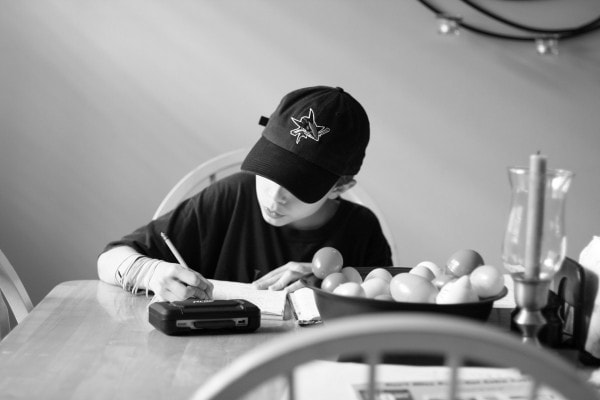
Loving the sharks hat!! We are from the bay area and love the sharks as well
Only time I`ve ever heard about homeschooling in Norway, is when the parents want to take a year off and travel the world, and thus have to take their kids out of school for a period of time, and "home"-school them during the trip. But I can see the advantages, as the kids would get more efficient studying done, and perhaps get done sooner. I remember very well, that I often felt bored at school, because I had finished all my assignments way before the others. The fact that you can have a much more flexible way of schooling sounds very interesting to me!
Along with socialization questions, people often felt the need to test my kids when they found out we were homeschooling. Once when my son accompanied his dad to the hardware store -- during "school hours" -- the clerk asked why he wasn't in school. After finding out that my son was homeschooled, he immediately asked, "Can you spell Czechoslavkia?" My son respectfully replied, "No -- can you spell Czechoslovakia?" 🙂 Enough said...and the clerk laughed, and never tested my son again.
High-five to your son! lol
The subject facinates me but I know it's not for me/my family. I am a strong believer that what works for one doesn't necessarily work for all, so bravo to those that do it!
This is so true...when I felt this is the path God chose for our family, I knew some of the difficulties would include the very things you mentioned. My biggest struggle is not having time alone...but a close second is having a house that has people and things in motion all the time which makes staying organized almost impossible.
Yet as you (and many) have expressed, the greatest blessings come along with some of these challenges. Being obedient to God's calling. Watching our children learn new concepts and their eyes lighting up. Knowing our children and the details of their lives. Being a family unit - working together, playing together, ministering together. Learning things that I didn't learn before - and finding out that I LOVE history! 🙂
Thank you for allowing us to know that our feelings are normal and that others are dealing with things just like us. It is encouraging to know that we are not alone.
My favorite phrase in response to socialization is "not all socialization is good" especially when it comes to middle school. We made the decision last year to pull our son, who is an only child, out of B&M middle school. I remember the days of him coming out of school with his head hanging low, lack of self-confidence, tears, and no smile. The "straw that broke the camel's back" was the day I picked him up in carline and the tears began to flow. I have NEVER regretted the decision to homeschool him! We get one chance with our children and then they're grown and off to pursue life for themselves. I want to be the main influence in his life! We live in a neighborhood with other children his age and he is a part of playing sports and church youth group. I am thankful for the opportunity, even though some days are better than others 🙂
Absolutely!
I remember a homeschooling Dad who said that when others ask "What do you do about socialization?" He'd reply, "Oh, that's no problem! Once a week, I beat him up, give him a wedgie & shove him in a locker so that he won't miss any of that public school 'socialization!'"
May I say that sounds like an awesome dad? He sounds like he has no illusions about the type of thing that goes on in schools.
Sociologically-speaking, a child's socialization pretty much ends around ages 8-10. Socialization is not being "social". It is about learning society's rules, how to respond to authority figures, things like that. It is not about how to have 75032843 friends and be involved in all kinds of extracurricular activities. This is why antisocial behavior has nothing at all do with whether a person has many friends and an active social calender or not. /rant
I homeschool an only child. She loves the undivided attention of the adults in her life.
Oh, social awkwardness is so not about being homeschooled. I was a public school kid most of my life. I wasn't bullied, thankfully. But I was different. I had a wider vocabulary, preferred reading to playing sports, so on and so forth. When you feel like the people (kids) around you have nothing in common with you, it leads to social awkwardness. Yet I never felt awkward around my sister's friends (she is 8 years older than me so all her friends were at least 8 years older than me). On the flip side of that, I don't feel awkward around my niece and her friends (they are all at least 8 years younger than me). It is pretty much my age group I don't feel comfortable around. LOL. But I wasn't homeschooled. <.<;;
I used to work for a non-profit music school, and we worked with a lot of homeschool kids and groups. By in large, I found the kids to be sociable and engaged - much more so than kids who got a "standard" education. Of course, it could be that homschoolers were just more comfortable interacting with adults than kids who attend school, I dunno.
But one thing I wanted to comment on is that even though homeschooling is so often associated with the Christian community, there are non-Christian homeschoolers too. One of my favorite moms from my music school days was a woman who was homeschooling her 2 kids. They were Buddhists, and she said that it was hard to find homeschool groups that she was comfortable with because religion was such a big focus of many of the groups. Sometimes she felt that they weren't welcome, and other times she just felt like it was too confusing for her kids, because the religious stuff was so intertwined with the group's activities.
For example, one of the homeschool groups decided to form a choir, and her daughter was soooo excited to join. But then it turned out that all of the songs they chose were Christian, and they'd start each rehearsal with a prayer... and she just didn't fell very comfortable there.
They ended up starting a family band, recording a CD and touring the country, so it all worked out, but I still think it would be hard for people of non-Christian faiths to find the same sort of homeschool support that's available to the Christian community.
That's interesting, and probably true in many places. In my immediate community, it is quite the opposite, though. It seems like the Christian homeschoolers are hidden in the woodwork somewhere and the non-Christian (or at least the all-inclusive) groups flourish. Step out of our county and just into the next state and it is overflowing with Christian homeschool groups and so forth. So I know what you mean, but as a Christian in this particular community, it is sometimes frustrating, so I imagine for others it would be too.
Can I add a couple of comments as a mom working out of the home full time with three kids in public school?
I love the idea of homeschooling and if our family circumstances were different and allowed for it, homeschooling would be my choice for our kids.
I kind of chuckled at the clean house comment. Given that I leave my house at 7:30am and return at 5 then make dinner, go over school work with my kids and do some activities with them before bed, plus skating lessons for two on one day of the week and gymnastics on one other day, I have a hard time keeping the house clean too:) You would be amazed how much mess three kids can make even when they are only home for 4 or 5 hours of the waking day. I still have the same amount of laundry, dishes (I send lunch and snacks in reusable containers), floors etc to clean but I have to fit that all into the time between the kids going to bed and me going to bed because I don't want to waste time I could be spending with them when I already miss them all day. We do all do a big pick up of some of the clutter build up every saturday morning and we are still working on training them to pick up as they go but you know what kids are like. And that time is shortened even more since I kind of like to see my hubby once in a while too;) The result is a kind of messy house and pretty much no free time. Not that I am in any way implying that homeschoolers have any extra free time. If I was a stay at home wife with my kids in public school it would be very different. It's just that I have to give 40 hours of my week to work.
I just wanted to add that public school (in our area anyway) is not completely free. We are required to bring in classroom supplies twice a year in addition to each child's own school supplies, they each need a pair of indoor shoes and a gym uniform and every time I turn around I have another slip asking for money for a particular activity. I also am very involved in my kids' education and choose activities to do at home that support what they are studying at school. While not every parent does this, I think that the amount I spend on my kids' education out of pocket each year would be the equivalent of what I would spend if I was homeschooling them - at their young ages anyway. Obviously as you pointed out though, it does take effort and planning to keep homeschooling costs down. They can very easily climb if not monitored.
I know that you were just listing the disadvantages for you I had to comment because just as you get asked a lot about socialization, I can't count the number of times that homeschoolers I know have commented on how easy it must be for me to keep my house clean, how much free time I have and how lucky I am that our schooling is free.
Goodness, I can't imagine anyone saying something to you about how much free time you must have. That's ridiculous. I mean, if I spent 40 hours a week on school and you spent 40 hours a week at work, how would that be any different?
People are weird. 😉
Yep, people are weird. We've homeschooled for 19 years now, and between homeschooling and adopting trans-racially, you wouldn't believe the things people have said to us! And don't get me started on 'socialization'-where did that word come from, anyway?
But what I've learned over the years is that we can all be 'weird' about things we know nothing about. I know that all sorts of cliches and sterotypes pop into my mind when confronted with someone who lives in a way that I can't identify-like a large family(we only have 3)or someone who works full time or more and has kids in school (I've never done that, so it seems overwhelming) and the list goes on. I'm just like those people who ask me about 'socialization' except my ignorance is in a different area. So I try to have mercy (but I do permit myself a private eye-roll when I'm asked if my kids are my 'real' kids or about the socializations thing!)
Ashley, I have to say that I often look at working moms with kids in school and sports and what-have-you, and wonder how they get it all done!! So I totally understand where you're coming from and would never say something like "it must be easy to keep your house clean." That is very ignorant and thoughtless. It is very admirable of you to focus on the children when you have the time with them and then scramble to get everything else done after they're in bed. Hats off to you.
We also home school and get asked about socialization, college, etc. Our oldest is in his freshman year of college. He gets along well with his classmates and instructors. He was recommended by one of his instructors as an orientation leader this summer and was selected. He is in the honors program. He is also one of several students featured in an art exhibit. One part of the exhibit was being available for the opening to answer any questions about his pieces.
Our youngest is active in our home school group's student council. These young people select several community service projects to do each year. They plan and implement these projects. We also participate in field trips and other activities. One of the local universities offers science enrichment classes where home schoolers and non-home schoolers are combined. He recently impressed the president of a major university with his maturity.
The issues people worry about are only problems if you allow them to be problems.
I have two kids, but only homeschool one of them. The other is grown now and the one I homeschool only has one more year left. We are always busy and the days fly. I can't believe the ten years I will have into this is almost over:( We also keep busy with violin lessons and orchestra. I wish there was a day I could stay home. I am so thankful we decided to do this and my son is better for it, so am I.
Great post Kristen. I think my list would have included many of the same things. I must say that I now have been home for almost 2 years and my to do list is not much smaller than when I stopped working full time. Sometimes I get discouraged by that and then I remember the reason I am here, the reasons we chose to homeschool and the fact that they won't be like this for long. Time goes so quickly and I wouldn't trade it for anything in the world. Sure there are days when we have trouble getting through a lesson, or getting things done and there are weeks we need a break. We just take breaks now. We try not to stress. We are on our own schedule. I am learning not to stress and worry about what we aren't doing and think about all we have done, learned and experienced.
I think sometimes people forget that kids can be unsocialized regardless of how they school or where they go.
I would agree with that list. I spend more than I should because I remember educational games the most from when I was a child being homeschooled so I tend to buy them for my kids. I would say a downside that I never noticed as a child but do now is feeling like you are judged everytime you step out the door during school hours. It really bugs me. It seemed like my children were asked everytime we went out for a while, why they were not in school and they are only 5&6! Most people were nice about it but the boys started to think it was everyones business on my we were out not doing school. My 5yr old even asked why we did not let everyone know we were going to the aquarium for our school for the day. Very frustrating. I love when the local schools are on break! I feel like I can breathe again!
This is our 15th year of homeschooling. It does get easier, but that could just be me, I would rather have an intelligent discussion about a topic with a high schooler than teach phonics and "borrowing and carrying" any day of the week! The socialization question has gotten to be so much less of an issue since we started and just the normalcy of homeschooling has increased. (i.e. we aren't the only weirdos!) If my kids are out during the day, no one bats an eye anymore and the continual decline of the public schools has certainly made homeschooling more attractive to a greater number of people. I would say that now that I am almost on the other side, (a senior and a sophomore in h.s.), the downside for me now is finding my place as I will no longer be a homeschooling mom. We got married young, had kids young and that is what I have done for 21 years, so I am praying for direction as to what ministry or effort to throw myself into with the time and energy that were used for homeschooling.
I strongly dislike the stigma that comes with homeschooling in New Zealand. Our kids went to a Christian School and excelled! Now in the States with no option but to homeschool, (private school is outside our budget) I have noticed that the 'stigma' of homeschooling is far less! All I would say with regard to my opinion on schooling in general, you NEED to be involved regardless of your schooling option. I've seen families (from both schooling options) do very badly! I'm also for achieving academic excellence (ie students doing their very best) I think that can be achieved regardless of schooling option! just my five cents worth!
I too am an introvert and after the kids outgrew nap time I instilled "rest time". During that afternoon hour the girls (8, 8, and 7) get to read, color, draw, sticker in their beds while I do some quiet work/rest/reading. I wouldn't be able to survive homeschooling without it.
Although I consider myself to be very much the introvert, somehow I never feel like I need "me time" or "quiet time" away from my Little One. I do take time to do my own things with her in the same room doing her own things (for instance, she watches a video after "school" - her reward for doing well - while I exercise). I get "people fatigue" from everyone else - but not from my Dh or Dd - thank goodness.
Perhaps it's because we're ALL pretty quiet (although dd is an extreme extrovert when we're out - she's fairly quiet at home)
This is a question that we ask ourselves often. Should we homeschool? So far we have chosen not to (we stick with a small charter school), but that may change at some point.
My daughter had severe social anxiety as a small child K-1 grades.. and I was afraid of making that worse by keeping her home all of the time.
A few points, and I mean this as respectfully as I can while critiquing the post and comments --
I have worked as a teacher (language teacher) with homeschooled students, interacting with "homeschool families" (From my work and from church!) on a daily basis. My first husband was homeschooled, as was his entire family.
I see some disadvantages, which are mainly the obvious ones. Although I am taking the comments at face value -- which means that every homeschooling parent on this thread is quite focused and well-educated enough to provide a good education for their children -- I think that the socialization, etc. questions are being all too easily dismissed. Not to say that attending a public/private school is always going to be the answer, but as some posters pointed out, what may work for one family may not work for another.
Without having a study to back me up, I know this is not going to come off well, but the majority of the homeschooled students I taught and interacted with DO have what I consider to be "socialization issues." While some were simply socially awkward, others had some issues that transcended that or were perhaps quite subtle, but still limited them in their interaction with the world.
This critique ties a bit into my views of evangelical Christian culture in America, so I apologize for the scattershot nature of this part of the comment. In large families, when children spend most of their time at home (not all, MOST), especially with the idea of "family friendly content," most are exposed to the same books, music, etc., with the seven year olds and the 16 year olds having the same hobbies. I've seen parents lean towards content most appropriate for the youngest children, so while they may personally believe that their oldest child may watch films or read books with more adult content, if they are trying to work as broadly as possible, they will skew their choice to what is appropriate for the youngest child.
As part of my conversations with my students in other languages, I ask them what they like. Students part of the same family, ranging from ages 8 to 17, answered that they had the same exact favorite books, music, et cetera.
Now, I understand that people do not want their children to be exposed to immoral (forgive the inadequacy of this word choice) content, but I hope that many will agree that what we enjoy as adults differs, in some way, from what our children enjoy. Of course I won't blink an eye at an adult watching and singing with Veggie Tales with their child, and even admitting some enjoyment with the show, but I find it puzzling and troubling when a man about to enter college cites it as a favorite television show along with his little sister.
With so much time in the household, around the family, I think that there is little chance for the child to explore on their own and discover age-appropriate (in comparison to peers, etc.) things to enjoy. While letting them do so may not bring good results, there is the other side, where a child can be extremely limited in their exposure, only seeing what mom and dad will allow them to see -- often times as a mixed-age group. There is something quite beneficial, I think, by constantly being surrounded, at younger age, for hours and hours at a time, with people that come from entirely different cultures, religions, etc. -- people in their peer group.
People who can expose them to different kinds of music, hobbies, art, etc.
I would not be as familiar with X culture as I am today had I not been sent to a school that happened to be in a majority X neighborhood (I grew up in a big Jewish community, but you can fill X in with whatever you want). And reading about it would have probably not helped me pick up the cues, stereotypes, and jokes associated with the culture as what I experienced by spending years with the other students.
My parents were immigrants, and while they didn't want their child to be so Americanized, it helped IMMENSELY to see what "Americans" did, how they ate, how they lived, etc, and how to interact with them. Not just being polite (which many of the homeschooled students are!), but really being able to pick up on social cues and American-isms that I did not grow up with in the household.
Many of the students/children I have encountered, even if their parents have exposed them broadly to the world as they could, seem to struggle with this. And I know someone who is now in his 30s and really, really struggles to understand the subtleties that I think just comes around being with people his age for a majority of the time. And the others have a lesser degree of it, but it's still there.
And I can name, sadly, quite a few students that I believe have learning disabilities or are even autistic, that are not diagnosed (my first husband was one of them -- he couldn't write at an eighth grade level and he is in his early 30s). And I can't blame the parents completely for that. These problems, in a good classroom, may be caught quite early, especially when a third-party can see how the child is interacting and catching up with their peers. You can quote percentiles and such at me all day -- and I do believe those statistics; my students scored extremely high on standardized tests -- but I have seen enough students that fall through the cracks. If there isn't a lot of comparison with peers that makes such problems evident, they aren't recognized until later or the parent believes that he or she themselves can address and fix the problem. And in some cases, being around that many kids for long periods of time, working with teachers and school faculty, having to meet people, interact, learn to share, etc, can actually be a big help for the child.
(And sometimes, parents have become furious at even hinting that their child may have a disability, but I fear that this is a separate issue...)
I am an introvert and can be very socially awkward. I completely believe that being forced to attend a private school with 20+ students in a classroom forced me to learn how to interact, pay attention to people in a way that seeing church friends several times a week, interacting with smaller circles of people, etc, wouldn't have.
I do not ignore the downsides to going to a public/private school outside the home. There are many and I am sure you are quite familiar with them. But I have seen some of the disadvantages of homeschooling, and the consequences are nothing to brush off or sigh in exasperation about the "socialization" question. The answers provided by several, frankly, are not comforting at all, although I'm sure that many of you do have your children's best interests at heart, educationally, emotionally, etc.
Best of luck with all of your efforts and thank you for letting me post my comment, Kristen.
I homeschool a child who is socially awkward.
He had undiagnosed disabilities, too - that were not caught by us OR his traditional classroom teacher. Because not all disabilities show up at 2 or 3 ... his only became clear at age 8.
Part of the reason I homeschool him is BECAUSE he is socially awkward. Not to keep him away from a traditional classroom environment, but because we are using aggressive OT and CBT to help him. Being in a "normal" classroom will not "cure" his problems magically. Lots of one-on-one work, coupled with opportunities to interact with others, will help him. That's why we chose to homeschool.
And yes, we're evangelical Christians. But somehow, we manage to read lots of books, watch lots of educational TV and meet lots of different people.
Just because people are DIFFERENT from you, doesn't mean they are backward and wrong.
I do not mean to hint that you are "backward" or "wrong" at all. I have seen a pattern as a teacher and a friend to many families, and I wanted to share my observations.
And I do hope to emphasize that I believe homeschooling IS the best answer in many cases, but that dismissing other options out of hand and deflecting any sort of criticism because YOU are doing it correctly may be counter-intuitive to actually looking at the topic carefully.
I understand your critique of the "bubble" method of parenting, and I share your concerns about that. I view my children, to a degree, as seedlings. One doesn't place seedlings out in gale-force winds until the seedling is strong. But by the same token, one doesn't keep a seeding indoors under a flourescent light forever, or the seedling will fail to thrive.
Our hope is to grow our seedlings in a safe environment as they're younger, and as they grow older, we'll expose them more and more to what's out in the world.
To go back to the seedling analogy, a plant that's been sheltered all its life won't grown strong roots, so if it does have to go out in those high winds, it won't survive. And I think the same thing tends to happen to children who have lived in a bubble their whole lives and who are then suddenly dropped at college...they're just not ready.
Anyway, I understand your concerns and share them, but I'd just like to throw out that not all homeschooling families are the bubble sort.
And I know this is anecdotal, but since you're sharing anecdotally too.. 😉 I personally know scores of homeschool graduates, and most of them are not socially awkward (There ARE some who are kind of dorky, just like there are some public schooled kids who are kind of dorky!) and have transitioned into college life and adult life without a problem. There are also homeschool graduates I don't know personally, but whom I observe doing successful things in life..Josh Harris pastors a huge church, Crystal Paine of Money Saving Mom runs what is arguably the largest deal blog on the web, and Kelle Hampton writes a very popular blog (Enjoying the Small Things. Then too there are figures throughout history who have done amazing things while spending very little time in a classroom. For instance, Abraham Lincoln received less than a year of formal schooling in his whole life and one would be hard-pressed to argue that this was a hindrance to him.
One last thing about exposure to other cultures...I think this depends greatly on the demographic of the student. A student who attends a public school in an upper middle class area is quite likely to be soaked in a very homogenous group of people, whereas children who are homeschooled in an area that's less homogenous could be exposed to more cultures than the former student. For instance, though Mr. FG attended public school, our children have significantly more exposure to people of other cultures than he did, simply because our church family is quite multi-racial and because his school was very not multi-cultural or multi-racial.
My three siblings and I were all homeschooled. From my vantage point it was a pretty good experience for my two sisters and I, but I think my brother illustrates what can be a significant disadvantage to homeschooling. He had a bit of a rough go of it during middle and high school with me (the emotionally closest sibling) leaving for college and our father becoming increasingly absent. In late elementary and middle school my brother became somewhat emotionally volatile, especially when having to work on subjects that he disliked. He and my mother often had willpower battles involving schoolwork that ended with him in hysterics or trying to run away from home for a few hours. He was more stable in high school, but had very poor motivation and seemed to be depressed. My point in relating this story is this: homeschooling puts the parent in the roll of both parent and teacher. In my brother's case, I think it would have been better for someone else to be the teacher so that my mom could just be the parent.
Now don't get me wrong--I was relatively happy with my homeschool experience and would consider taking that educational route if I have children someday. But just as I think we'd all admit that homeschooling isn't for every parent, it also isn't for every child.
Oh, and my brother seems to have turned out alright in the end 🙂 He's 22 now and has a job he loves with the Boy Scouts.
I think you listed the downsided very nicely. I had been in public, then private, and finished up homeschooled. It worked fine for me but was not as successful for my siblings. We are all well adjusted adults who work hard and are well integrated into society. 🙂 I graduated from university with honours and have worked steadily in my chosen field for a very long time. My siblings struggled to get a full education...but that lies somewhat with the homeschooling parent being unable to fully address the educational needs...and not seeking additional support...unfortunately.
I also agree that it is not for everyone. I was fine as a student but do not have the skills or patience for it as a parent...and my only child thrives in a school environment. Thank you for sharing your thoughts with us.
I'm really glad you wrote about this. We really want to homeschool our daughter (now 15 months), but I have had concerns about a few of the things you touched on. She is an only child and probably will stay that way (daddy says we're done), so I worry about her feeling stuck with me all of the time. I really want her to be active in other activities, so that should help. I just worry that I will not be able to provide the learning "variety" that she would get in public school. Have you thought of this? I just don't want to do the same things day in and day out.
Amanda - You'll do great! I homeschool an only, and here are a few ideas to help: 1) Start when she's in preschool- perhaps when she turns 3 or so. When she gets to "compulsory age" you'll probably have a huge amount of confidence in what you're doing, and all your worries will disappear. 2) Join an online homeschool discussion board, such as "Homeschool Christian" or another one that fits your worldview/beliefs. That will give you a chance to discuss things with others who have been where you are. 3) Join a local co-op. This gives the kids & parents social time, and also helps us encourage each other. Sunday School & Library story times are also good. 4) look at the up-sides of having an only. I look at large families and wonder how they do it, and feel like I have it easy having only one! We're able to offer opportunities to an only that large families cannot offer : )
I LOVE homeschooling, and am fully convinced that it is the BEST thing for my daughter - and for me. It makes our family stronger & more loving - can't beat that! (and, I might add - my daughter is incredibly socially confident & outgoing, and relates well to others of all ages. )
While I do think there are some wonderful things that can come out of homeschooling and appreciate your effort to acknowledge some disadvantages, Kristen, I think your post illustrates an extremely common superior attitude that is very widespread in the homeschool community. I'm sure part of that attitude springs from the questions about socialization. Saying homeschooling is "different" or "unusual" these days is a bit of a stretch, though. In most evangelical Christian communities it is widespread and very, very common.
Like several other commenters, I am often amused and slightly annoyed by the comments of homeschoolers about the expenses they incur from homeschooling. Although public schools are theoretically free (and in poor, urban communities there may be very limited expenses expected of students), our highly ranked school in an affluent community ends up costing us in the upper hundreds of dollars per year per child. Admittedly, these expenses are for fabulous experiences like rock climbing courses, ethnic parties, field trips, etc. but they are expected. We also spend time transporting our kids to and from school every day, work on homework with them, and volunteer at school. My perception is that many homeschool parents are completely oblivious to the time and money investment that typically goes into public school attendance by concerned, involved parents. Especially for those that have never experienced it, please don't make judgments about the time spent if you don't want us to make judgments about how much we think you "should" be able to get done while at home teaching your children.
The dozens of homeschool families we know vary widely in the level of exposure they allow their kids to the outside world and therefore their successful socialization. Some of them are amazingly socialized. One common and, in my experience, univeral academic weakness I've witnessed is a fear and adversion to test taking by homeschool kids. I realize it can't actually be universal, though, b/c I am aware that there are homeschool kids who have been admitted to Ivy League schools. I realize that test taking is not the only measure of knowledge, but for many professions, the ability to take standardized tests under time pressure situations is non-negotiable to entering the profession. For example, the bar exam for attorneys, medical boards for doctors. And, although the educational system is changing rapidly, tests to measure a minimum of competence in one form or another will not go away in many jobs and careers.
I realize the self-congratulatory tone I perceived about your own experience as well as your choice to home-school is unintentional, but it is quite off-putting.
Just my 2 cents.
Hi there-
First, I'm so sorry that my tone hit you as self-congratulatory. While I do think homeschooling is the best choice for my family, I do not think it is the only good choice, nor do I think it's a good fit for everyone, so I have no reason to look down on people educate differently. What I DO always hope for is for other people to treat my choice with respect.
And I bet if you and I could have a real life conversation about education, we'd understand each other better because we could read body language and hear tone. 🙂
Secondly, I'm really glad that you felt comfortable enough to offer an opposing viewpoint. It makes me happy to know that the atmosphere here is such that people can feel free to disagree with me!
Just a few points-
-As of 2007, only 2.9% of American children are homeschooled, so it is still a bit unusual (though not nearly as unusual as it was when I was in grade school!).
-When I mentioned that homeschooling isn't free, I was trying to be sensitive to the concerns of low-income parents who might be reading my blog. Though one can certainly spend money on a public school education, it is possible to go to public school and spend very little...less than would probably be possible even when homeschooling on a shoestring. In addition, I do believe that a lot of school districts offer things like lunch programs and such, and obviously those aren't available to homeschoolers. So, for someone who is in desperate financial straits, a public school would probably be a cheaper option.
-As far as test-taking goes, I'm wondering if you know of studies that show that homeschoolers test poorly. One can throw anecdotes out ad nauseum (I qualified for a scholarship on my PSAT and got to skip college classes due to my SAT scores, my brother-in-law graduated with a double major from VA tech, and my sister graduated magna cum laude, for example.), but as both of us know, anecdotal evidence isn't as good as scientific evidence.
The evidence I can find shows that homeschoolers test better, on average, than public schooler (like the critics say, this does NOT prove that homeschooling is better, but does prove that homeschoolers are not worse at testing than public schooled students.) There's also information on homeschoolers and test taking in this Wikipedia article.
Though I don't think standardized tests are very accurate measures of education and knowledge, because I know that standardized tests are a part of life, I do prepare my children for them. That's why we do some workbook pages, even though I think they're generally poor teaching tools and also why we do timed reading comprehension tests. My children also regularly take non-standardized tests (for instance, they have math, Latin, and Spanish tests.) Again, I'm not a big fan of tests, but I know that they'll be part of college life, and I want my kids to be prepared.
Oh! I forgot to reiterate that I think parental involvement is THE key to educational success, no matter what the method of education happens to be. This is why you see kids succeed with all sorts of educational backgrounds...the parents matter more than the method.
And that is why I'm not a "Homeschooling is the ONLY way to educate." sort of person. You sound like a parent who is heavily involved in your child's education, and because of that, I'm quite sure your kids will be well-educated. 🙂
Hi Kristen,
I appreciate and admire your ability to be so gracious in response to my post. You demonstrated a great effort to understand my point of view and maintain a respectful tone. I appreciate that!
I don't know if I would call my view "opposing," but I must admit I am sensitive to what I perceive as a superior attitude from many home school families. And I may have read some of that into your post when it wasn't there and I apologize for that. It is understandable that home school families are generally passionate about their choice to educate their children at home, otherwise, why would they devote themselves to the effort with so much of their time and for so many years? As I mentioned, I know numerous homeschool families (more than 50% of our church has home schooled kids and our church supports a co-op), and many of them have fabulous kids and are doing wonderful jobs raising them.
What I was trying to express (in an inartful way) was that there is an inevitable unspoken and possibly unconscious tension between homeschooling families and schooled families. As much as it's popular to say "I respect each family's choice" it probably isn't completely true.
The homeschool/school divide is not nearly as clear-cut or widespread, but it has some resemblance to and reminds me in some ways of the much talked about "mommy wars." As you probably know, a recent survey by More magazine revealed that 90% of women perceive that working women and stay-at-home moms have negative feelings toward the other. Some might dispute this finding, but in my experience I believe it to be true.
I believe if you were to get the truth out of committed stay-at-home moms (including me), most would say that what they are doing is the best for their kids, that they wouldn't be spending their life doing this work if it wasn't much more important to the long-term well being of their children than devoting themselves to a career. Conversely, if you gave truth serum to committed career women (not including moms who work out of financial necessity or part-time, but those who are very driven and oriented to their careers), many would say they find stay-at-home moms a throw-back to a time when women were stuck in subservient roles and had no other options, and present a poor role model for girls to aspire to. That's not what people really say, though. The politically correct language is "it's a choice and I respect everyone's choice." I guess that nugget of what I perceive to be true also with the school issue what I was digging for in my comments.
While you are correct that statistically homeschooled kids are a very small percentage of the overall U.S. population, I was referring to homeschooling's prevalence in the Evangelical Christian community, in which it is not only extremely widespread, but is large enought to have spawned its own mini industry, including cirriculum companies and numerous conferences all over the United States.
And finally, I'll respond to your correct comments about homeschooling kids doing better, on average, on standardized tests than the average public school student. I don't dispute that, but it is worth mentioning that there is a huge (and tragic) swath of this country that leaves high school barely literate (or never completes hight school). These young people are generally poor, urban and enter school with severe disadvantages that are only exacerbated by poorly run schools. So it doesn't seem to me to be a very strong argument for the virtues of the academics of homeschooling to compare it to the average American student's test scores. Maybe comparing similar demographics--parental education level and income, which has proven to be, unfortunately, the best predictor of student achievement--would be a fair comparison.
But truthfully, I don't want to get into comparisons, b/c I know that all the homeschooled kids have parents that care enough about their kids to even endeavor to educate them themselves. I was really just commenting about test-taking skills and that there is some value in that.
It is true that my observation about test aversion is anecdotal and I have no good argument to defend that point. I just have concerns about many families I know (including close relatives of mine who home school) who I believe may be shortchanging their kids by not exposing them to testing until an older age, which in a few kids has produced great anxiety around the testing process. It sounds like you are approaching this issue very sensibly. There is no question that my public schooled kids spend way too much time on standardized tests. It is a ridiculous waste of time. They only need a little exposure to it.
Thanks for responding to my comments. You set a good example in your blog in general of a loving Christian woman and your response to my critical comment was no exception.
I want to add this link because I think people misunderstand who is homeschooling and why. We are a 'mixed family' with advanced degrees in law and medicine, so this article caught my eye:
http://childrensmd.org/uncategorized/why-doctors-and-lawyers-homeschool-their-children-18-reasons-why-we-have-joined-americas-fastest-growing-educational-trend/
I started homeschooling in response to a crisis with my oldest child. After a few years of enrolling him in Montessori school, we decided to switch him to public school only to discover a major misalignment in curricula. We started out thinking we would homeschool for a year, and then put him in public school. What we discovered is we loved homeschooling. For me, it was an improvement over tons of driving, volunteering at the school, teach conferences, funding committees, etc. For a while, we were probably obnoxious converts, who gushed a bit too much. We finally settled down, and came to the conclusion that 'different strokes for different folks' was totally true when it came to educational decisions. I have seen successes and failures in both homeschooling and public school students.
Oops...and that would be teacher conferences.
And CP: Regarding test-taking skills. My 18 year-old took the LSAT's as a college senior. I do think that he was slightly disadvantaged at taking them since his exposure to standardized testing was close to nil. Nonetheless, he triumphed, and entered law school at age 19. Two years later, he's doing really well and may graduate early.
I'm sorry you've been hurt in the past by things homeschoolers have said! I think you're right in that it does have some similarities to the mommy wars. We who homeschool feel criticized by people who don't (Just recently, someone who knows I'm a homeschool graduate and that I homeschool my children told me that homeschooling was only a good choice when the family has a schedule that's very unusual or when a child has disabilities!) and people who don't homeschool feel criticized by people who do.
When I talk about education here, I try really, really hard to keep it positive and not negative because I really don't think negativity gets us anywhere helpful. If I make my point in an offensive way, no one will be receptive to what I say, and where's the sense in that?
I do sincerely and honestly believe that parental involvement is THE educational hill to die on, which is why I am not willing to die on hills about educational methods.
Generally when I share about homeschooling, I'm not trying to persuade the naysayers to believe that homeschooling is superior. Really, I'd be happy if people just acknowledged that it is just as legitimate a choice as other schooling methods.
In that vein, what I was trying to point out is that though the test score statistics do not necessarily say that homeschoolers are doing better than statistically comparable public schoolers, they do prove that homeschoolers can indeed do well at tests. Scoring in the 84th and higher percentiles is a sign of competent test taking skills. If homeschooling produced statistically significant numbers of children who could not take tests, that would be reflected in the study results.
Again, I am NOT saying homeschoolers are necessarily better at tests...I'm just trying to point out that I believe the evidence shows that they are not, as a whole, at a disadvantage at test time.
Anyhoo...whether we choose homeschool, public school, private school, or whatever, we are the ones who can really help our children excel, and if we remember that, we'll all have more common ground to share. 🙂
Kristen: You are truly a humble and accepting person. I agree that it would be lovely if people could accept homeschooling as a legitimate alternative, and not feel threatened in any way. Different things work for different families. They are all hard work, but worth it.
I am glad I found this post. I am a teacher. I am a Christian. My son attends public school. The rest of my family homeschools. You can not imagine the number of snarky articles, laying claim to the superiority of homeschooling, I see in facebook posts of people that I love. It is very hurtful. I started researching today, trying to understand the perspective of my family members. On multiple ocassions, I have felt that my choices were not honored by my family members who select to homeschool. I know that many people do not homeschool for religious reasons, but many do. My challenge to the Christian homeschool community, especially those who blog, is to review their writing to be sure it reflects their faith. We are accountable for our words. Here, I think you have demonstrated good character with your words. However, more often than not, the post that I see are complaints about people not honoring the choice to homeschool that seek some sort of resolution by claiming it is the silver bullet of education. Oddly, those posts don't make me feel like my choices are honored.
I just wanted to throw my $0.02 in here. I was home schooled as a child. I was in a unique position because my 4 siblings were all 10+ years older than me, so I was pretty close to being an only child (it also made a gap between me and them because we have different dads). My siblings were all home schooled as well, though some for shorter periods than others. My mom (and for me my dad) gave us a choice (of course weighted on the parents' decision) of which we would like to do. Public or homeschooling.
In junior high school, I wanted to try out public school, so the school nearby allowed me to join the last few weeks of the school year to see if I would want to go the following year. I went for a few weeks and hated it. I had grown up around adults and learned to be polite, kind, and gracious to people. Junior high had none of that. After that short enrollment, I went back to being home schooled until I was a junior in high school when I enrolled in classes at a community college to get my A.A. Now over 10 years later, I've got my B.A. and I'm living abroad (4 years in Japan!!).
When I talk about education with the people around me, they are always shocked that I was home schooled. I actually used to be the anti-social, shy kid who couldn't talk to anyone. I even avoided eye-contact while speaking to someone and got nervous when someone approached me. I was the dork who wore black and people avoided, but now that's all behind me. I've been made a better person by my experiences. For my sister, she needed to go to public school in high school. It didn't work that way for me.
I suppose this post isn't saying anything in particular, just giving an example of someone whose life greatly benefited from being home schooled. Now my husband and I are considering which we'd like to do for kids in the future. But it probably depends on each individual kid, our financial situation, my work situation, and a load of other factors.
Sorry to take so much space, but thanks for the post!
Kristen, the more I read about homeschooling on your blog, the more I wish I could make the transition to homeschooling. I had a few questions. I know you have always homeschooled but do you know the steps one must take to switch a child out of public school into homeschool? Are there any legal requirements or yearly tests? Also, when the child reaches 16, would it be acceptable to go into a community college or something full time? The more I read about our public educational system in America, the more I see how it is failing. The region where I live I think they said about 75% of high school graduates need remedial classes in math and English. This makes me think that public school is a waste of time. I wish I knew where to start 🙁
We are thinking about homeschooling. I was told to find out the disadvantages but all the disadvantages I have found are more like advantages compared to the now situation. Great read, thank you!
Though I have personally chosen to send my kids to public schools, I see major merits of home schooling. Thanks for sharing your thoughts!