
Wednesday Baking | A little bit 'o troubleshooting
 Every Wednesday (ok, most Wednesdays!) I share a baking recipe. And lots of pictures of said baking recipe. I don't call this Wednesday Baking because I bake solely on Wednesdays...no, my oven gets a workout much more frequently than once a week! Wednesday just happens to be the day I share baking recipes with you. All the past baking posts are archived in the Wednesday Baking category, which can also be found in a tab underneath my blog header.
Since most of you are probably kind of baked out by now (I know I am!), I thought that I'd talk about some yeast bread troubleshooting instead of sharing a new recipe.
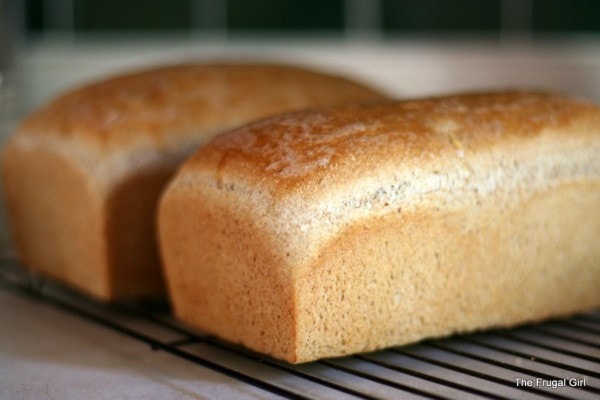
First, if you're having trouble getting your yeast bread to rise, my very first recommendation is to use less flour. 99% of the time, yeast bread trouble is caused by too much flour, not by bad yeast.
Yeast is pretty powerful, but it has its limits, and it struggles to lift a really stiff dough. A softer dough has much more "give" and the yeast will be able to lift it more easily.
If your dough isn't at all sticky, you've probably added too much flour. If you can make your dough into a ball, put it on the counter, and have the dough stay in a round ball shape, you've probably added too much flour (when I mound mine into a ball, it flattens out some as it sits on the counter). Your dough should feel soft and squishy, not firm.
The flour measurements in yeast bread recipes are almost always approximate, so don't get stuck on those. The amount of flour your need can vary, depending on the humidity level in your air and in your ingredients. I actually never measure my yeast bread flour...I just add flour until the dough looks right.
So, if your recipe calls for 6 cups of flour, don't just blindly dump the six cups in. Start with 3 cups, mix the dough up well, and then gradually add flour until the dough reaches the proper consistency. Always, always start with less than the total amount of flour. You can always add more flour, but you can't take it out!
(please note that I only recommend using this loosey-goosey flour "measurement" style with yeast bread. With most any other kind of baking, you should measure your flour precisely!)
_________________________________________________________________
Secondly, a reader sent me these pictures to ask if I could help her figure out what's going wrong here.
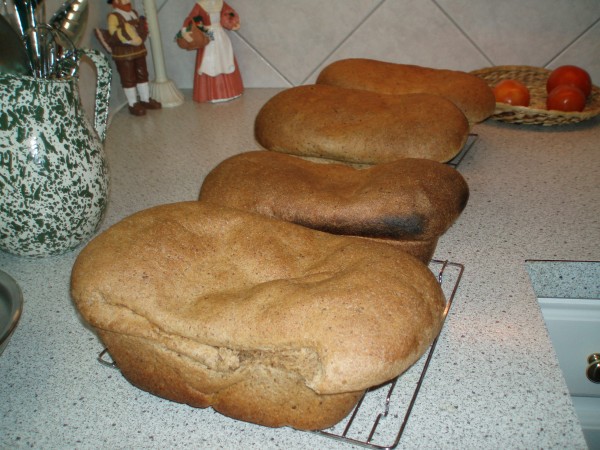
My thought is that these loaves look over-risen. When I let my dough rise too much, the tops look lovely and round while they bake, but then settle into this unhappy looking shape as they cool. If I saw the inside of these loaves, I'd guess the texture would be very open and airy because the yeast was allowed to grow for too long.
It also looks like these loaves might be a little too big for the pans they were baked in. A properly risen loaf in a properly sized pan should not be overflowing the edges, before or after it's baked.
_____________________________________________
Thirdly, let me tell you about my favorite bread pans.
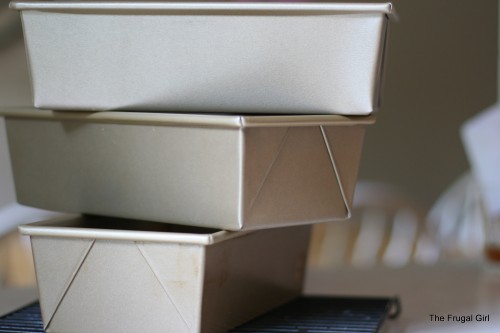
The reader that sent in the pictures uses glass plans, but I have to tell you guys, glass pans are really not my favorite thing for baking yeast breads. I've had such trouble getting my loaves to come out of those pans neatly, and I've had difficulty getting even browning and cooking with those pans.
My very favorite loaf pans are Williams-Sonoma's GoldTouch pans. They're pricey, but so worth it. They cook breads evenly, and the nonstick coating is incredibly durable. I've owned a lot of nonstick bread pans in my lifetime, and the finish has always worn off. I've used my GoldTouch pans over and over and over, and the finish is in perfect shape. Not only that, the finish is incredibly non-stick...I don't use any grease or baking spray when I use them for yeast bread (I do grease them for quick breads) and my breads pop out with nary a problem.
If you're wanting to do any serious amount of yeast bread baking, do yourself a favor and save up for these pans, or ask for them as birthday and Christmas presents (that's how I've gotten most of mine). I'm certain you'll be happy with them!
___________________________________
If you've got yeast baking troubles or questions, feel free to email me (the frugal girl at gmail dot com) or leave me a comment here, and I'll try to troubleshoot your problem in a future post. If you email me, including a picture of your bread or dough would be really helpful.
Today's 365 post: Squeaky
I just love my Le Creuset stoneware loaf pans for baking both quick and yeast breads...especially that they go in the dishwasher! They are pricey too, but somehow I found them for half price on Amazon several years ago.
On the subject of pans, I absolute adore my Hartstone Pottery muffin pans. I've never had a metal muffin pan that didn't end up with rust on it (my fault I'm sure for not being more careful with them). The pottery pans can be soaked forever without rusting and they go in the dishwasher too. The gingerbread pan is on sale right now, but you can also find these on Ebay. http://www.hartstonepottery.com/store/shopexd.asp?id=638&ccode=11600420 Oh, their baking stone version is nice too but not quite so easy to clean - it makes a crisper mini quiche, though.
Thanks for the tip about too much flour in the dough. I have a weird desire to keep adding flour until the dough no longer sticks to the bottom of the mixer bowl. Probably not a good idea. I'll have to aim for more loosey goosey dough from now on.
My trouble to shoot with yeast breads is that the first day out of the oven they are delicious. But after a day of storage on the counter (usually in an airtight Tupperware container) they are dried out and crumbly. This is really disappointing when it comes to sandwich breads, as I'm trying to get my children to like homemade bread as well as store-bought.
Do you store it in the fridge? That will dry it out. Baked goods should be kept at room temperature or frozen for longer storage.
Adding a 1/2 cup of potato flakes in with the first few cups of flour in your bread recipes help the bread stay fresh and moist. It makes a huge difference with the texture, too. I have also mixed leftover oatmeal, or cracked wheat cereal from breakfast in with the wet ingredients in my bread recipes,too. It keeps me from wasting food, and it gives the bread a nice texture.
Those are great ideas. I have the same problem as Becky and it's quite frusterating. The only good thing about hard, dry bread is that is makes for very good french toast.
I'm going to try the potato tip and see if that helps. Do you think it would be ok in sweet breads (like raisin or cinnamon)?
Yes, I've used it in sweet bread and cinnamon roll dough,too! Potato flakes are usually way cheap in the bulk food section of the grocery store.
I enjoy your baking tips. However, I must eat gluten free so entirely different techniques are used. I have found that good equipment is really a help.
I also LOVE my Chicago metallic bread pans. Actually, all of my Chicago metallic bakeware.
I recently picked up some silicone bakeware at a fleamarket. I was pretty skeptical at first (and am still uncertain if they present any weird health issues with silicone chemicals leeching into your baking), but they are amazing. You would not believe how easily breads come out of them.
Thanks for all your help! I'm anxious to start making bread again. I think the flour is the problem - I put way too much in. I thought it wasn't supposed to be "sticky." Oh well. Live and learn. Those bread pans look great too. I might look into getting one or two of those sometime.
I have had great luck with all of your yeast bread recipes, but I find that I generally have to add a bit more flour (1/2 to 1 cup) than the recipe calls for in most of them. I'm assuming that this is because I mix by hand.
Have you ever considered using a bread machine? I have baked bread by hand and with the bread machine and have had good luck either way... but must admit that I like the 'idiot proof' part of using the machine. LOL! I got the machine as a gift and I use regular bread recipes in it (not the mixes) so, other than a little electricity, the machine doesn't really cost me more to use. Though it is not as much fun as making it by hand, I must admit.
My "new to me bread pans" are at least 60 years old and they are amazing! Another tip for good yeast bread? You should hear it Squeak when you punch it down!
Kristen, do you think that the "too much flour" thing could be the problem for me(?): I can never seen to get the bread/rolls to rise well the second time, after the punch down. First rise = awesome. Second = nonexistent and results in tough bread. Probably too much flour...
Is your yeast fresh? Don't go by the date on the package. Instead put it to the test - put 1 pkg (or about 1 T. for bulk) in 1/4 c. hot water (whatever temp recommended by the manufacturer) with 1 T. sugar. In no more than about 5 min it should be heavily bubbled and smell almost beery - actually it should look like the foam on the top of a well-drawn glass of Guiness. Which makes sense since beer is made by yeast also.
Thanks for the tips! I tried some buns before Christmas and they came out like hockey pucks! My dough was definitely stiff and not soft! We replaced the yeast, which was very old, but at least now I know what the real culprit was I can try to fix that, not just be frustrated by the same results! Perfect timing on this post for me! Thanks!
I clicked on Kristen's William-Sonoma link and watched a video about her favorite bakeware. It has a lot going for it, High quality, made in USA from recycled material etc, but I'm here to tell you that you don't need to spend anywhere near $20. for a loaf pan. If you bake your own bread regularly that cost is recouped fairly quickly compared to store bought bread prices. However I bake bread my bread in $1 thrift store pans and I don't have any difficulties. I do second Kristen's thoughts on glass bread pans, stick with metal.
Hi,
I like to bake bread a lot. I've even sold some of my bread. I occasionally have the problems that you talked about. Thank you for helping me understand about the flour. I've never had anyone teach me how to make bread. It's good to have a fellow baker make it so clear for me.
God bless you, and do drop in!
Laura
Before deciding yeast is or isn't the culprit for under risen bread, you can try one simple trick. Put a teaspoonful of yeast into a bowl with some warm water and sugar. Wait about 5 min. If you see bubbles forming, your yeast is still good. If there are no bubbles, the yeast is dead.
Often in yeast bread recipes, the instructions will say to mix the sugar and wet ingredients (water or milk) with the yeast, wait several minutes to "wake the yeast up" then add the flour and/or other ingredients. This can save you some headache if your yeast has died since the last time you baked with it.
Hope that helps!
That's a great tip! It's a good idea to check the yeast before adding it in with the other ingredients to be sure it is active. One note, add a tsp of sugar to the water (110-115F) so the yeast will have some food to get it started. More info here: http://www.redstaryeast.com/lessons/yeast_storage/yeast_freshness_test.php
I think Cook's Illustrated recommends the WS pans, too. We use Le Creuset and they work quite well.
Kristen,
Do you use the 1lb or 1.5lb? or both?
It took me years to learn to make bread. I kept adding too much flour and wondered why it was consistently so awful. Finally a neighbor gave me the right tip: the amount given on the recipe is the OUTSIDE LIMIT of flour which will work and includes what you put on the counter to knead with. Once I quit killing it with too much flour my bread improved immediately.
Something else you might try is steam in the oven. I put an empty, heavy pan directly onto a cast iron griddle on the bottom shelf of the oven while the oven preheats. Preheat at least 30 minutes to get oven walls properly heated up. When you put the bread in pour some boiling hot water into the empty pan and close the door. After 10 minutes of baking take that pan of hot water out, very carefully, and dump the water in the sink. Continue baking till your bread is done. The steam gives the bread a push and it rises beautifully. Just don't leave the water in the oven because it will interfere with browning.
great tip! thanks, carla!
I've been very luck to find really nice Calphalon loaf and cake pans at Home Goods/Marshalls/TJMaxx for a fraction of the original price. I have a 10" loaf pan that I got for $8 I think, and I was lucky enough to find a lone 8.5" loaf pan (which I was looking for) in the clearance aisle for $3 (yay! I was having an awful day that day too - I felt like someone was looking out for me when I found it, or maybe it was just luck!). I checked Macy's and those pans go for $17 and $15 respectively, so I thought I got a good deal.
They seem to have a steady stream of Calphalon pans, so I'd definately suggest checking it out!
Great tips Kristen!
I have to say, I actually love my glass bread pans! I have a few metal ones, but go for glass every time. The bread gets the best crust that way!
Yum I like to use both metal and glass. I am wondering if you have ever baked homemade pizza.
I bought a new KitchenAid mixer on sale the day after Thanksgiving and haven't yet taken it out of the box. I've always wanted one and thought it would help me with making bread. Today's FG post and subsequent comments have me really motivated to bust the mixer out (finally!) and make me some bread! But first...to get some new bread pans...and finally, true hope for some homemade bread that works out...
Which size do you prefer?
You mention to add flour until it is the "proper consistency"? What is proper? If I add the amount of flour that recipes call for, when trying to knead it, the dough sticks all over my hands. It's very frustrating.
Try this: instead of having flour nearby to dust the dough and your hands with, have a bowl of water. Yes, water! Dip your hands into water as often as you need to but be careful about too much flour; Kristen is right that too much flour makes a dense, dry loaf. Your dough should finish up very soft and definitely a bit sticky. (Having sticky hands is just part of the process although water helps with that.) And the dough will change its character some after that first rise and be easier to handle. Odd how that works.
Thanks! I'll give that a try.
I think the issue is that as the dough rises, gluten is developing. Even if you don't add flour, kneading should also make the dough progressively less sticky for the same reason. (Think about how sticky and batter-like it can be at the beginning, versus the cohesive ball it turns into at the end.)
Another way to describe the proper consistency is that the bread should be the consistency of your earlobe.
Another idea - try kneading the dough for 5 min or so even though it feels too sticky. I do this in a bowl rather than on the counter to help contain the mess. After some kneading the dough tends to get less sticky.
I LOVE those pans. I have the loaf pans, the half sheet pan, the square plans and the 9x13 pan. WS guarantees them for life too. They are the BEST pans Ive ever used. I'm debating on whether I need the goldtouch muffin pan too. If you bake a lot, you more than get your moneys worth.
My mum taught me to bake bread. On the subject of pans, they should be metal and never washed. Yup, they are to be treated like cast iron and develop a seasoned surface that is naturally non-stick. So my basic loaf pans get a thin coating of lard before the dough goes in, and after I tip the loaves out, they cool and go back into the cupboard. This won't work for sugary or cheezy bread, but I use different pans for those, so I never wash the regular bread pans. Just wipe out any crumbs and away they go.
Funny - I've had problems with browning with any metal pan I've used, but my new Pyrex pans brown bread delightfully, and if I add plenty of oil, the loaves are easy to remove. I've made yeast and quick breads in them and I'm very pleased. Plus, I don't have to worry about any problems with the finish or integrity of the pans when I put them through the dishwasher, unlike the metal (rusts!), nonstick (coating comes off, and I try to avoid nonstick things as a rule), and stoneware (no good in dishwashers) pans I've used.
I'm wondering if someone could advise me in what the texture of homemade bread should be..? I've never had homemade bread, and I made a few loaves here recently (white sandwich bread) but it seems kind of chewy and a little hard- it's not the same texture (soft and airy) as store bought bread by far and I don't really care for it. Is homemade bread something you just have to get used to, or am I doing something wrong with my bread?
oh, I so have bread pan envy now!! wish someone had told me when I was young to invest in high quality pans in the first place...
I am putting this incase someone checks back on this. I found a great blog http://dealstomeals.blogspot.com/2010/02/french-bread-brought-to-whole-new-level.html she is amazing!!! Her recipes for bhread have ALWAYS worked out for me. I have made many many may loaves of french bread and rolls that I have NEVER had a problem with rising and I follow her directions to the T. She does not live in Arizona and I did not know that you should not dump all the flour in I did what she said. I even make her homemade cinnamon rolls and they rose beautifully!!!
Hey Frugie, You can't bake bread on a Wednesday. Dontcha know anything? Traditional Bakers have always taken Wednesdays off since forever. Read a freakin' book, man. Gee whiz...
Oddly, I have been able to bake bread on Wednesdays many times. lol