
Tightwad Gazette, book three | Nothing new under the sun
The first article is one that made me think of the adage, "There is nothing new under the sun."

Because...it is about how, at the time, baby boomers were complaining about how generations before them had it way easier financially.
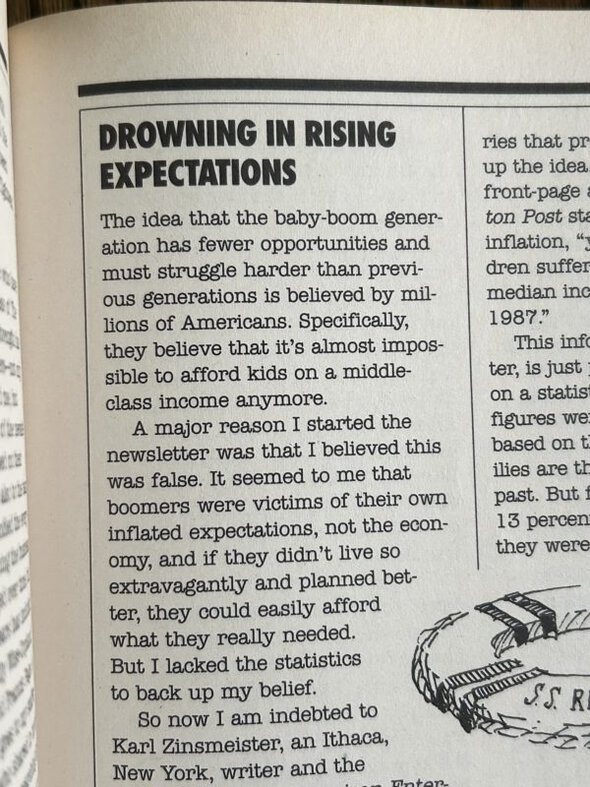
And this made me giggle a little because the tune of current generations is, "Oh, the baby boomers had it so much easier than we do!"
Apparently, we always believe the previous generation was strolling down easy street.
Amy shares a bunch of financial facts which show that in a lot of ways, the then-current generation was not worse off, and that part of the problem was inflated lifestyle expectations.
I am not up-to-date enough on current statistics to know if this is still true or not, but I want to highlight two of her main points:
- We do have some control over how we spend our money; not all of this spending is forced on us.
- There is little point in obsessively focusing on "how much easier" some other generation had it. It's better to spend your energy figuring out how to maximize your current circumstances.
This kind of reminds me of my habit of asking myself, "What CAN I do?". Because I'd rather feel empowered than helpless.
How does your food budget compare?
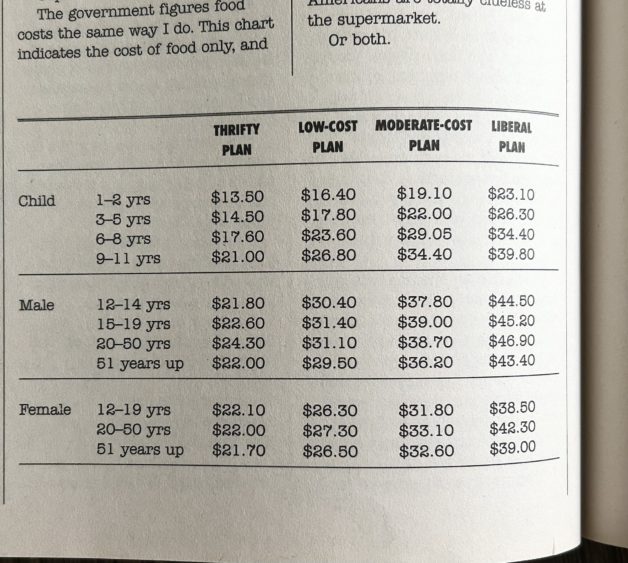
Amy shared the USDA's Cost of Food at Home chart for 1993, and of course, she and her family came in WAY below even the thrifty plan.
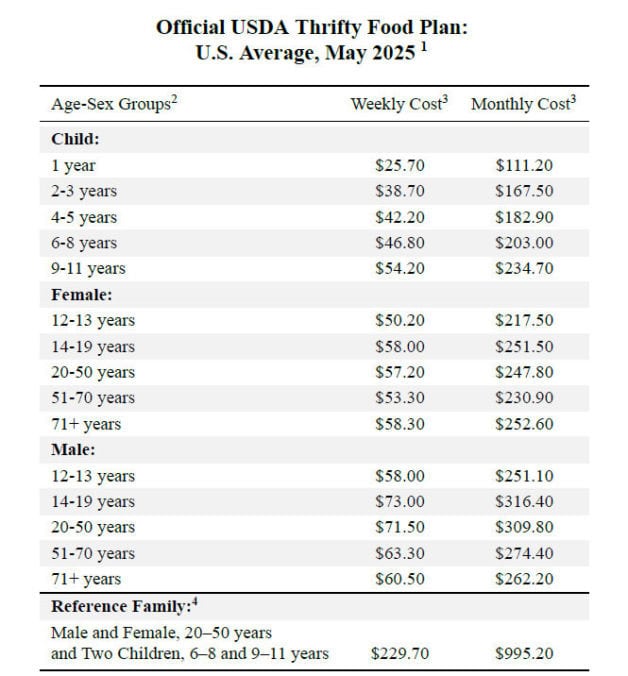
I was curious to see the current numbers, so here's the Thrifty plan for May 2025.
And here are the other plans for May 2025 (notably, there is a separate one for Hawaii and Alaska, which I have not included here!)
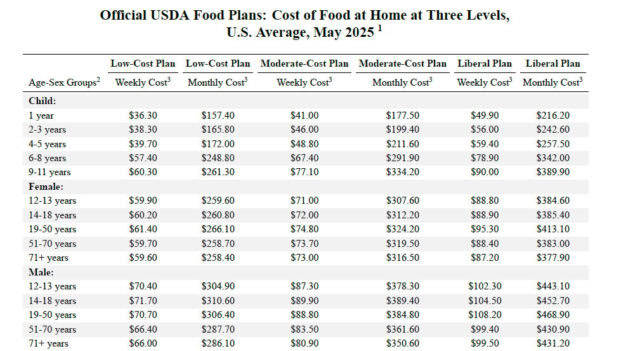
I believe this only includes actual food and beverages, not other items like paper products, cleaning products, toiletries, and so on.
Although I share my grocery totals each week, I actually haven't kept good track of my monthly food expenses lately. So I'm not sure off the top of my head where I land on the chart. However, I know for sure I don't spend the liberal amount ($95/person/week) and I also don't usually spend the moderate amount ($74.80/person/week).
Maaaybe I should keep track for a few months, just for fun!
Ooh! A DIY anti-static spray
A reader wrote in to say that you can mix one part fabric softener with 20 parts water to make an anti-static spray.
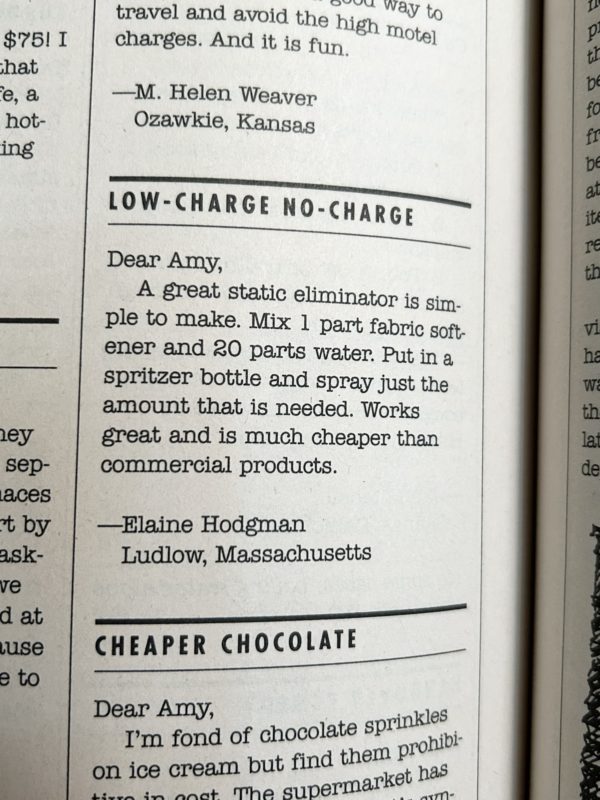
I googled to see if other people have tried this, and I came across a lot of articles recommending it.
This one suggests a 1 cup water: 2 tablespoons fabric softener ratio, with the addition of 2 tablespoons rubbing alcohol (to help the mixture evaporate faster once sprayed).

I don't use a lot of anti-static spray, but occasionally I haul out my can of Static Guard, especially for my black long-sleeved dress that I often wear to the symphony.

The commercial spray is kind of smelly, though, and it's aerosol, so this DIY version seems like a great alternative!
I will give it a try when my can is used up.
Refrigerator bread dough
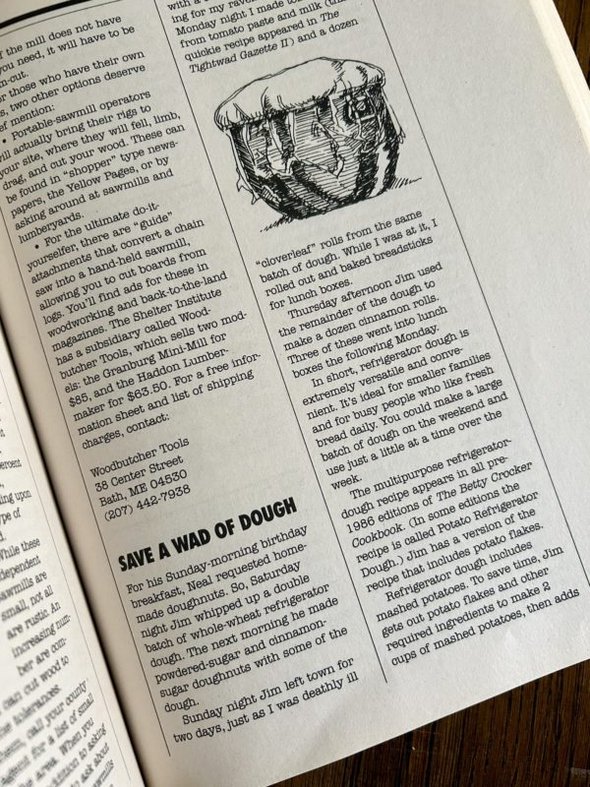
Interestingly, Amy wrote a whole feature about how awesome the Betty Crocker refrigerator dough is, but then didn't include the recipe.

However, a quick Google search turned up this forum where someone shared it.
Amy says the batch her husband makes is whole wheat, so I think they must have modified it; the original seems to be all white flour.

If you want to try it with whole wheat flour, I'd probably start with a 50/50 ratio of white and whole wheat flour, and then modify from there.
Amy says the dough is good in the fridge for five days, and you can just take out whatever amount you want, shape it as you wish, let it rise, and bake it.
This idea piqued my interest because I have a very small household now, which means that most yeast baking produces too much bread.
But if I adopted a refrigerator dough habit, I could have fresh bread on the regular. I might try this!
It reminds me a little of the Six-Week Bran Muffins that were popular in the 80s, except this is more versatile. Six-Week Bran Muffins are sort of a one-trick pony...you can have muffins, muffins, or muffins. 😉




The chart from Amy: are those numbers per week or per month?
As I am in Germany I cannot add anything valid to this discussion :-).
But I do know that grocery prices here in Germany are a kind of (very) low when compared to the rest of Europe. After all "LIDL" and "ALDI" originate in Germany......
And - shame on us - alcohol certainly is a kind of cheap here.
@Lea,
I'm pretty sure those were weekly rates. Back then, a thrifty goal was one dollar per person per meal per day. So $21 hits about the right amount for an adult for a week.
@Lea,
We will soon be making an errand run across the border again, and make a day out if it. What we save may well be spent on a nice lunch and some coffee but who cares? Meat is not much cheaper, but far better quality.
@Lea, I absolutely loved shopping in LIDL when I was in Munich. That store is amazing and I was struck by how cashiers in Europe (at least in Germany and Austria) sit rather than stand. I look forward to going back.
This reminds me of the grocery shopping pictures you used to post with the stuffed animals!
I wonder how the averages were calculated - some groups of people will need higher averages than others (Vimes's boots theory comes to mind). I expect that the average is higher in Denmark, but wages are generally higher as well. Maybe I should check!
I've never actually baked anything with yeast because for some reason I have a weird fear of messing it up, but I should - messing it up is part of learning, after all! Similarly, I know I could do better at saving money and sometimes fall into defeatist thinking.
@Sophie in Denmark,
Yeast baking - I like to bake with yeast. It is so easy actually....
@Kristin: my household is a also small right now (2 people) and homemade yeast baking goods freeze extremely well and therefore are very suitable for a very smalltalk household I find.
@Sophie in Denmark, You made me smile referring to Vimes! (Terry Pratchett fan here!)
@Lea, I bake all our breads and rolls and agree that the key is to utilize the freezer. We only thaw a half loaf of bread or a couple of rolls at a time.
Sophie -- yeast baking can be intimidating. It took me a few failures before I found a recipe that worked for me, so if this is something you're really interested in, keep trying.
@Cindi, I haven't read a lot of Terry Pratchett but I did meet him at an event once! He seemed very nice.
@Sophie in Denmark,
Didn't he co-write Good Omens? Great book, great series. Did not watch the sequel though, I am always afraid sequels will disappoint.
@JNL, Yes, he did!
@Cindi, @Sophie in Denmark Me, three!
Those charts are so interesting! I had no idea such a thing existed. I was surprised to see that our normal grocery/eating habits for a family of five (two adults, three children 7 and under) falls below the thrifty number. We usually spend $900-$1000/month for groceries, which I would have guessed to be average or even above average for our family size. I know I could spend less, but I really like to be sure we’re getting plenty of protein, lots of fresh produce, and our budget includes “hospitality,”cooking for guests or larger groups (20+) fairly regularly. Our meals don’t feel like deprivation or “thrifty.”
@Kyndra, I agree with your meals don't feel like deprivation or thrifty. I don't feel bad for buying beef steaks (sale) $5/pound when cheap ground beef/burger is regularly $5/pound. I feel like I win when I find pork chops for $2/pound instead of almost $5/pound.
According to the current Thrifty Plan, our family of six (four men aged 18-55, and 1 teenager, and me) would spend $414.60 a week. This last week, we spent $385.35 (food for us only, I subtracted donations and household goods). Not too shabby! Of course that number seems huge when I write it down, but I remind myself that we hardly ever eat out (road trips being the rare exception) and we eat very healthy meals, with lots of fresh produce, and we have nut allergies and a dairy allergy to contend with, as well as a low-to-no sugar diet.
Forgot to add, that aside from chicken nuggets (for the kiddo with braces, who can't bite into drumsticks or whathaveyou), I don't buy any readymade meals like TV dinners or meal kits. The most processed we get is ingredients like cheese, flour, oil, canned goods like beans and tomatoes. Oh, and turkey bacon and lunchmeat.
There is a fascinating book called, I believe, "How the World Eats" or something like that--where the authors take pictures of families around the globe and what they eat in a given week. Very interesting to contrast North American families' grocery hauls with those in other countries.
I just remembered, the book is "Hungry Planet: What the World Eats" and though it was published in 2005 it's still very interesting and probably relevant in some way!
@Karen A., There is a link with some of the photos here!
https://www.theguardian.com/lifeandstyle/gallery/2013/may/06/hungry-planet-what-world-eats
@Karen A., I reread my copy just last week. Fascinating study.
@Karen A., I own this book and have at the moment lent it to a friend, so I can´t verify where the quote comes from, but there is a country where they don´t know the meaning of " favourite food". There is just food or no food.
Hilde in Germany
@Hilde, Similarly, though I suspect on a very different scale: A friend had told me of a study in the U.S. about food and family income. In poor families, parents asked children after a meal, "Did you get enough?" In wealthy families, the question was, "Did you like your supper?"
@Karen A., we have food allergies also so many people don't realize that dairy free is significantly higher, especially the healthier versions. The only actual non dairy ice cream we can eat (found out allergic to coconut milk also) is $9 quart (plain vanilla). I remember my (now Ex) husband saying to me (when it was $7) are you really going to pay that much when regular ice cream $2-$3?
@Karen A.,
Thanks for recommending - I'll see if our library can get hold of it!
@Sophie in Denmark, Thank you for sharing! That was so interesting, and very evocative.
@Regina, I have been using my Vitamix to make "smoothie bowls" for my son who has braces--I can sneak in veggies like frozen riced cauliflower, or spinach--and I've found soymilk plus enough frozen fruit like bananas and such, in the right proportions, make a good "soft serve" texture!
@Regina,
Theres a good reason he's now your ex. 😉 Food allergies are no joke.
Amy's wisdom and practical advice (original and shared by her readers) is timeless. I have thought about the Rising Expectations article so often in the current economic situation.
I have all 3 of her books and love to reread them for inspiration and ideas I may have missed in the past, such as the anti-static recipe.
What are they buying to get those numbers? My current budget for food I spend on 6 people ( 2 adults, 3 teen boys, 1 girl) is what they would spend only on the three boys. I wonder if they're including restaurants and take out? But I know prices are higher- I used to feed a much large group (10) for less than that 10 years ago.
Isn't interesting how there are fads in cooking - refrigerator bread, bran muffins, sourdough recently. there was also a named sourdough type starter ( I think my recipe was called Harvey) that you fed and then could use for cake or bread.
That refrigerator dough uses mashed potatoes - those tend to make a very luscious moist bread. I think I'll try this after the heat wave is done!
@mbmom11, I would like to know as well what "basket" of items or recommended servings they use to create those figures, and how it's averaged across the US.
Our family of 3 (2 adults, 1 toddler), spends about 60% of the recommended thrifty plan - and it honestly could be lower, but we have invested in a few more convivence items to encourage less eating out (down from 1x a week to once every 2-3 weeks). Even adding in eating out 2x a month, we'd be well under the thifty plan. I feel we eat pretty well - lots of fresh veg from local farm stands, chicken/lean beef/fish bought on sale, etc.
@Mallory L.,
in 2006 recommended serving sizes were the same as 1950. Not sure if have changed since then.
I shop at Whole Foods which is not considered budget-friendly by any means and my monthly total still comes way below the thrifty plan from 2025. I also would be interested in how these numbers were calculated (surveys from real families?) and what is included (takeout/restaurant meals).
As a reporter and a historian, I must respectfully point out that Amy's book and your post do not adjust the money figures for inflation.
To do that, one can go to the West Egg Inflation Calculator online and fill in the blanks. Since we are still in 2025, it only goes through 2024, as the year must end before they can calculate inflation for that year.
As an example, I took the figure for a 1-2 y.o. child on the 1993 Liberal Plan and plugged it in. Per the West Egg Inflation Calculator, "What cost $23.10 in 1993 would cost $50.97 in 2024. Also, if you were to buy exactly the same products in 2024 and 1993,
they would cost you $23.10 and $10.47 respectively."
It is unclear whether the $23.10 figure was a weekly or monthly one, but I suspect weekly. Assuming it is weekly, the $50.97 is in the range of the $49.90 and $56.00 that the second chart for today's prices says is the liberal figure for a 1 y.o. child and a 2-3 y.o. respectively. So, adjusting for inflation, it really hasn't changed all that much.
Mind you, that calculation is using last year's statistics. Since prices have jumped sky-high this year, I imagine that the 2025 figures will likewise increase by quite a bit. But we'll have to wait until 2026 for them to update the Inflation Calculator chart.
You can play with this chart yourselves to see if today's prices are wildly off the charts, but perhaps they're not so outrageously different after all.
@Fru-gal Lisa,
Thank you for this! Numbers mean nothing without context.
@Fru-gal Lisa, I noticed that my monthly food amount increased May 2024 & stayed increased after that. And in all honesty we buy mostly the same food with not much variation.
I had put myself on a $50 a week budget, then upped it to $60, then realized I was spending so much time and effort thinking about it that it was making me kooky putz! So, I adopted a strategy called "buy what you need" and I use digital coupons and an HEB Partner card, provided by Son #2. Into my grocery expenses each week I add whatever personal care or cleaning products I need. So it ends up being around $75/week on average. For one person, that's not terrible. I eat most of my meals at home and I have very little waste - not no waste, but very little. I'm still working full-time and I can cut corners elsewhere.
Try Angel Biscuits for fridge dough -sorry I don't have the recipe with me right now. It's leavened with both yeast and baking powder and can sit in the fridge about a week.
As for your stats, I know two very significant things are only getting harder for current generations: housing and education. All one needs do is look at what percentage of household income each takes now.
Education: in real terms, a 4 year college degree is over twice as much as it was 50 years ago and there are fewer grants annd scholarships available now. Yes, there are alternatives but I'm comparing like to like. My alma mater costs over THREE TIMES what it did when I attended.
Housing: I'm not sure if I even need to say anything. But you know I will, right? It's much worse after the labor and developer losses after the Great Recession, of course, but relative prices have increased dramatically. When I graduated from grad school I bought a nice, well-located 700ish ft(2) condo with parking in a highly walkable city neighborhood - grocery, hardware, subway, entertainment, all of it. It cost less than 1 year's typical income for my degree. Now, thanks to the magic of the internet I can tell you it is now more than 3 year's income.
@WilliamB, And most jobs also want a master's as well as a degree!
When my parents went to university their education was paid for by grants. I am paying back student loans (and am lucky to have graduated before they trebled in cost). I was very fortunate that my master's was free, as I was eligible at the time for a free EU course in Denmark. Renting in the UK and Denmark is incredibly expensive on a single budget. If you are born in Denmark, you can be put on a list for cheaper renting when you are born, but I was born in England.
@WilliamB, for a musical take on this question, watch the Simpsons episode "Poorhouse Rock" (Hulu, I think), inspired by the Atlantic article "The Life in the Simpsons Is No Longer Attainable" (paywall, trial subscription).
https://www.theatlantic.com/ideas/archive/2020/12/life-simpsons-no-longer-attainable/617499/
PS: all prices calculated in real terms thanks to the magic of the Westegg Inflation Calculator.
@WilliamB, This is the Simpsons video mentioned, in case people can't get behind the paywall:
https://www.youtube.com/watch?v=5MjTWtS5TAI
@WilliamB, Apropos of your comments, and purely by coincidence, I recently ran current cost of my 4-year undergraduate program versus what it cost when I matriculated, and the current cost of my professional degree versus same.
I had a free ride through undergraduate school thanks to multiple scholarships; at today's price, it would have cost$87,446 a year for tuition, room and board (but not including books, incidental expenses, travel to/from). Times 4 years = $350,000. And I got to spend a year abroad at the London School of Economics on my college's dime.
3 years of professional school at my alma mater (I had scholarships, worked on campus, and had a small loan ($10,000 which, at the time, seemed huge) is now $77,700/year = $233,100. That does not include room and board, books, travel to/from, etc.
So just about $600,000 now versus $10,000 then. No wonder people are sinking under the weight of student loans.
@WilliamB, We are in the middle of selling our house and my husband was just commenting on the difference (house cost compared to salary) between ten years ago when we bought it and now. It's pretty crazy! Even considering the many upgrades we've made, the difference in price is incredible.
Depending on the week, my spending as an almost 70-year-old single female may be thrifty, low, moderate, or liberal as defined by this plan. I concede that I have room for improvement. However, I'd like to know for sure whether the plan covers food only or some non-food grocery purchases.
@A. Marie, the USDA food plans are just food and beverages! (Source: USDA website)
@Andrea G / Midwest Andrea, thanks for the confirmation.
@A. Marie, I think I may average out to the USDA amounts for weekly/monthly expenditures, but I know there are big blips week to week and month to month depending on how much I have to replenish staple items, take advantage of sales/specials, etc.
Family of 7.
Five kids.
We spend $180-$200 a week.
Thrifty spending should have us at $355.60.
I don’t think many people track just food spending since most food shopping trips include householdand/or personal care products. That being said I suspect if I removed household and other non food items we would come in at the moderate level for an over 71 couple.
@Juhli, I should add that I live in a high cost area near San Francisco and don’t garden. I am rather shocked at how much less food they allocate for preteen and teen girls vs boys in the 2025 chart. I don’t recall eating that much less than my brother during those years.
@Juhli,
I was just thinking that I really don't know what we spend for food in our household (2 adults, 1 teen boy). When I grocery shop, there's almost always cleaning products, paper goods (we use an ungodly number of paper towels, tissues, and toilet paper - I know we could do better, but cannot convince DH and son), and personal care items mixed in.
Plus, may I complain about my DH's soft drink addiction? Not looking for advice, I just need to complain.....he drinks A TON of diet Mountain Dew and diet root beer. Every. Single. Day. It's not good for his health, and it's EXPENSIVE. We've discussed it ad nauseum, he knows its not good for him, but he just can't kick the habit. :-/
(Rant over)
I agree with mbmom11 and Kristen that it's fun to think back on the various baking crazes. We don't (can't) eat much bread anymore, but for years I used the Artisan Bread in 5 minutes a day concept and we loved it. Suuuuper easy: mix up some flour/water/yeast, let it sit out on counter for a bit, cover and keep in fridge, pull out however much you want @ 30 minutes ahead, and bake in a preheated dutch oven to get the crispy crust. Here's one link: https://anoregoncottage.com/easy-artisan-bread/#recipe
I bounce around on that chart, but my average is generally low-cost to sometimes thrifty. Since I buy a good amount of organic, local farm products, where regular ground beef can be up to $11 a pound and milk $17 a gallon (I don't pay those highest prices! I choose the lowest cost options amongst several farms.), I knew I wasn't going to hit thrifty or below thrifty very often, and I don't. I used to, when the whole family was home - I generally was at thrifty or lower. These days, I gulp when I buy the higher priced stuff, but it's been worth it to me. I save by cooking almost exclusively from scratch at home, I almost never eat out or get take out, and I keep food waste to very, very rare occasions. I can't imagine what people are eating to pay the high end of that scale. Naturally, living in a high cost area will affect one's budget, so I guess that could move one into the higher cost columns. In fact, groceries are not as cheap here as one would think, although nothing like some areas have to pay.
I remember that anti-static formula, but I don't buy fabric softener, so I've never tried it. I have tried rubbing lotion on my pantyhose, which helps, but not if you don't wear pantyhose, obviously.
I remember that refrigerator dough. I make bread products rarely now, but in the good old days when I could eat all the gluten I wanted, I always froze my extra breads after I baked them. I didn't want to take up space in the refrigerator for the dough or be obligated to heat the oven up several times for one batch of dough. But I know people who found the refrigerator dough worked great for them. Give it a try and report back! It is hard to beat fresh-from-the-oven bread, that's for sure.
I hired my 20 yo nephew for summer grunt labor (his words) and he picks my brain during lunch break regarding finances, budgets and future planning. Every week his buddies come over and we make bread, snacks from scratch, dehydrating fruits, making granola, fruit leathers, jerky and yogurt.
They are learning how to mend, sew buttons and simple crochet. I'm teaching them on a 1935 sewing machine that sews leather, canvas.
I have been reading my great grannies journals (she was born in 1888) so much of my day to day mirrors her life. Living close to the earth, simple joys, enjoying some modern conveniences (living without my instapot? Big no).
@Blue Gate Farmgirl, what a beautiful life! So cool that you're sharing it with your nephew & buddies - giant bonus for them.
@Blue Gate Farmgirl, What a treasure those journals are! I would love to read them.
@Blue Gate Farmgirl, way to go! Your nephew is one lucky (and smart) kid—love it when we realize they have been paying attention all along when we casually talk about finances, health, life, etc. Sounds like he’s getting a great education this summer!
@Blue Gate Farmgirl,
Your nephew and his buddies are going to become fantastic husbands, learning all of that!
@Blue Gate Farmgirl, I love reading about your time with the young men! They are so lucky to have you guiding them.
@Blue Gate Farmgirl,
Can we pretend I'm your much older niece, and you can hire me for grunt work? Ha. 🙂
@Blue Gate Farmgirl, Loved everything about this post. And I know you realize how fortunate you are to have those journals.
This was interesting. According to the chart, the two of us would spend $500 on the thrifty plan. I just checked and we're averaging $400 a month this year. I was a little surprised because we eat really well -- lots of protein and fresh vegetables and fruit, and a few convenience items like chips and canned seltzer. I will say that years ago when we were focused on saving enough that my husband could retire, I became very serious about making as much as possible from scratch and not wasting anything. Those habits became ingrained and I still practice most of them -- what was difficult in the beginning became second nature after a while. I guess the biggest habit gained from those years is we very rarely eat out. I'm sure we would spend much more if we were raising children, who are growing and need a lot of food. We're two older people with not very big appetites.
I have been using the usda charts since 2012 to gauge my food spending. The highest I ever got on the scale was frugal. Currently I’m probably between the lowest two. It’s hard to gauge because of my situation (me + 3 kids half the time, but one eats for fun and not for the bulk of their nutrition) and because I don’t separate out food items from other things I get at the grocery store.
There is a book called Artisan Bread in 5 Minutes a Day that has refrigerator doughs for all kinds of bread, from boule to brioche. I love it for my small family or for making for a crowd.
There’s a healthy version of the book too.
I'm a big fan of the cookbook Artisan Bread in Five Minutes a day. It has so many yeast bread recipes where the dough hangs out in the fridge until you need it. It does take up some fridge space to keep the dough, but all the loafs I've made have been delicious.
@Geneva, Or until you knead it? (Sorry! Couldn't help myself.)
@JDinNM, Ha!!!
@Kristen - Zoe Francois highlights this refrigerator dough concept in her book The Best of Artisan Bread in Five Minutes a Day. There is a recipe in there where you mix up the dough and then pull from it as you need it, rise and bake. I have tried it and it is very good. When we enter soup season this is a great trick to have up your sleeve as there is not much better than a homemade bowl of soup along side some fresh crusty bread on a cool night.
I always find the poverty levels interesting. In 2013 we averaged $45 a week for groceries with the chart says we should be around 129. I have a similar result now. I know buying meat in bulk, gardening and preserving helps but really don't know how I would spend 258 a week every week. Although my neice has a 4 person family and doesn't do these things and has said groceries cost her $200. I just find it interesting.
Thank you so much for sharing this! Since the cost of groceries has gone up so much, I wondered if I was way overspending. I consider myself a liberal spender at the grocery store, as it helps curb restaurant/takeout spend. For my family of four, the liberal spend is about $1400/month and I am on target with that. We spend about $300/week on our main grocery store run at Harris Teeter, and this does not include mid-week pickups, the farmers market, and Costco ($400/month though not strictly for food). We also have dietary issues (lactose, gluten) that result in some higher costs.
FWIW, I live in a suburb of Raleigh, NC and my anecdotal assessment is that our grocery store prices are higher here than where the rest of my family lives (in the Northeast).
@Meeghan, I live in Raleigh, Harris Teeter is very expensive. I only shop them for sales items. Aldi and Costco all the way. And you are correct the farmers market has gotten very expensive also. I am fortunate to be in my church community garden and also have a garden at home.
@karen, and at Costco I never buy their prepared foods. I can buy rotisserie chicken and make my own chicken soup and chicken salad. If you buy their premade it is so much more expensive.
I check in with the thrifty plan regularly, to see if our grocery budget is getting inflated by our meal choices or general inflation! Pay attention to the footnotes, because there is an adjustment for buying for a single or couple household opposed to family of 4. Even without the 10% adjustment for there only being 2 of us, we are right at the thrifty plan budget, and our grocery budget includes vitamins, toilet paper, and essential toiletries. I think part of that is living in a low cost of living area, but also our efforts to not waste food and other frugal hallmarks of meal making!
My spending for any given week can range from well below the thrifty plan up to the liberal plan, but on a monthly basis, I almost always come in under the thrifty plan. A spendy month for me is one where I spend over $200 on food.
For everyone wondering exactly what's included, you can find all the official publications here: https://www.fns.usda.gov/research/cnpp/usda-food-plans/cost-food-monthly-reports
It seems to be only food and drink, and not from restaurants, basically the same things you can buy with SNAP benefits, since these numbers are used as the basis for the amount of benefits a person or family can get.
Here in Michigan, my family of five (with all 3 kids in the range they gave for their example family) spends less than their example family of four. That's encouraging!
I'm in California and the USDA numbers seem high (although maybe they would say we should eat more fruit). It has taken me awhile to get used to how much a toddler eats. In my mind I was budgeting for a family of two but we really are feeding three.
Same as many here, I use the USDA guidelines as interesting data while I tally my grocery spending each month. Depending on what I'm stocking up on that month or how many extra diners with us or birthdays we're celebrating, sometimes we're way under thrifty and other times we're a bit over. It's hard to have a national figure when some areas are so much pricier for food, and others you are spending a lot more in gas to get to decent markets. But I find the average interesting nonetheless.
Hm, that was absolutely FASCINATING and thank you for sharing! I converted into Canadian dollars and I was stunned to discover that our food-at-home spending is actually less than the "low-cost" plan, and that spending includes soap/toiletries/paper products. And here I was feeling pretty bad about our food spending! Our local grocery stores are all non-discount grocers, and I've been too tired to meal plan and do big weekly shops at the discount grocer that's farther away. I guess it's really true that if you eat at home, you can buy 'most anything at the grocery store.
I laughed when you started out that the younger generations blaming older generation about how rough the younger generation has it & older generation had it SOOO EASY. 🙂 That definitely is the thing right now. I don't recall hearing much about that until the last few years, but it's not something that I would be talking about because I know it's definitely not true.
I was fortunate enough to have 4 generations alive at same time. My great grandparents hosted us great grand kids (I was 8-9) for a week in the summer at the lake they lived at & I remember Nanny showing me/us tricks to make food last longer (old baked goods/donuts that got frozen & warmed up to eat that day--just enough so no leftovers), my grandparents lived not too far where they owned a country store so outdated items were taken home to use or given to the wildlife.
My grandparents later sold that store after my great grandparents died & then moved to a farm where we learned so much about food & frugality.
Today's food costs chart/grid was surprising to me, as I think I had commented last year about then cost information. This years costs per person was higher than expected, even at the lowest amount. Here I have been thinking I need to be doing better (cost per person) but am still under the lowest price per person. But I also buy the healthier not just the cheapest, which I know increases costs but it is (mostly) worth it to me.
I have been doing expenses spreadsheet for 4-5 years now. I recall when I started doing it (now Ex was complaining about not having money for new ____) that I searched different available spreadsheet to see how they broke into categories & decided that food only & non food separate & eating out seperate (one reader said she considers eating out as entertainment 🙂 ). I have kept doing just to see how compares to previous month/year.
I'm interested in hearing if anyone (Kristen) tries the refrigerator bread dough (not just white) how they think if it works well, was it worth it (cost & time) & taste comparison. I love to make bread (have done in past for neighbors holiday gift) but (like Kristen) not many people to eat before going bad (my store bread goes in refrigerator to keep longer). Teen wants me to get bread maker but I'm not a fan of teflon & prefer to make in oven with cast iron, stoneware or glass. If there was a non teflon option I would consider it as I know bread makers do a faster job.
Apparently it was happening back then too; enough that Amy wrote an article about it!
@Kristen, My dad read a book published in 1910 complaining about how the young people of today 'eat buns and do nothing!'
@Regina, I mentioned above that I used to make bread on demand with the "Artisan Bread in 5 minutes a day" concept - I usually used all whole wheat flour (sometimes added some vital wheat gluten to get a little less dense); you store the dough in the fridge and then take out however much you want @ half hour ahead, preheat your dutch oven while the dough rests, and bake at high heat (like Kristen's pizza!)
The anti-static spray works quite well. When I worked at an arcade in college, we had to treat the carpet in front of the machines a couple of times a day with it, or else people would get zapped by the machines (dry New Mexico air, synthetic carpet, everybody wears sneakers). Well, really, they would zap the machines, which would then reset, which tended to make people grumpy 😉
For two people and three cats, we spend about $800/month. That includes the usual non-food items. The cats work out to be about $130 of that, thanks to expensive prescription food. Subtracting out the non-food, non-cat items (vitamins, OTC meds, etc), I'd ballpark it around $550-$600. We have some form of animal protein at all meals, but I try to make up for it cost-wise by bulk-buying where feasible (frozen meats, paper products, etc at Costco). Oddly, neither oats nor farro are available in reasonably-large quantities locally; I get them from foodtolive.com, as they have pretty good prices on a bunch of semi-bulk foods such as those and free shipping (not a paid endorsement, etc, etc).
While I am lumped in with the "boomers", I think those born 1960-1964 are NOT the same boomers as those born earlier. I do think 1946-1959 boomers are spoiled and a bit entitled - honestly they grew up during the best US economy in history. Most got jobs that qualified them as middle class (read: before the war on the middle class/unions started).
I also think the oldest boomers are particularly selfish and have little to no empathy for others. We'll see how the dinks do once they "get old". One set of dinks on my side of the family who won't be hung out to dry in their old age. Better half's side of the family - good luck Chuck. You're not going to inherit (dinks) and those that purchased their kids, I doubt either will be there for you when you need help. To be blunt, I don't blame the kids - an example of why some people just should have kids.
I'm proud to say I've remained a Middle Class Mabel despite raygun and after's best attempt to make me low income.
Wages have not kept up with inflation - there is no denying this. Federal minimum wage is woefully out of touch and far too many states use that.
@Selena, wow, you have stereotyped an entire generation. As an older boomer I suggest you reconsider your conclusions.
As a baby boomer who spent a career working with baby boomers, I confess, we are a generation of complainers. Amy was right then and is definitely still correct. Her points are timeless.
As a young mom, I used to check the USDA food spending guidelines every few years and they were always way above my food budget. I always wondered if they polled real people to get the numbers.
My husband signed up for a nutrition study during the bran heyday and was paid to eat nothing but bran muffin for an entire month. Bran is one thing he refuses to eat.
Oh my goodness, seriously nothing but bran muffins morning, noon, and night???
@Kristen, he worked for USDA, which sponsored the study and paid him for his participation.
@Kristen, yes!
I don’t think that my baby boomer sisters , friends, and I think that our parents had it easier than us. Our parents lived through the Depression and World War 2. Some immigrated to Canada to start over after WW2.
But I do think that younger people have a harder time getting ahead than most of my generation did.
About 50 years ago, when I was attending UBC in Vancouver, BC, my first year tuition was about $464, and we could get summer jobs that covered most if not all of our expenses for school. I looked up the cost of first year tuition now and it is over $6000. In the seventies and early eighties, rent was very affordable in Vancouver, not so now. Also, getting summer jobs to cover the school year expenses isn’t always easy. No wonder post secondary graduates are drowning in student debt. Of course, some students benefit from education saving plans or family financial help.
And then there’s the cost of buying a home nowadays…
the boomers are 1946 to 1964! as i am the first of the baby boomers bo4n 1946, i grew up with parents and a grandmother who lived thru the depression. my grandmother would make dinner from scratch (not the meat, but pretty much every other part of the dinner), growing tom, veg, basil corn, potatoes etc. she made the dough for pizza and canned tom for the sauce. she sewed holes in our socks and all other clever ideas to save money! it helped that my bc my dad owned a small grocery store and took home the meats, eggs, milk at a discount! he to was frugal! when things had to be fixed around the house, he did what he knew best - after my parents passed away and i cleaned the housse out i saw many of my dad's handymans frugality - some were pretty funny! all in all, here i am 78 and when my daughter was born i went to thrft shops, tried to sew some clothes for her and me, budgeted dinners etc did alot of diy in the house.. well today, between helping family out all the time, financially, my fruigality has gone out the window! the way i see it, maybe i have a place in heaven bc i'm not spending the money on myself!!! at my age, i'm not worrying! good luck to everyone here!
For my husband and I, the total thrifty plan would be $547/month. On average we spend $273/month, and that does include cleaning products, paper products and toiletries. We live in rural Maine.