
Three Homeschooling Questions
Hi there!
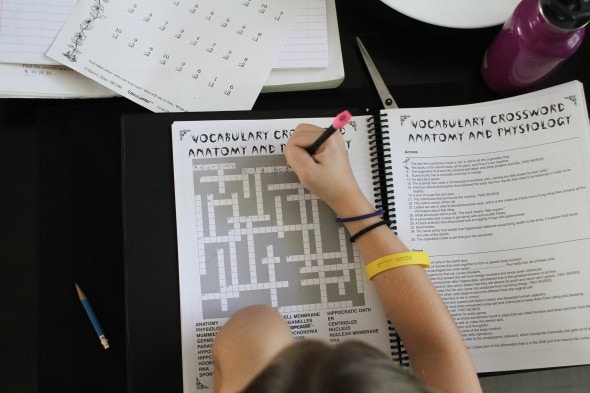
I love your blog and I had a few quick questions about your homeschooling methods. I am amazed at your ability to juggle four little people, and I was wondering when you started homeschooling (what age). I have two children, one is seven and we are well into school, and the other is 2.5 and is constantly begging to do school. Did you run into this problem with your younger ones?
You mentioned one of your children was reading by the time kindergarten rolled around.....is that because you did some sort of schooling with her beforehand?
Lastly, is there a curriculum you have found helpful when it comes to handwriting? I've been struggling to find one we can use that doesn't cause a tearful reaction the minute I pull it from the shelf.
Thank you!
Melissa
Well, my four little people aren't quite SO little anymore. They're 16, (almost) 15, 12, and 10 now. But I did manage four small people back in the day. 😉

Regarding your first question, yes, that happened most often when my third kiddo (Sonia) started school.
That left kiddo #4 (Zoe) without a playmate, so she hung out with Sonia and me while we worked on school, and I sometimes gave her something to color or some other kind of busywork to do to keep her occupied.
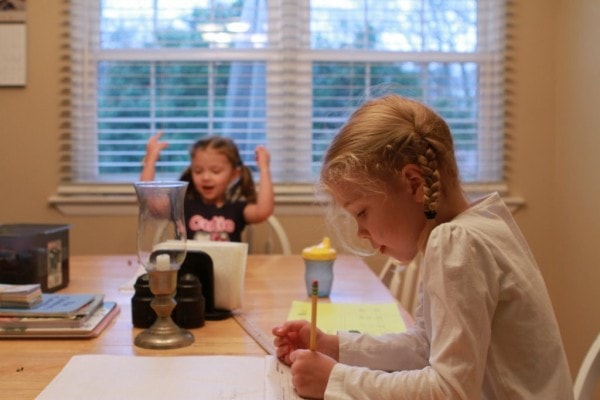
(Snacks, coloring, watercolor painting, play-doh, and dot-to-dots all were helpful for us.)
That leads perfectly into your next question: Zoe was indeed reading before she started kindergarten, and I think that's partly because she sat with Sonia and me while we worked on beginning phonics and reading.
I wasn't officially teaching her, but she soaked it up just from watching and listening to Sonia.
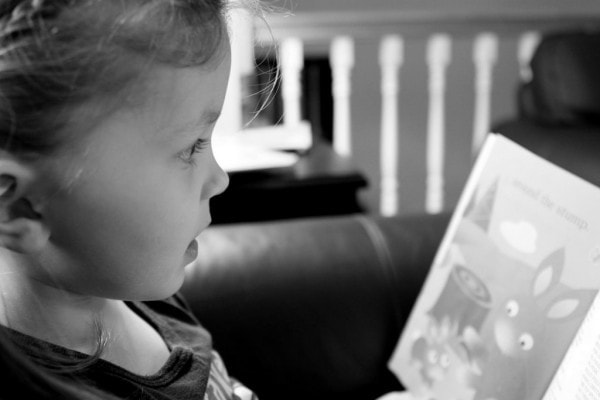
(I don't necessarily think this will happen with every kid. Zoe is probably naturally inclined toward reading and she'd have picked it up quickly in kindergarten if she hadn't learned early. Reading comes easily to some kids and more slowly to others.)
I definitely did NOT stress about doing preschool academics with my kids. I read out loud to them, of course, but we didn't ever do workbooks or formal learning before kindergarten.
I think the preschool years are wonderful times to freely learn by playing, having conversations, and being read to, and there's no rush to hurry up and jump into formal learning.
(This Slate article offers some interesting thoughts/research about preschool. And this NY Times article is also relevant.)
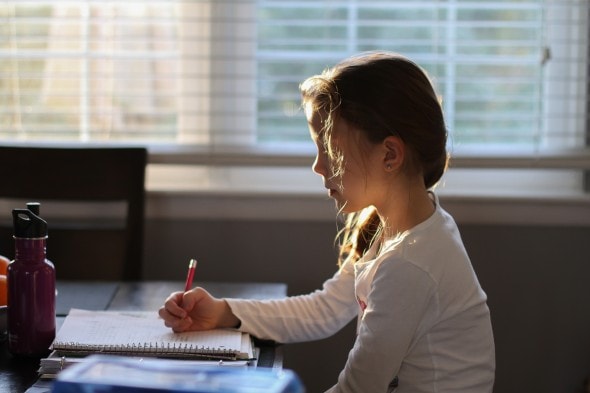
It's not that I think that it's necessarily harmful to do some ABCs and such in the preschool years, especially if your child is interested. I just don't think it's a dire necessity, especially if you're talking to your kids and reading to them and giving them enough screen-free time to allow for imaginative play.
And I definitely don't think it's important to work really hard at getting your kids to read before kindergarten. Two of mine were early readers, two were not, and all four of them are very competent readers now.

If reading happens early, great. If not, that's just fine too.
On the handwriting front: I've used Handwriting Without Tears for all of my kids.
Unfortunately, all four of them DID shed some tears while using this curriculum. But I think maybe there would have been more tears with other curricula?
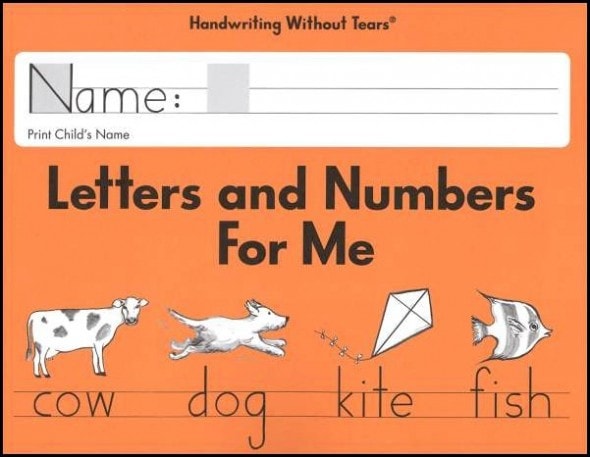
One thing that's great about Handwriting Without Tears is that the daily assignments are very short. So even if your kiddo does hate the exercises, he/she will still be done with them pretty speedily.
(Related: A 2015-2016 full curriculum list for all four of my kids)
______________________
Readers, share your advice with Melissa! If you've homeschooled, how did you handle your preschoolers during school time? Also, any good handwriting suggestions?
And homeschooling/non-homeschooling people alike, feel free to share your thoughts about preschool and early reading.


We are on our third year of partial homeschool. My oldest goes to 'real' school, but will be coming back home for the 16/17 school year, so this will be the first year of two students - fortunately my boys are only 2 years apart so I'm using a Sonlight core for them.
We like A Reason for Handwriting. It's Christian based, but is a lot of fun. They use a treehouse to explain parts of the letter and both boys have taken to it well - we have also used Handwriting Without Tears, but it's not my favorite 🙂
We have homeschooled our oldest at times, due to severe dyslexia and autism, but mostly he has gone to school with the other two. I think I have tried nearly every way that exists to teach a child to read and write with him and the handwriting curriculum you mention, Kristen, was the least melodramatic and his handwriting is fairly presentable.
As for reading...ha! We have seen just about every permutation. The oldest adores books but didn't read competently until he was 13. THIRTEEN. It was rough. We finally invested heavily in a private tutoring method called Lindamood Bell and he went from kindergarten reading level to 5th in one year. The middle son was an early and very competent reader...above grade level, but has rwading comprehension issues that we have worked on a lot. He can read anything but used to only "get" half of it. The third son was uninterested in reading until he was six...then he was reading chapter books within about 6 weeks. 0-60 in nothing flat. It was wild. He remains the best and most enthusiastic reader. The one that cheers when I bring home new books. The reading comp challenged one thinks most books are "boring" and the one with dyslexia is still trying to accept he can actually read almost anything (5th grade reading level means you read just about anything, esp. if your comprehension is normal or above average). Reading has been a dramatic thing in our house...which I didn't anticipate. My mom thinks I must have taught myself to read at 3 because I was reading livrary books then and no one actually taught me phonics. I foolishly expected things to be easier for my kids than they were. Life is humbling, no?
Lol..."library"
Wow, I am thrilled to hear this about your thirteen year old! Professional at my school are constantly saying if you don't read by 7 or 8 it won't happen. So wonderful that you guys persevered and your son can read!! Have never heard of this method and will be looking for it.
congratulations on the success of all your hard work -- very inspiring as I go to work today!
I meant to say that imposing artificial limits on any skill acquisition seems dunderheaded. kudos!
Yes, we were told similarly dispiriting things. Our public school completion-tracked him when he was 7. We left and never looked back. He is now attending a school that specializes in Aspergers and learning disabilities and is thriving. Here's to hoping we are ready to have an easier time of it!
My eldest has had "issues" all his life but was dismissed because mum had been a special ed teacher. At the age of 22 he was finally diagnosed as autistic. But he functions very well. He now loves to read but I still question is comprehension. He works as a qualified chef and you do exactly as the recipe or your boss tells you and it works fine for him. He was nearly 13 before he could read indepently.
Whoops please forgive my spelling errors.
Two of my homeschooled brothers-in-law also were in the very delayed reading camp. .. one learned to read at 14 and went on to 4.0 in college. He just wasn't ready. The other learned a little later than that and isn't the strongest reader, but is definitely able to read now. Those averages are just that. Averages. There are always outliers on either end of the spectrum.
The very experienced retired educator who performs our homeschool reviews commented when I told her I struggled to get my 1st-grader away from playing, "Just let him play. That's what's best for him right now."
I think handwriting is just about the same at reading, math, spelling, etc. If your child likes it, it doesn't matter what the curriculum is. If your child struggles, he will struggle regardless of the curriculum.
My experience is as a special ed. teacher for severe K-3 and would just add that handwriting is often not preferred 🙂 We, too, use some Handwriting without Tears, but we also pull up interesting FREE worksheets on line that support letter of the week activities. So during R week, it was robots, rockets, etc, and appropriately themed worksheets that made it a bit more interesting. They practice the letter and the words and color in the pictures and sometimes turn the sheet over for more practice. Finding sheets that relate to their interests can be helpful.
So agree with Kristin about pre-school being a time to NOT do worksheets and heavy academics. "Playing is their work," is what our wonderful preschool teacher said. It's wonderful when the younger sibs want to join in and to have activities so they can join in. Good luck!
We've been homeschooling for 10 years now. I have 4 kids, and for one season I was babysitting my niece which upped my kid numbers to 5. My niece and youngest are the same age. It was like having twins. I always put together a special "school" box for the smallest kids to pull out on school days they were having trouble keeping themselves occupied. Also, we added Circle Time to get our day started when all the kids sat together and we did Bible, memorization, history. That gave the smallest kids a feeling of them having done school, plus it helped to teach them how to sit still when it was expected of them!
At work we use zoophonics is my preschool classroom. I like it a lot. It teaches them the letter sounds and builds from there on letter recognition. We also use handwriting without tears. Of course I'm just introducing it, they learn sight words in preK then go on to kindergarten. But I think you could use zoophonics in a home setting too.
One note about the handwriting: handwriting w/o tears is great, but if you think your kid is really behind for his age, talk to your doctor for an OT evaluation. My son struggled mightily with writing, and it wasn't until the end of 1st grade that we got an evaluation. He has fine motor and coordination deficits that he was able to compensate for in other areas but not writing or shoe tying. We got great services to help strengthen this deficit, and he's now a very successful HS junior who mostly types as his typing our paces his writing by a mile.
Of course, many kids just don't like to write and have no underlying issue, but since you are homeschooling, a deficit like my son's might fly under the radar a little longer. It is very beneficial to start treatment as young as possible if there is a gap.
As an OT, I say "yes!" to getting therapy services. Fine motor skills are addressed by occupational therapists. Many kids also have sensory processing disorders and a good OT can help navigate that. Here's a helpful link: http://www.spdfoundation.net/about-sensory-processing-disorder. Sadly, parents may have to fight to get OT services provided in a public school setting. I have an acquaintance whose son was denied services in school. The parents are driving 45 minutes away to get him the services he needs, but she says it has made a world of difference for the boy.
Kristen, a book I stumbled on this past fall that I think you would find very interesting is The Self Motivated Kid by Dr. Shimi Kang. It dovetails nicely with your NY Times article.
On a personal level--we send our kids to public school. Both children are good readers. My son learned in kindergarten and my daughter was reading proficiently at age 4. She has a November birthday and despite her academic skills, we chose to have her start school when she was 5, going on 6 (we had the option to start her at age 4 in our state of Michigan) due to her struggles with socialization. I am SO glad we did that and would recommend it to anyone on the fence about starting their children in the school system versus keeping them home for a year. It gave her the time and space she needed to grow and mature and while we have had struggles with her shyness, it has been more manageable.
For similar reasons, I sent my children to preschool. I was a stay-at-home mom during the week and worked Saturdays when my husband could care for the kids. We are a family of introverts and while we sent our kids to church activities/playgroups, I felt that preschool helped them connect and develop socially. Both of my kids had at least one friend from preschool when they transitioned to kindergarten, which helped minimize their anxiety.
I enjoyed reading the comments. Each child is different and a caring, committed parent typically will find a way through the struggles. I wholeheartedly agree that play and creativity are much more important than the heavy push toward structured learning that is so prevalent in the public schools today. I shudder when I hear about parents using flash cards and other learning tools. Who wants to work that hard? Snuggle your children and make funny voices for the characters when you read to them; plant a seed and watch its progress; show them a bird's nest with eggs.
I'll stop writing now. 🙂
LOVE your family photo!!!
The topic has come up before on your blog about penmanship. As a non-homeschooler, as a non parent I have to ask 'what's the big deal about hand writing?' I don't remember it being any kind of an ordeal (back in the dark ages) when I was in school.
I'm not sure. I mean, I think it varies kid to kid. Out of all my kids, Sonia and Joshua probably struggled the least with handwriting, and that makes sense to me because they are both more artsy than my other two kids. Sonia writes fancy letters for fun and anxiously waited for the year when cursive handwriting started!
While my kids shed a few tears about handwriting, I think they've all cried way more about math. Ha. But there are other kids who sail through math cheerfully while struggling a lot with handwriting.
I remember the ordeal with great displeasure. We had to use cartridge pens - like a fountain pen but the ink was in "pill" that you loaded into the pen. Half the time the loading process burst the cartridge and sprayed the ink. The ink dried slowly so we lefties were usually smearing our papers and ruining our shirts. Uniforms, of course - heaven forbid we ruin inexpensive clothing.
I am strongly in favor of children learning how to write legibly - by hand, not just typing - with a pen. But for the life of me I don't see what the fuss is about script vs. print vs. the muddle in between that most of us use.
I'm definitely of the muddle-in-between style! Some of my letters are script, others are printing.
I have two grade-school kids and one toddler who has no desire to do school lol ... He goes off and does his own thing. I actually did find a curriculum my kids like: it's an online one that plays out like a video game called time4learning. I balance that with actual workbooks from Singapore and Getty-Dubai handwriting, which they don't like, but I tell them it's non-negotiable and most days there are no tears. We also have a morning reading time where we read from the Bible, our history curriculum, and an art resource that they really enjoy. Basically I'm trying to hit all the learning pathways and make sure they're technologically literate. Oh and while my eldest was readin kindergarten and now can read whatever, my other child (6) had no interest in reading until just recently. I can't say we've had a lightning transition but we're steadily progressing. The video game approach seems to really help with this particular child.
While I don't homeschool, I do have a child with dysgraphia, and we use Handwriting Without Tears both at home and at school to help with that. Because sitting and doing worksheets is kind of painful for our child, we branch out and try other methods of practicing writing that are more fun, both for our child with dysgraphia and our other two children: tracing letters in the dirt or on a tray filled with shaving cream, on a small chalkboard, painting them with a finger, or stamping them along a dotted line with do-a-dot markers.
Those are all such great ideas! They're fun ways to take a small-motor task and make it not QUITE so much of a small-motor job.
I have two boys and they are 5 years apart.Mine are a lot older now but when they were younger my youngest always wanted to do school. I tried to find things he could go at the same time. I had some special educational toys I would take out during school. When he was doing math I would take out a number toy or let him play with some math counters , during english time he would try to write or draw or play with alphabet magnets. This was all optional if he wanted to do school I would find something if he wanted to just go play that was ok too. It usually was a mixture of both.
I will also say if there is something they really want to do, let them do it. We do math u see for our math curriculum. My youngest son begged at three that he wanted to do do the math with the videos like his brother. I ordered the preschool one thinking that he would try it and not want to do it after that so I would just keep it till he was ready.He was so excited he cried. He proved me wrong, he did every lesson easily. Math is still his favorite subject today. Kids have different interests and abilities. If they really like something they may be ready to do it younger.
I think reading aloud to your children is the best way to help them learn to read. They can more easily recognize words they've heard before. But, then I was a kid who thought the workbooks Mom bought at the drugstore were games I enjoyed playing. She bought me one each time I had to go to the doctor as my treat for enduring the appointment. Maybe that setting (treat rather than task) helped me be such a quick learner?
I have 4 kids ages 8 and under, and while the youngest (20 months) isn't asking to do school just yet, her 5 year-old brother has been doing school for about a year already, but it has been very informal. I agree that once the younger ones see the older ones doing their work, they feel like they need to do it too. I didn't really push reading on any of our kids but they were all interested in starting before the age of 5. I just did Alpha-Phonics, which is a simple red book where I would do a lesson here or there with them, and because we started earlier, I didn't feel pressure to stay on a schedule. I don't think kids learn linearly anyways - mine at least seem to make big leaps and then need to plateau for awhile to reinforce their new skills.