
Monday Q&A | Leftovers, Bread Freezing, and Make-Ahead Bread Dough
Every Monday I answer a few questions from you, my readers! If you have a question you'd like me to answer in a future Q&A post (or a question that you'd like me to pose to my husband), leave me a comment, or email me (the frugal girl {at} gmail {dot} com) and put "Q&A" in the subject line.
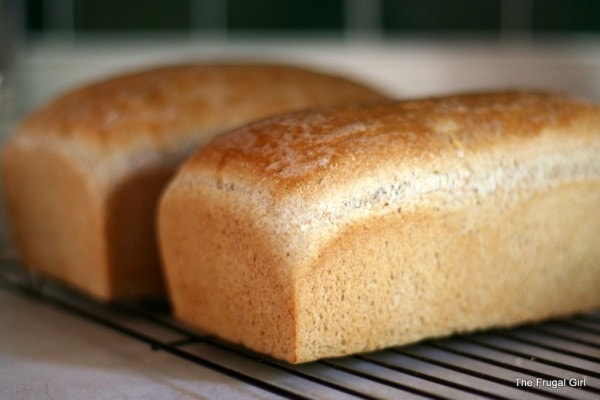
I recently started reading your blog and have been inspired to try a few new things, including doing a lot more of my own baking. I am assuming you usually do one baking day a week, so how do you store your bread to keep it fresh if it won't be used for a few days? And I have heard a lot of people mention freezing bread. I have never had any success with thawing frozen bread without ruining it. Is there a method that seems to work best?
-Shaylin
I actually bake here and there throughout the week, depending on what we need. The only consistent baking I do is on Sunday mornings. I make a whole wheat/flaxseed bread for communion at our church, and while I'm at it, I make three loaves instead of one. Two loaves stay here at home and one goes to church. We use that bread for toast at breakfast and for sandwiches at lunch.
When I need bread for dinner, I usually make it the day of because I just like having fresh, warm bread to serve with our meals.
I do make some things ahead of time, though. Usually when I make hamburger buns, I make a large batch so that I can freeze the extras to use on a busy day. And I normally freeze one of the loaves I make on Sunday mornings. I also freeze French bread so that I can easily make garlic bread or French Bread Pizza later.
To successfully freeze bread, you will need to make sure that you package it properly. I use plastic bags (which I reuse many times before retiring them), and I make sure that all the air is squeezed out of the bag. Air is your enemy when you are freezing food.
It's easiest to thaw bread by just letting it sit out on the counter for several hours, but you can also use the defrost setting on your microwave. This tends to heat the outside of the loaf before the inside is thawed, though, so it's not the method I would recommend.
I wouldn't store bread in a self-defrosting freezer for more than a week or two, but in a manual defrost freezer, you can keep it for a month or two with great success.
I hope that answers your question! If it doesn't, or if you want to give me more specific info about what happens to your bread when you thaw it, leave me a comment or send me an email.
I was wondering what the protocal is regarding how long leftovers are good for? I feel that I waste A LOT of food because if it is in there a 2nd day I just can't risk it. Especially meat (chicken & pork)
-Karen
Ooh, I have very good news for you! As a rule, you can definitely keep meats for more than two days in your fridge (3-4 days is usually safe for most meats).
Let me introduce you to a site that will be your new best friend: Still Tasty. On this site, you can enter any food item and find out how long you can store it a food and still safely eat it.
For example, the results for "chicken" cover everything from gravy to chicken wings to chicken sausages and everything in between.
Still Tasty doesn't just cover meat products, though. You can find information about grains, spices, dairy products, produce, and even beverages. If you're ever in doubt about a food item in your fridge, check Still Tasty before throwing it away. You just might be able to keep your food.
I have a question about the dough rising... I have really wanted to take a chance with yeast breads since I've been a reader here, but find that I never have the time for the rising process. In this recipe you said the dough could sit in the fridge overnight... Can you do with with all yeast doughs? how long could they really stay in the fridge? Could I make the dough at night and bake it for dinner the next evening or is that too long?
-Kimberly
You'll be happy to know that yes, most yeast doughs can successfully be left in the fridge overnight. 24 hours is a good rule of thumb, although I know some people keep their dough in the fridge longer than that.
Basically, the refrigerator retards the growth of the yeast. High heat kills yeast, warm temperatures encourage yeast growth, and cool temperatures slow yeast growth. When you first put your dough in the fridge, the yeast will continue to grow for a little while, and as the dough cools, the yeast growth will slow to a crawl.
The yeast does continue to multiply at these cool temperatures, albeit slowly. So, if you left your dough in the fridge for several days, it would start to be very yeasty tasting. A 24 hour rest in the fridge won't affect the taste of the dough adversely, though, so if you're busy working outside the home, your idea is a good one.
Refrigerated dough is fairly stiff and difficult to work with, so you'll want to let it rest on the counter for 20 minutes before you try to shape it. Also, since your dough will be a lot chillier than normal dough, you'll want to allow more time for the pre-baking rise of the dough. This is more important when you're making loaves than it is when you make breadsticks. A large loaf of dough will obviously take more time to warm up and begin rising than will a skinny little breadstick.
_________________________________
Readers, as always, if you have some advice to add to mine, feel free to leave a comment!



Thank-you for this post. I do make bread, but never have time in the mornings or my day to really do it, without it being a hassle/ordeal. Now that I know that I could refrigerate it the night before, yea! I'm set. One question though, if the bread keeps rising, will it overfill the bowl if I'm not there to keep an eye on it? Or if I put clingwrap over the top of the bowl, will that be enough of a barrier to keep the dough in the bowl. I'd hate to wake up to a mess!
Lara, since the yeast growth slows down so much in the refrigerator, your dough shouldn't overflow and make a mess. Just make sure to put it into a bowl that allows some room for the dough to expand, and cover it with cling wrap.
I was just wondering if I could refrigerate dough - so now I know!
I was also thinking about part baking bread, particularly french sticks, then freezing them. Then defrosting them and popping in the oven to finish. Do you think that would work? You can get part baked french bread vacuum packed in the supermarket.
I actually had a question....how do you freeze dough? Oftentimes when I make bread or pizza we have too much dough, but I wasn't sure at what stage to freeze it or how. Any help?
Great post, Kristen! A few other ideas:
If you do an internet search for "Artisan Bread in Five Minutes a Day" or the new "Healthy Bread in Five Minutes a Day" you will find recipes for a "master" dough that you can leave in the fridge for up to two weeks. When you want to bake, just pull off a piece, shape it, preheat your oven, and bake. It lets people who work out of the house still have freshly baked bread in time for dinner, every day if you wish. (The books have many more recipes, but they are pricey. Try the library!)
I use shower caps you can buy 12 to a pack at the Dollar store instead of cling wrap to cover my rising dough in a bowl or other container. These can be reused many times, making them very frugal and environmentally friendly.
If you freeze bread, thaw it wrapped up as Kristen suggests, then throw it in the oven at 325 or 350, wrapped in foil for 10 minutes to fully restore that fresh-baked aroma and flavor. The bread will be warm, but not too hot to eat.
For homemade bread to be truly frugal you need to buy yeast in bulk. Check your local Costco, Smart and Final, Sam's Club, or other "big box store" for a 2 pound bag of yeast. It'll cost about the same as two packs of yeast in envelopes at the grocery store and last an entire year if store in the fridge or the freezer. Even if you hate big box stores, this is worth a trip because it's hundreds of times cheaper than the envelopes. How often can you say that????
For what it's worth, I subscribe to the America's Test Kitchen emails and just recently, they had a taste test of identical doughs left to raise at 3 different temps (of course, the cooler it is the longer it takes to rise) and they said that the cooler temps/longer rising left better tasting bread. Specifically, they said rising for 24 hrs in the fridge was best in their test.
I haven't tried it though...I've never had much sucess making bread anyway! 😉
Thought I'd pipe in here. I sometimes use a system much like Kristen's "overnight cinnamon twists" for bread as well.
Basically, this means that I make the dough, let it rise, then punch it down and shape it, and then put it in the fridge for up to 12 hours. (It might work for longer that that, but the longest I've tried is overnight.) When I take it out of the fridge, I let it sit on the counter for about 15 minutes to warm up (while the oven is pre-heating) and then I bake it as per usual.
You do have to experiment a bit, but I have had good luck with this method. Just like the cinnamon twists, it allows me to make the dough entirely in the evening, and then in the morning before work I just have to bake it. Nothing like fresh-baked bread for breakfast or packed in lunches 🙂
I loved your day in the life posts and was just awed at how you are able to accomplish so much in so little time. I'd love to see a third one--a typical Sunday for you. We have a hard enough time making it to church on time and it's just my husband and me. I can't imagine getting four little ones out the door and having to bake bread, too!
I'm going to be recommending your blog to a cousin of mine. Your photographic styles are very similar, among other things.
my husband left dough out on the counter for a day and 1/2 and then baked it.... i cant get myself to touch it, but he says it tastes fine.... should i try it, or should i expect he'll get really really sick over the evening?
Nope, I expect he'll be fine! The heat of the oven will kill anything noxious that grew in the bread dough, though I doubt there was anything dangerous even in the raw dough. I would think the bread would taste really yeasty, but I highly doubt that it'll make him sick.
Do report back! lol