
Monday Q&A | Homeschooling Questions
Today, I'm going to answer a few questions about homeschooling. Though I obviously feel that homeschooling is the best choice for us (otherwise I wouldn't be doing it!), please understand that as I answer these questions, I'm not trying to deride other forms of education.
Instead, I'm trying to defend homeschooling as a viable method of education.
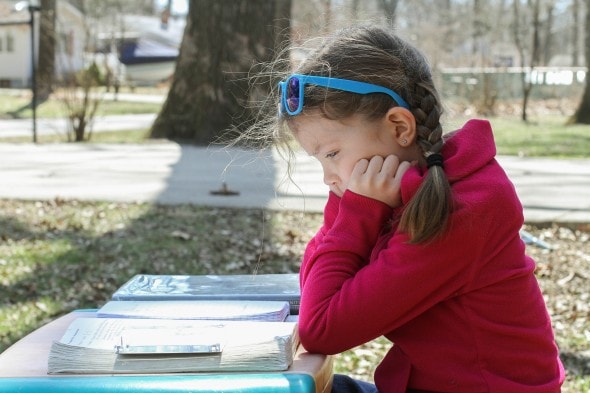
I have a question about homeschooling; coming from a non-homeschooling background. Even with an assortment of materials & resources, how do you feel confident that you know "enough" about a subject to teach your kids? I know that question can seem snotty, but I'm truly not trying to be. I have a BS & a MS in mathematics education & taught high school math for several years. So, from my perspective, I don't think I could ever have a proper knowledge base in all the fields & sub-fields of English, math, science, social science, art, etc. to do a proper job of thoroughly educating my children. I'm not confident that I could do a better job than people who have made it their life's work to study & teach a particular subject area.
I fully acknowledge, of course, that as a parent, I am my children's number one teacher & have a bigger impact on my child's life than anyone else. We do talk about & explore language & math & science & all those other things, but I don't think I can replace well-qualified teachers.
-Becky
This is certainly a common question about homeschooling, and I think probably the best way to answer it is to point to the success of homeschool graduates. Every study I've ever read on the topic has found that, at the very least, homeschooled students do as well as their traditionally-schooled peers, and oftentimes they do better.
So, I think this question is more theoretical than anything...though it might seem impossible, homeschooling parents are somehow managing to produce students who are at least as well-educated as traditionally-schooled students. I could give you lots of anecdotal evidence of this (for example, I was at the top of all my college classes, and my homeschooled siblings, relatives, and friends have had similar levels of success.), but studies have shown this to be true pretty much across the board.
In the early grades, the subject matter is really just not that complex. I'd imagine most parents are capable of teaching their children to read, to write, to do arithmetic, and so on. I've been homeschooling for 6 years now and I have yet to come across anything in my children's curriculum that is remotely confusing to me.
Of course, as the children get older, the subjects get more difficult. However, I don't necessarily think the parent needs to be an expert in every area in order to give their children a good education. A huge part of homeschooling is learning now to figure things out for yourself. For instance, when I got to high-school level math, my mom didn't give me a math lecture every day. Instead, I read the book, figured out how to do the problems, and came to her only when I got stuck (at which point she would read the book and help me figure it out). Even now, that's how Joshua and Lisey operate with much of their schoolwork. They're 9 and 10, but they are already learning how to teach themselves.
Knowing how to read a book, process the instructions, and figure out what to do has served me so, so well in life. I'm hardly ever afraid to try to learn a new skill because I'm confident I can teach myself. I've never taken a single photography class, but I've learned a lot simply by reading about photography. No one ever taught me a thing about blogging or all the technical stuff involved with setting up or maintaining a website, but I've managed to figure it out just by reading.
If parents are too overwhelmed to tackle a tough subject without support, though, there are options. Some parents handle difficult subjects by utilizing a tutorial service or having their children take a class at a local community college. Sometimes homeschooling parent work together and swap skills (for example, a mom who is good at chemistry might work with a mom who is an excellent writer).
Without getting personal, does your child decide on going to public school or is it for educational reasons?(1 out of 4) Just a question...no judgments.
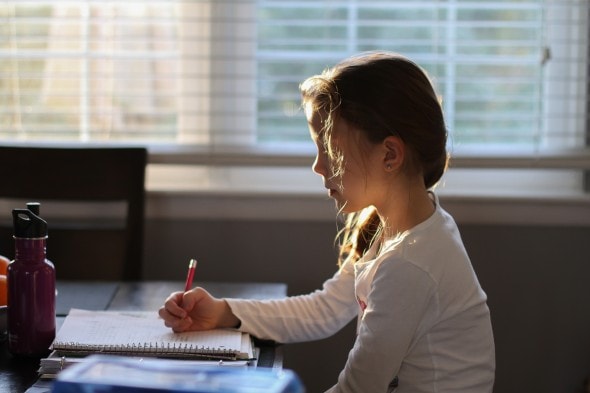
When I first read this question, I was a little confused, and then I realized that I wrote a confusing sentence in last week's Q&A post! I mentioned that Sonia had started school in the fall and that I was now homeschooling 3 kids. Sonia started school, yes, but like my other kids, she's doing school at home. And the reason I'm only homeschooling 3 kids is that Zoe hasn't started any formal homeschooling yet.
We plan to homeschool all of our children for the foreseeable future and this will not be a decision that is left up to them, at least for now. We are very firmly convinced that this is what is best for our family and our children.
All that is sort of moot, though, because our children have absolutely, positively, NO desire to go to a traditional school. They love being at home, they love all the free time they have (because homeschooling is very efficient), and they love our flexible schedule. In fact, they are vehemently opposed to the idea of doing anything except homeschooling, and that's exactly how I felt when I was a kid.
So, it's not at all like we're forcing them to be homeschooled...they are at least as sold on the idea as my husband and I are!
Do you think that your kids will be prepared for "life after" their k-12 education? (Not that public school does a great job of this - this is something that swirls in my head. I wonder if you wonder about it too.)
-Laurie
The amount of time I spend worrying about this is somewhere right around nil. I sometimes worry about other aspects of homeschooling (Am I doing enough to help them love learning? Am I making this knowledge practical and lively?), but I am absolutely confident that my children will be ready for life after high school.
Mostly, my confidence stems from seeing that my siblings and I have all been well-prepared, as have my homeschooled friends, relatives, and acquaintances. We've done well at college, in the workplace, in our churches, and in our neighborhoods.
Of course, there are some homeschoolers who are dorky and socially inept, and they probably aren't going to do that well in real life. But, some people are just going to be dorky and socially inept no matter where they go to school (and kids who are that way will probably be much less miserable at home!), and anyone who's been to school knows that socially inept people don't only exist in homeschools.
___________________________________
As a footnote, I'd like to offer up this list of famous homeschooled people. Without formal, traditional education, these people were able to accomplish amazing things. While I know that traditionally schooled people have also accomplished amazing things, reading over this list gives me great confidence that homeschooling is not going to have a detrimental effect on my children. And more than that, I personally am quite confident that homeschooling is going to give them a solid education and will prepare them well for life after school.
If you're interested, here's some information on the studies that have been done on homeschoolers. If you've got any to add, do leave a link in the comments!
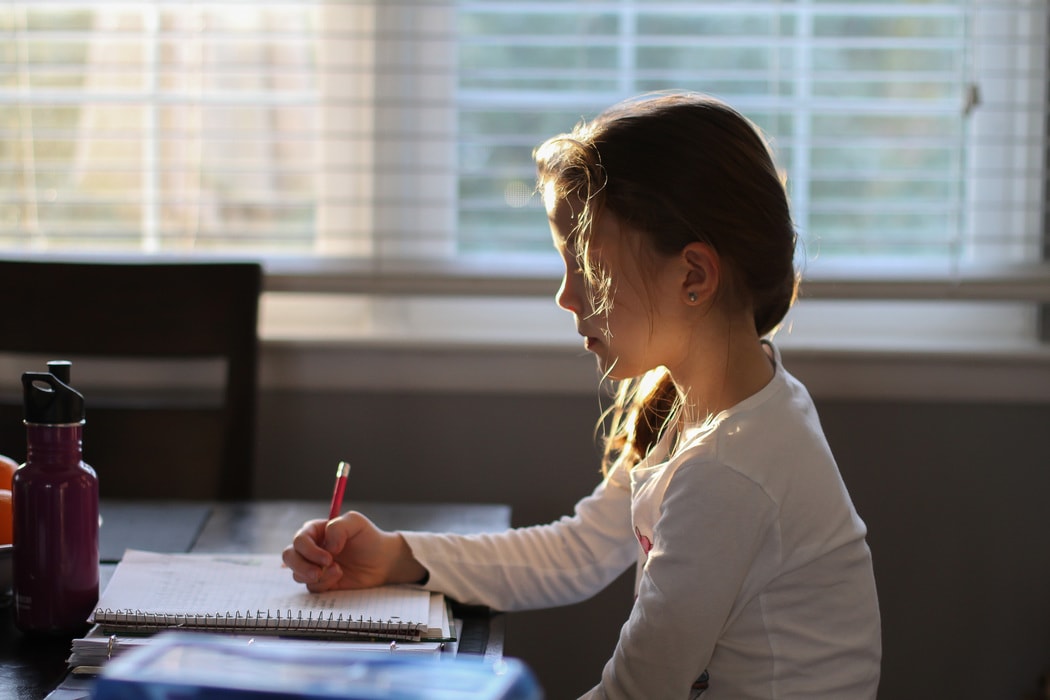

The one thing I've wondered is if your kids have friends in the neighborhood? I have an only child, so if I home schooled him I think he'd be bored out of his mind. He really needs, and greatly enjoys, the social aspects of school. He's got his school buddies, his Cub Scout friends, and his neighborhood friends (which is more of a mixed bag of ages)...and as an only child, I think all of those friends are a HUGE blessing for him.
Yes, they do, and they have cousins in the area. My son has a best friend that lives about an hour away (they used to live next to us!), and my kids have friends at church too. They also play with all the siblings of my piano students while I teach.
And of course, they have each other to hang out with too. If I had an only child to homeschool, I'd probably make more of an effort to go to playgroup and group field trips and other stuff like that because I do think it's important for kids to hang out with other kids.
As things stand, though, my kids get plenty of time to relate to other kids without me putting a ton of effort into it.
For what it's worth, I think it's GREAT for kids to have friends of all different ages...that way they learn to relate to people older and younger than them, not just to people who are their own ages.
My son is an only child, homeschooled for 1.5 years. (If he were in school, he would have just completed 3rd grade.) His best friend since age 2.5 attends the local school. While she (and all the other kids his age) are still in school after lunch, my son frequently plays with her 4.5 year old brother. They've become great buddies and it's a wonderful chance for my son to play the "big brother" role and to see that he can be friends with all sorts of people---age, color, religion etc. does not matter as much as what's in their hearts. If he were in school, he'd probably just ignore her brother or make fun of him---putting down other people seems to be how the boys at his former private school amused themselves! puttinpriv
I saw your Titter post about the library reading program, and ours was canceled this year...due to budget cuts!
I wondered if ours would be, but it's still going. A lot of stuff has been cut at the library, though.
I really enjoyed reading your post. This fall, we will be starting homeschooling our oldest who will be 4 in August, doing Pre-K4 work. I am nervous about the undertaking myself and wonder if I'll be a good enough teacher for my children. However, my husband and I are dead set against public education and Christian schools are not an option we have at the moment. My husband, being on active duty in the military, has the rest of us maintaining a very flexible schedule and homeschooling would fit much better into this lifestyle than anything else. Others that have no association with homeschooling wonder if our children will lack social skills that a traditional classroom would offer. My response is usually that keeping them active in church and sports-type activities when they are old enough will help round out any of those edges.
I don't mean to ramble but it is always encouraging to see/hear/read of other homeschooler's successes! Thanks again for your post!
Ah yes, I think I have SUCH a distinct advantage because I am a second-generation homeschooler. Because I experienced homeschooling myself, I'm easily able to dismiss any fears about socialization and preparation for real life and all of the fears that are so common with first-time homeschoolers.
When I'm having a conversation with someone and they ask me about socialization, it always makes me giggle and I want to say, "Um, I'm talking to you, aren't I?" lol Seriously, though, socialization is SO not a worry of mine. Your kids will be with you, living life, socializing with the people you socialize with, socializing with your family, and they'll be fine.
Karen S.--
As a homeschool graduate, I'd like to respond to your comment. 🙂
Lack of socialization/loneliness is a common concern I hear about homeschooling. There are some homeschooling parents who home educate as a way to shelter their kids from the evil of the rest of the world, and this small niche has probably produced much of the "dorky, socially inept homeschooler" stereotype that Kristen mentioned. I think the reclusive approach is wrong and unhealthy, and those students probably do suffer for it.
However, the vast majority of homeschoolers I know (myself included) go out of their way to include many extracurricular social activities in their lives. Scouts and neighborhood friends are two common outlets. I also participated heavily in 4-H, youth leadership programs, volunteer work (with/for people of ALL ages, not just my age peers), organized sports, music lessons, drama clubs, as well as an assortment of activities, field trips, classes, etc. with other homeschooling families. These diverse activities allowed me to develop relationships with kids and families all over the political, racial, and socio-economic spectrum. And a whole lot of those friendships weren't with homeschoolers.
Because homeschooling is efficient, as Kristen mentioned, we had so much more time and energy to enjoy these activities. Other kids might have been stressed out by a full-time school schedule plus multiple extra-curricular pursuits, but for us these activities often took the place of formal study. (For instance, a music lesson or band practice would be our formal "music class" for the day.)
Another thing to consider is how much time a child actually has in a formal school setting to freely interact with other children. Especially in upper grades, opportunities are pretty limited. Much of the time I spent with other children as a homeschool student, outside the bounds of a classroom schedule, was full of free conversation, play, and exploration. It was quality time.
I would submit that my schooling experience was, perhaps, MORE social than the average public/private school student. And I'm very thankful for that!
Sorry for the essay... thanks for reading. 🙂
thanks for posting such a detailed outline of how you did things growing up. i love hearing about different options if i am able to one day homeschool my daughter
"Another thing to consider is how much time a child actually has in a formal school setting to freely interact with other children. Especially in upper grades, opportunities are pretty limited. " I have to disagree with this. I'm a homeschooling mom who was not homeschooled herself, and I think I had tons of time to socialize with friends at school. And I formed lasting friendships--one of those friends is still my best friend 18 years after graduation (although we stopped attending the same school 20 years ago), and we live several states away from each other.
@ Emily-- Every individual's schooling experience is different. Perhaps I should not have made that statement so broad-- it was a general statement based upon my own experience in a structured school setting as a private school teacher (K-8th). I didn't mean to imply that public/private school kids do not develop lasting friendships, and I'm glad your experience was a positive one! 🙂
It's a comment I've heard several times before, and usually to show that homeschooling has a one-up on brick & mortar schools in that particular area. I don't know if you intended it that way, but I wonder if your perception as a teacher is different than a student's in this case.
That's great to hear! Maybe I should say that homeschooling my only child wouldn't be social enough for "me."
I find the question about "life after school" interesting. As a home schooled child (now adult) I feel that being home schooled prepared me for real life FAR better than my non-home schooled peers. Because I wasn't busy at school at with homework all day, I had time to learn about the "real" aspects of life - cooking, cleaning, doing laundry, keeping a job (I started babysitting at 10 and have been gainfully employed ever since), making phone calls, and generally being a functional member of society. I work in the college environment and am finding that many "traditionally educated" kids don't know how to function once they are out of their parent's homes. Laundry, grocery shopping, and even taking care of themselves when they are sick are totally foreign concepts for many college freshman. This is not the fault of parents but of the lifestyle that is dictated by the educational system.
I hope that didn't sound too harsh...
I feel the same way about my teenage years...because I had more free time than my traditionally-schooled peers, I was able to pursue a lot of really worthwhile activities. I started my piano-teaching studio, I spent lots of time practicing the piano, I babysat, I worked as a mother's helper for my aunt once a week for several years (she had twins after having three children, so my sister and I did laundry, cleaned, baked, and organized for her), I worked at church, I planned meals for my family and cooked and baked up a storm, I studied nutrition, I worked out 6 days out of 7, and so on.
I know it's not for everyone, but I am SO grateful for how well my teenage years prepared me for real life.
Ah cooking and baking skills, I love you (and my husband does too). My husband remarks all the time about how much of a blessing it is that I know how to cook and we aren't eating microwave meals all the time like some of our other newly married friends. Yay, for cooking! I am so thankful my mother taught me to cook and bake and clean.
"This is not the fault of parents but of the lifestyle that is dictated by the educational system."
In my opinion,this is completely the fault of parents. It is not the job of a school, public or private, to teach children how to do laundry, cook, clean, etc. These are skills to be learned in the home from the family. My children all attend public school; they cook, clean, meal plan, babysit, do laundry, etc. They are great students, and have rich and rewarding social lives as well as do all of their friends.
Whose fault is it if homeschooled kids don't learn these skills (and some of them don't)?
And I have no idea what the educational system lifestyle is.
i enjoyed the Q&A today. homeschooling isn't an option any longer as i'm a single mom now. but it was something i was very interested in when married.
the questions you answered today are all of my fears - teaching math and science is something i'm not sure i can do, my daughter is an only child and super social and will she be prepared for life.
i think it's harder for parents who were in a traditional school system to make that first step. it was probaby easy for you to choose this option because you had first hand experience.
i love how you brought up how you have the confidence to figure stuff out on your own and not expecting someone else to figure it out for you. that self-confidence is a great trait to have.
thanks
Absolutely. My experience as a homeschooled child allays many of the fears that are typical for new homeschooling parents.
I have never left a comment on your site before, but I enjoyed today's post so much that I really wanted to comment. As a former homeschooler, I've heard all the arguments against it (socialization, qualification of the parent, etc), and I have to say that I found the pros of homeschooling to far outweigh the cons. My siblings and I went on to college, did very well there and have had good experiences adapting. I graduated at the top of my undergrad class and went on to get almost a full-ride scholarship to graduate school, which was a huge blessing.
I guess I have the somewhat unique perspective of a homeschooler who went on to become certified to teach in the public school system. I got certified because I wanted to homeschool my own children, and I wanted to feel "qualified" to do so. My first experience in a public high school classroom was as a student teacher, and I was genuinely grieved by a lot of what I saw. It was tough as a teacher to give some students the amount of attention they needed. In a classroom of 33 kids, the brightest were often bored waiting for the others to catch up while the slower students were often unable to completely grasp a concept before we needed to move on. It was disturbing to me to see how much time was wasted during the day. There are a lot of great teachers out there, and I'm not saying that they aren't doing a wonderful job, but every child is different and it is tough for one person to handle all the challenges that come with a roomful of those differences. Homeschooling isn't for everyone, but I do think it has definite advantages.
I'm glad you de-lurked. lol
I do really appreciate the way homeschooling allows me to customize things for my kids. They can work at the appropriate level in all of their subjects, regardless of the grade level. It's actually pretty rare for my kids to be working exactly at grade level...they're always doing some stuff at grade level, but in some areas grade level is too easy, so I move them ahead to the level that challenges them.
I second your applause for school teachers...I cannot even imagine trying to teach 30 kindergarteners at a time! Teaching one at a time is much, much easier, I'm sure.
I agree. I liked how my mom could customize things for my siblings and me. I am a huge fan of homeschooling!!
I as well had a full ride scholarship to grad school to get my masters in mechanical engineering. I love every minute of college and I think that is due to my parents teaching me to love learning. My next two sisters have also graduated from college (and in the top of their classes). I really think it is because my parents showed us how fun learning could be and taught us to work hard at whatever we put out hands (and minds) to.
And I totally agreed with one of your earlier comments about your kids having friends of all ages. I love that I can strike up a conversation with anyone of any age. I think that is because of homeschooling (and my amazing church family). It is really fun not just talking to people that are your age, but people of all ages. People have such interesting stories (older people and kids too).
Here here. I imagine that a lot of what school teachers need to be skilled in is managing and wrangling a room of 30 students, not the subject matter. I mean really, if children are expected to pick up the subject matter I'm sure you can learn it well enough. I guess that changes at a higher level to a certain degree, but it sounds like there are so many different resources and options out there.
I homeschooled my 2 older children up until junior high, and had planned to continue through high school until some non-school-related things came up and changed our plans.
As Kristin said, in the early years especially, if you as a parent can read, you can teach your child--you just have to stay one lesson ahead of your kid! As the kids get older, if you don't believe you're capable of teaching your child as expertly as you might wish (or if you lack science lab equipment, or other things), there are a multitude of options: hiring a tutor, joining a co-op, trading teaching with another parent (you teach English, they teach math), learning on-line, enrolling in community college, and probably lots more that I'm not aware of. If those don't appeal to you, remember that there is tons of curriculum out there that is written for a student-learner. For instance, there are math programs that include DVDs with a teacher showing and explaining the problems, and there are also many math programs written to the student and not assuming that a teacher will be lecturing.
Don't give up on homeschooling just because you think you aren't qualified! There is no One Right Way to homeschool, and you can find a way that fits you and your child.
I have the weirdest of weird questions.
Have you ever heard of someone homeschooling children that are not their own?
Have you ever heard of someone removing their children from public school and starting to homeschool after say...the 3rd or 5th grade? Is it usually successful?
If you have, do have any idea of how I might find out more?
I would love to homeschool my kids, but we cannot live without my employer paid insurance.
I don't think they are weird questions:
I lived with the grandparents of a family in our church when I went to college and graduate school. Their cousins lived nearby to the grandparents and the grandmother would go over and teach math and science twice a week to the kids. I don't know if you were looking for non family memebers...
Also, there are a lot of group homeschool things where one parent will teach a subject to a group of kids. My brother went to a bio and a chem class that were taught by a homeschool mom that taught at our local community college. My sister and I went to a writing club once a week where I would have to write a paper and read it to the group. My mom is an english major, but she figured it was better for us to be accountable to writing a paper a week and it would help our public speaking skills to be in a group. She taught a writing club a few years later for child number 3 and 4 in my family and about ten other kids that we knew.
As for the second question, I have had friends who were homeschooled later in life. I am not really sure how to answer that question. 🙂 I think it was successful, but I don't have any information about it. Someone else will be able to answer that better.
I started homeschooling in 8th grade. My mom had decided to try homeschooling with my younger brother and sister (1st and 3rd graders) when it became legalized in our state. My brother had been having a rough time in 1st grade and was always in a bad mood, picking fights, etc. When they started homeschooling he was so happy and relaxed that he stopped fighting with my older sister. The change in my younger brother was so shocking to my older sister and I that we decided to come home as well.
@Jeanine-- I have heard of homeschooling other people's kids. I'm not sure how successful it has been, but I can't think of any reason it wouldn't be. Every state and county has different laws, however, and you'd have to check with yours and see what the guidelines would be on this type of arrangement.
I have also known working parents who educated their children in the afternoons/evenings/weekends, and continued to work during the day. I imagine this would be quite challenging, but it can be done.
There are also private schools with alternative approaches to education that you might look into-- such as Waldorf and Montessori schools.
I am a firm believer that the primary reason homeschooled students tend to successful is that their parents maintain such a high level of participation in their education. Home educating parents take responsibility for the success of their children's education-- instead of pushing that responsibility to others. If you stay in constant communication with your kids' teachers, work together with your kids on projects and homework, maintain dialogue about their successes and struggles, and try to create an atmosphere of creativity and learning at home, I think your kids could thrive at almost any school.
Best of luck to you! 🙂
Absolutely. I've read that parental involvement is the single most important predictor of success no matter what the educational approach. So, whether kids go to public school, private school, or they're schooled at home, if the parents are heavily involved, the child will probably get a good education.
Just a response on two threads:
My sister is a single mother of one. She has ordered her life to make it possible to homeschool her son, now thirteen. He does some work while with his grandparents (independently, for the most part) while she is working. They are flexible about times of day for "school" and I am sure that it is hard and not for everyone. However, they have been at it for 5 years and are going strong.
As to the homeschooling other people's children question, my children attend a homeschool Academy and it has been a wonderful blessing. It answers some of the concerns people have. The children sit in a classroom with peers. They have two mornings a week of class with teachers other than me and the remainder of the time, we do school at home. For us the hybrid of school and home has been good. The downside is that you give up a bit of the flexibility of homeschooling schedules, but you gain accountability (useful as I am one who can get busy and let a subject slide too much without that accountability).
My aunt married a man from Holland whom she met while in college. They married, moved to Holland after graduation and had two kids. Both children attended public schools. There was always a possibility of transfer to the US, so my aunt obtained copies of her friend's children's American textbooks. After school, she home schooled them using these books. The expected transfer never happened, and both kids chose to attend American colleges. The result: boy attended Harvard (BA, MBA, PhD) and is now a director of a multi-national corporation. Girl became an MD and is now a full Colonel, serving in the US Air Force. They both speak at least five languages and have lived and traveled throughout the world. This is a case of kids benefitting from both kinds of schooling.
My brother-in-law was in traditional school until 5th grade or so until his mom pulled him out. He did really, really well at home....so much better than he did at regular school.
And my brother-in-law's mom homeschooled some children that were not her own, so yes, it does happen!
We pulled our son out to homeschool after he attended kindergarten and first grade at a private school. He was so miserable, so angry, so unhappy while at school, that he was practically a wild animal when he got home. He hated homework with a passion and always felt it kept him from doing what he really wanted to do. He also became convinced he was terrible at math---we never did figure out how he got that idea. And kids were just starting to tease him about his Tourettes Syndrome and extreme sensitivities. Now, after 1.5 years out of school, he's back to the way he was at age 5 before he started: sweet, curious, kind, content. We just started working with a math tutor who says he's a natural; he goes through 2 lessons in the Math-U-See curriculum per week. And he LOVES to do his "homework" now, because it's interesting to him and not just sheets of busywork. I think if a kid is not doing well at school, at any age, don't hesitate to take him/her out and homeschool, if work situations etc. permit. You would be doing that child a huge favor.
I know this is one of the reasons I want to homeschool my future children. My DH and I both did very well in school understanding-wise, we both read and understand quickly - but curriculum did not cater at all to children who learn fast and we often didn't do homework or hated it because it is SO boring to do the same problems over and over to "learn" something you understood in the first place. I did do a year of math in summer school to get a grade ahead, and that helped a little - but if either of us had been able to work at our real pace all along I think I could've been done with "high school" early and have been able to move on to college level work.
I don't have any problems with homeschooling; don't think it's any better or worse than public schooling. It's just a different option that works for some families and doesn't for others. One thing I've noticed is that homeschooling vs. public education is one of those areas where people usually have very strong opinions, and feel they need to defend them! It's sort of like the SAHM vs. working mom divide; people really seem to feel like they need to defend their choices, or that it's OK to attack the choices of others. The arguments I've heard from both sides can unfortunately get ugly (which is thankfully not happening here!).
In our family situation, homeschooling wasn't and isn't an option. Our daughters are all ethnically Chinese, but very culturally American. The girls all know that most people see Chinese first, American second. Also, their heritage is a strong part of who they are, their self-identity and how they will integrate into society as they grow. We felt that attending a public school was one of the best ways to have them interact with other Chinese American kids and families and feel comfortable with their racial identity. Second, we are fortunate that our public school system has an incredible Mandarin Immersion program (K-12), where kids spend 1/2 day learning in Chinese (language, math and science) and 1/2 day in English (language arts and social science). There is no way we could have provided this if we had chosen to homeschool, even with tutors. Our soon-to-be 9th grader is now conversationally fluent in Mandarin (other two speak it as well), and can write academic papers in Mandarin. The program also has allowed them to attend school with other Chinese adoptees; about 1/4 to 1/3 of each of their classes are adoptees. In other schools, they might very well have been the only international adoptee or Chinese-American in their class, and we have unfortunately heard horror stories about teasing and racist remarks that have occurred in other schools in our area. Our youngest daughter came home at age 5, and spoke no English. She is currently reading and writing above grade level, and you'd be hard pressed to know now that she was not a native speaker since birth. Even though I'm an ESL instructor, I don't think that would be the case if she had been homeschooled.
Our girls would rebel at this point if we said we'd decided to homeschool! They love their school(s), their classes, their friends, the teachers, the whole package. Again, it's just a different choice, neither better nor worse than homeschooling.
Perhaps "defend" was a poor choice of words on my part...I'm sorry. Basically I just meant that I'm trying to show that homeschooling is, at the very least, an educational choice that is as good as traditional school.
Most of the questions I get about homeschooling basically express a concern that homeschooling will not be adequate in one way or another, and it's kind of hard to answer those sort of questions without coming off defensively. I don't feel upset about these kinds of questions, but it's difficult to answer them without seeming upset!
I know a fair number of people who feel that homeschooling is THE ONLY acceptable option, but I am not of that school of thought. I do think it is the right thing for us and our family, but I'm not about to make that judgment call for other families, you know?
Again, I'm with you that homeschooling is a choice that can be as good as traditional school. I just get tired of both sides feeling that they have to explain those choices. BOTH sides too often come off as defensive.
Education, whether homeschooling or traditional school, is what the family makes of it.
Hmm. Do you feel that I'm being defensive? I don't normally run about explaining my homeschooling choices, but when I'm asked, I'm happy to explain.
I guess I would see it as one thing if I just up and wrote a post about this topic, but I see it as a totally different thing when I'm answering a question. I hope that makes sense.
Kristen, I have to say thank-you for being such a great example of a home schooling mom. I appreciate your positive reponses and insight on the common questions home schoolers get.
Being a public school teacher and mom of three (who attend PS), I see a great deal of problems with our educational system. I actually do worry about the "life-after" school for my kids. As I consider whether or not to home school, it's reassuring to me to hear that it's not something you even think about.
Your post and the responses are really helpful in weighing the PS VS HS debate.
Off topic...I know. But I signed up under you for Swagbucks and even earned an amazon gift certificate. But today, I haven't earned a thing. Has that ever happened to you?
It does seem to be pretty random...some days I earn nothing, some days I earn swagbucks a couple of times.
What a great post! I often wondered a few of the same questions! Like how my {future} kids would fit in with society when they go off to college. We're in the pre-kids planning stages and we've been trying to figure out where we'll live based on the top Christian schools in our area. Because public schooling is not an option for us. Christian schooling - or any "private" school for that matter - isn't cheap. And I am a stay-at-home-wife at the moment, so home schooling is not far fetched. Once I do more research, and with your experiences, I'm sure I'll be more confident in that decision.
I definitely didn't have any problems fitting in at college. I made friends in every single one of my classes, and the other homeschoolers I know had similar experiences.
Honestly, I almost wonder if some homeschoolers would have an advantage in terms of making friends in college. For me, it was a big transition since I went from PS (where I'd been in a class with more or less the same people since age 5) to a place where I knew no one.
Of course individual differences would play a big part in that, but I can see a strong pro-homeschool argument.
People were always amazed when they found out I was homeschooled (when I told them in college). ha. Some of them never believed me. They said I was too talkitive and outgoing. Most of them had never met a homeschooler before though. I guess I wasn't what they had imagined.
I do have another comment about homeschooling, from someone who was home-schooled: that is a lack of social pressure to fit in, so children who are home-schooled don't experience that much and they, for lack of better words, become "themselves." Not like others don't, I guess with lack of pressure to fit in... It seems true enough. Any thoughts?
I do think that's a definite advantage for some people, especially those who don't fit into the norms that other kids expect. For instance, for much of his life my son has been anything but the typical boy. He's not very brave, hasn't been much into the usual boy kind of stuff, and is super interested in animals and science and learning. For him, I could see where school might be a little bit challenging because some boys might give him grief over the way he is. But here at home, he's free to blossom and pursue his true interests and passions, and I'm grateful for that.
I definitely agree with that. I went into public school in middle school, and it was horrible. Suddenly, being me wasn't "cool" and I got all sorts of flack for it. It's taken the rest of my K-12 experience and some college for me to get back to being comfortable with myself and what I like, instead of trying to fit in with whatever "normal" is supposed to be.
Hey FG,
I must say, you are a great homeschooling ambassador! Where I live homeschooling must not be very popular because I've never met anyone in real life who was home schooled (maybe a Canadian thing?). Before hearing about homeschooling from you and other bloggers I thought it was a pretty strange idea. I've got to say, I'm really starting to see why this whole homeschooling idea makes a ton of sense. Especially when translated to the university environment where students are (suddenly for some) expected to take initiative for their own learning. I see how it addresses a lot of the downsides of traditional education.
Here's my question for you: do you ever plan to take your homeschooling on the road? There's so much to learn all over the globe, you could really go almost anywhere. I remember how much I loved my western civilization classes in highschool...image leaning it in Europe. Or styding biology in Costa Rica. Or learning Spanish in Argentina. Or a million other option. Talk about instilling a love of learning! But maybe that's just me because I've got an intense case of wanderlust.
Goodness, it's enough to make me want to homeschool my kids. Except I don't have kids...
Though I don't know if our travels will take us abroad, yes, I do want to get out and about more as my kids get older. My mom took us on bike tours of the Civil War battlefields when I was a kid and I'd like to do some stuff like that.
And yes, I think homeschooling does serve kids well in college because most homeschool graduates are used to being responsible for a lot of their learning. It's nice to not be uber-dependent on a teacher.
I send my kids to regular school, but then, I live in a really good school system! I think my kids are getting a great education at school, but I know that a lot of school systems aren't that great. The better schools was the main reason my ex-husband and I moved to a more expensive area!
I'm actually really against homeschooling. I feel that school offers a lot more than just academics. It offers other points of view, exposure to all types of people, and a place for kids to develop a varied social life. I don't like a lot of the things my kids hear about in school, and I don't approve of all of their friends, but my kids are not me. I want them to hear all the information out there and then decide what to think. It's very tempting as a parent to want your kids to think the same way you do (I am very guilty of this!).
I am not being judgemental of anyone on here, by the way! I'm just stating my opinion.
My kids are also in an excellent, excellent school district. I have considered at times pulling one of my girls (or both LOL) out and homeschooling them - but I have serious reservations about my ability to teach complex subjects.
I feel that if I were to say, "Oh yes, we're homeschooling" - but then farmed them out for the complex subjects (in my 11th graders case it would be things like AP Physics & Trigonometry) - then that is actually disingenuous. * I * would not be homeschooling them - I would be relying on another entity (college, tutor, whatever) to teach them. Given that I have never homeschooled, I realize that my opinion doesn't count for much, but it seems like if you are going to homeschool, then YOU are going to homeschool. You know?
Well, in a case where parents are farming out every single subject, I'd agree with you. If it's one or two subjects, I'd still categorize that under homeschooling.
What would you call it? It's not traditional schooling, certainly.
My own mom never farmed anything out...we were 100% homeschooled, and so far, my children are the same way except that my mom comes over once a week to give them a Latin and Composition class (and then they have work to do all week without her). I'd still consider that homeschooling, though...it's just that another member of the family is doing some of the teaching.
I personally value my freedom and flexibility too much to enroll my kids in a tutorial type of thing, and so I will only do that if I'm pretty desperate. I kinda like being in charge of it all right now. lol
After thinking about this, I've decided that maybe a better term for this sort of thing is "alternative schooling". When parents send their children to a tutorial or off for a class here and there, it's still very different from traditional schooling. The class is usually one day a week or maybe two, and then the child is home the rest of the week with the parent supervising the work.
I'd probably say that's closer to homeschooling than traditional schooling. But, I'm not really too hung up on what all of this stuff is called. Parents should do what is best for their children, and if it's a mix of homeschooling and traditional schooling, that's a-ok with me. 🙂
I have no experience with home schooling vs public but something you wrote really hit home with me. I am an adult that recently needed to pursue an advanced degree. I could either go into a structured teaching environment of two years and about 20,000.00 or try to do it by myself with a self teaching course for about 300.00. Originally I was frustrated "that I had to teach myself" and "relearn geometry and algebra from the internet" but I now believe I came out ahead (of course I can say this after I passed the exam). I had to really learn and really comprehend the course. I couldn't hide behind others asking questions. I don't know if that is the confidence or the ability to learn on your own that your children are practicing. My experience gave me the confidence that I can still learn on my own...and save alot of money and time doing it.
Yep, that's EXACTLY what I'm talking about! Go you!
I am 55 years and about a month ago we were talking at church about school and kids and I said that if I had it to do over I believe I would home-school. I think it is a lot more acceptable now and a lot easier. There seems to be less of a stigma. I really enjoyed the lists of well known and accomplished people who were home-schooled and the list of people who are home-schooling. I think the world would be a kinder, gentler place if parents were actively involved and concerned about what others put into our children's minds and what our children are exposed to at school.
I stumbled upon your blog because I was searching for food blogs, since I just started my own and wanted to broaden my horizons. I am so happy I found your blog at this time so I could read this post. Homeschooling is something my husband and I really want to do for our children, but we are so heavily critisized by family and friends for even thinking about it. I just don't think they understand, or have done as much research on the subject, as most of those against it have not, and just dismiss what they are uneducated on.
Great blog!! Thanks!!
Growing up as a homeschooled kid, I've heard all of the above questions. In my own personal experience, I am so, so thankful that my parents made the decision to homeschool us. We lived in an area where the public schools tested among the lowest in the nation. In addition to extremely low scores on standardized tests, this particular school district was among the first to introduce sex ed as part of it's curriculum. As Christians with strong moral standards, my parents knew that public school was not an option. Private school was not in the cards for us either; my mom stayed at home with us and we lived off of my dad's income alone.
My parents met opposition from family members who were worried that we wouldn't be "socialized." I think this is pretty funny, actually. As kids, we were involved in our church, participated in community service, played organized sports, belonged to a group made up solely of homeschooled families, and participated in neighborhood events. I feel that being homeschooled taught me how to communicate/interact well with my peers as well as adults. I'm not saying that this is a trait only common in homeschooled children, nor is it something that is lacking in a child just because he/she attended a public school. I simply believe that this is an important skill that is often neglected in children.
My family moved to a different state when I was 15 years old. My parents allowed me to finish high school at a public school and let me tell you, I was SHOCKED and appalled. The amount of time that was wasted in a 50 minute class period was unbelievable. By the time attendance was taken and announcements made, we generally had 35-40 minutes of lecture time, interrupted multiple times by smart alec students or by any multitude of off-the-subject reasons . Also, I quickly learned that a class can only progress as quickly as it's lowest common denominator. The benefit to homeschooling for me was that if I was advanced in a particular subject, I could work my way ahead of the designated lessons. If I was having a hard time fully grasping a subject (math was always that subject for me),I could take my time. I don't know if all states require standardized tests for all school-aged children, but we were required by the state of California to take them every couple of years to ensure that we were meeting the educational standards as required by the state. I can tell you that all of us--my sister, brother and I--were highly advanced in almost every subject. Even in math--my absolute WORST subject, I was right on target with the national average.
I can say with all certainty that when I have children, I will homeschool them. It was such a positive experience for me in so many ways (the most important of which was allowing me to spend extended periods of one-on-one time with my parents--I am blessed with a solid relationship with both of my parents due mostly to the fact that we were able to spend so much one-on-one time together). Homeschooling was nothing but positive for me and both of my siblings. I feel so blessed to have had that experience.
Oh gosh! I SO felt that way at college about the consistent waste of time. In a number of my classes, I could have accomplished the same thing in a minimal amount of time simply by reading the book myself.
And I feel like you do...simply grateful to have been homeschooled. I can't think of a single negative effect that it had on me and I can think of somewhere around a bazillion benefits.
So to chime in with all of the other former homeschoolers, I'm glad to see this post up. I was homeschooled until middle school, which, granted, probably wasn't a great time to enter public school anyway - all the drama and hormones and blegh. I was definitely quiet, dorky, and awkward, but I think I would've been that way with or without homeschool.
I've been very successful in public school, shooting straight into advanced courses, not necessarily because I already knew the content, but because I had learned how to teach it to myself and problem solve, so that even without the teacher's full attention I could still move forward.
I'm now a 19 year old college senior - having graduated two years ago, when I was 17 - and getting ready to finish up a minor and go into teaching myself. The homeschool graduate is going into public school teaching 🙂
Just one story from one of my teaching classes - the topic of homeschooling came up, and I was interested to hear what people said. No one at that point knew that I'd spent half of my K-12 education at home. Mostly the opinions were reasonable, or from a lack of information, but this one girl boldly got up and said that she considered homeschooling child abuse, it had horrific impacts on the child's social skills, and it should be completely illegal. I raised my hand and, without even looking at her, gave about a three sentence summation of this post. The girl turned bright red, and was considerably more quiet for the rest of the semester.
My sister has four boys and still home schools the youngest two. The oldest boys are in college now. She took a lot of flak from the family in the beginning. Funny thing happened along the way: Girls! When the first two boys grew into tall teens, and started attracting a lot of attention from the opposite sex, they successfully campaigned to attend public high school! Once in school, one of their biggest challenges was not socialization, but dealing with different teachers and their styles.
Overcoming what they perceived as inefficiencies in the traditional school system proved to be their biggest hurdle, not socialization and certainly not the classwork.
Hi Kristen,
I do have to comment on your post with a few questions I've had for a while.
1.) Since you were homeschooled, don't you think that perhaps your background is a bit biased? Meaning educationally, if something wasn't taught to you as a child, you might not teach that to your children. And because you were homeschooled, you don't really have a traditional schooling background to base your opinions upon. You can't say "this worked for me" or "this didn't" and then change it for your kids.
2.) What are you planning on doing about more controversial topics, such as evolution? I personally strongly believe in evolution, but I know a that this can be a point of contention for strongly faith-based individuals. If you don't believe in something, will you teach your children about that? If you don't, wouldn't that be taking away from their ability to come to their own conclusions?
3.) This is less of a question, more of a comment, but I'm going to throw it out there. I'm going to have to disagree with you that traditional schooling is "very inefficient". Sure, parts of it are not curriculum based, but I think there is a lot to be said for teaching children that they need to be aware that other children have different needs. Waiting in line, having a strict schedule, raising your hand to speak in class, etc. are all important parts of development. They provide structure and socialization.
I'd be interested in your input on those two questions!
Regarding your first question, I'd again point to the overwhelming success of homeschooled students. Obviously we homeschool parents are not doing an inadequate job of teaching our children, despite the theoretical idea of us leaving out stuff we didn't learn.
I don't base my children's curriculum simply on what I learned or what I remember from my school years. We use books and curriculum, and teaching methods I've learned from people wiser than myself. lol
On the controversial topic issue, we're going to teach our children what we believe to be true. When it comes to matters of truth, I see things as very black and white. It cannot be true both that God created the world and that God did not create the world (two opposite statements cannot be true at the same time without qualification), and I feel it would be quite illogical for me to teach that when I believe that one of those statements is not true.
This doesn't mean that we're not going to teach them to think or that we won't expose them to multiple points of view. But I think it would be incorrect to assume that public education is somehow neutral...everyone has a worldview and everyone has some sort of bias, not just homeschooling parents.
That's really a bigger topic that I can address in a comment, though! lol
On #3, did I say somewhere that traditional schooling is "very inefficient"? I mentioned that in my experience, homeschooling is very efficient, and that my experiences at college exposed me to a lot of inefficiency, but I don't think I said that schools are "very inefficient". Feel free to point out where I did, though!
My children are indeed aware that other children have needs (they live with three other children and there is only one mom to go around! lol), and they do have some structure and scheduling.
Again, though, I'd offer up the evidence that homeschool graduates function well in college, in the workplace, and in their communities. If homeschoolers were lacking in their ability to socialize, work with others, maintain a schedule, and function in a classroom environment, they wouldn't be doing so well in college, in the workplace, and in their communities, you know?
I'm not saying it's BAD to be educated in a classroom environment...I'm just saying that it's obviously not necessary in order for a child to be a productive, well-rounded college student/adult.
I hope that makes sense...holler if I need to clarify anything!
I'm going to have to go out on a limb here and disagree with your statement that "truth is very black or white". In some circumstances, yes, it is. However there are other more philosophical issues that are more difficult to prove one way or the other, and in those cases a pure "truth" may not exist, or there may be no way of determining it.
I certainly don't disagree that homeschooled children can be very successful! Clearly you have many examples of this being true.
It's just that I can't fully agree that it's ok that parents are allowed to censor the information that is provided to their children. It's one thing if you say "this is one point of view and this is another", but by excluding important points that most of society will be aware of is really putting your children at a disadvantage. They should be able to make up their own minds regarding certain topics without being swayed one way or another. If you give them the proper resources to examine each side fully they will be able to come to their own conclusions, as it should be.
I'm certainly not planning on excluding important points that most of society will be aware of, and I'm sorry if it sounded like that's what I plan on doing.
And my children will certainly have the freedom to make up their own minds about things...like Stacey's siblings, my siblings and I are not carbon copies of our parents, and I don't expect that our children will be carbon copies of us either.
Here's the thing, though...we do all try to influence our children away from things we think are wrong and towards things we think are right and we all draw the line somewhere. To take an extreme example, none of us will pat our children on the head and say, "Honey, being an axe-murderer wouldn't be my choice, but I''m glad you've come to your own conclusions about this."
So, I think we all do try to influence our children and instill values in them...we just differ on what values we're trying to instill, you know?
None of us is without a worldview and a bias...even the, "Truth is all relative and can never be known, so we should never judge anything as right or wrong." sort of philosophy is a worldview.
And public schools are not really any more neutral than parents a lot of times. Public schools often teach philosophies and worldviews.
Not to beat a dead horse, but if homeschool graduates emerged as carbon-copy robots with an inability to think for themselves and to develop their own views, they wouldn't be doing as well as they are, and there wouldn't be that enormous list of famous homeschooled people, you know?
I dunno...I guess I just don't see this as a problem, but I don't mind agreeing to disagree. 🙂
Oh, and you don't need to feel like it's going out on a limb to disagree with me. lol I don't expect everyone to agree with me. 🙂
Erika-- I think question #2 is a terrific question, and I'd love to throw in my two cents. I don't yet have children, but when I do I intend to homeschool them and share your concern in this area. I want my kids to feel they have the freedom to be unique individuals with their own convictions and beliefs, even if those beliefs are different from mine.
The funny thing is, I was raised and taught by extremely strict fundamentalist-type parents. Truth was very black & white to them, and they presented their beliefs to us in a "my way or the highway" manner. However, they also allowed us to participate in a wide range of activities with different people (including college classes during the highschool years). They also instilled in each of us a deep belief that we should stand up for what we believe is right-- EVEN if those beliefs make waves. We were taught to question the accepted norm. We acquired exceptional (IMO) critical thinking skills.
The end result of all of that is that each of us 6 kids are as different as could be. And not one of us is a cookie-cutter replica of my parents. Even though my parents taught us their fundamentalist beliefs, as we grew older the critical thinking skills and guts to question the "norm" (in this case, our parents' beliefs!) kicked in and we each became our own person, with a unique worldview. If you don't believe me, just drop by during the holidays and hear some of our heated family "discussions"! 😉
I know this is not the experience of every homeschool family, and maybe this is more of a parenting issue than a schooling issue. Regardless of the actual CONTENT that is fed to kids, I think critical thinking and confidence to ask tough questions is more important than exposure to a variety of beliefs at a young age. Hope that makes sense! 🙂
I think you have a fantastic point of view on this. Love your comment above: "I want my kids to feel they have the freedom to be unique individuals with their own convictions and beliefs, even if those beliefs are different from mine."
So true!
Amen on the critical thinking. I feel like that and the logic studies my mom put us through have been enormously helpful to me.
Dear Erika and Kristen,
If Kristen did not say group education is "very inefficient" from an academic perspective, then I will say it. To receive group instruction is to receive it at the speed appropriate for the group. Necessarily a teacher must teach most of the time to the middle of the group. If they don't they lose either the medium to last to pick up the concept kids teaching to the quickest or they lose the quickest and medium teaching to the last to catch on. Certainly the teacher cannot tailor the lesson to one child.
We have two sons who went to a private school when they began their schooling. While I liked the school, I found that, because they picked things up quickly, they were given reading time or jobs in the class room if there was additional work to be done. How this manifested in second grade was that my son spent the last week of school packing up books and materials for the teacher during lesson time. When I went in to volunteer, they rarely let him read aloud for the parent or do the speed drills for which little prizes were given because he did not need help. He was always terribly disappointed and I realized that I was paying not an inconsiderable tuition for him to sit and read to himself a lot.
Because my next door neighbor is an elementary school librarian, she talked me into trying the public school's gifted and talented class. Sadly "enrichment" consisted of being given a pretest which if passed made the child able to be handed a xeroxed packet to work on independently during lesson time. This went on for a semester before we pulled him and homeschooled.
Now that my sons are older, I have hired tutors for some math and piano and have him enrolled in a homeschool academy 2 days part time per week. They receive the experience of the group in a smaller setting.
I have a daughter who has a language based learning disability. I also tutor a publicly schooled 7th grader with a similar disability. Believe me when I tell you, my daughter gets more remediation with me than the young lady I tutor gets. What she gets is special allowances, but no help addressing root problems except in the time I spend with her.
As to "controversial topics", wow. If you think public schools do not censor the information they allow in textbooks and classrooms, than go talk to Christians who teach there or who have children in upper grades. You cannot seriously believe after doing so that they are receiving neutral presentations of all the theories or religions out there.
We teach what we believe to be true and present our children with alternate views that they will encounter. We give them more information about alternative theories certainly than the public schools are allowed to give students!
Lastly, I have known many who tell me that children in a public school are better socialized than homeschoolers. I have observed much of the socialization these children receive when my children participate in scouts, team sports and in hanging out at the neighborhood pool. I have to say that I have not noticed that much of the socialization they receive has not been positive. My younger son learned his first "bad" words on the reading rug in the public school second grade. He heard similar language from the youth leaders in boy scouts. He did make some friends in school, but he makes friends in other settings too.
I
That reminds me...as I was putting way our schoolbooks for the year, I read the letter to the school teachers inside Lisey's math book. It cautioned against giving the student the whole book, and suggested giving students only one page at a time. The reason? Because some students might work ahead if given the whole book.
Reading that made me appreciate all over again what a privilege it is to homeschool and to be able to let my kids work at their own particular pace, whether that's slower or faster than the norm.
For the record, I don't fault teachers for teaching to the average...I think it's mostly impossible to do otherwise in a classroom with a lot of children, and I give teachers all the credit in the world for juggling so many children at one time!
Kristen,
I totally agree that it is simply the function of working with a group of children, not anyone's fault.
"I have to say that I have not noticed that much of the socialization they receive has not been positive."
elizabeth, I totally agree with you. At school, the socialization my son experienced was as follows: teasing, bullying, shaming, ridiculing anyone who dared to show that they were different; being disrespectful to adults including parents and teachers; and a rampant "keeping up with the Joneses" mentality among these rich spoiled brats. (My son attended the school on scholarship and he felt bad that other kids traveled the world during breaks, had every kind of video game system known to man, and that they had mysterious (to him!) logos and other people's names on their clothing.) Homeschooling kids do not live in isolation bubbles. They are out in the world almost every day, interacting with kids and adults, whether it's at the grocery store or at a sport or religious activity, just hanging out in the neighborhood or whatever.
p.s. I just want to point out my son was only at that school from ages 5 - 7 and still he encountered all that ugliness. I kick myself for ever letting my kid into that snake pit. Kids grow up fast enough in today's society, so "socializing" them at home and keeping them innocent for a few more years is not a bad thing at all!
I know some very successful people that were home schooled. And I didn't even realize it until I really got to know them. I wasn't home schooled.
I worked with college freshmen and see many of the challenges that students may face when transitioning from high school to college. (Most of the students I advise come from public high schools.) I also have a young son and often think about how we want to raise him to be successful in life. Thank you all for sharing your thoughts on this topic. I am approaching it with a more open mind.
Okay, so I am a little late asking this but I have a couple of questions I am hoping someone can answer for me about homeschooling;
1. My son is 8 months old, at what point do I start getting ready for homeschooling and how do I even go about that?
2. Can children who are homeschooled still apply for scholarships for college?
3. When you are a homeschool graduate - do you get a GED or a diploma?
My questions might sound dumb but I honestly do not know much about homeschooling. (Maybe someone already answered this in the comment section but there were so many that I just skimmed some so I apologize in advance if someone already answered one of these).
Thanks!
Jill S--
Regarding question 2: YES! There are scads of public and private scholarships out there-- especially academic scholarships-- that are largely untapped. I went to a community college, and there are a plethora of transfer scholarships as well (these cover the last 2 years of your bachelor's). The financial aid department of any college or university is usually more than willing to help students explore their scholarship options. The payoff for doing a little scholarship research is enormous.
As for question 3: There are a lot of options. Some homeschool families issue their own non-accredited diplomas (which is as legitimate as many Christian schools' diplomas). Some students take the GED, although there is a "high school dropout" stigma attached to that. I think the most common option is to just take the SAT. A high SAT score is much more impressive to colleges than whether a student has an accredited diploma. My personal experience was none of these. I attended community college as a high school student and earned my Associate's degree before I technically "graduated" high school. No state university even asked for my SAT score or high school diploma because I had a high GPA and an A.A. degree.
Your questions don't sound dumb! Kudos to you for doing research and educating yourself while your son is still young. There are many benefits to homeschooling, but one thing is certain-- its success or failure rides entirely on the parents' commitment and sacrifice. It's not an easy job and I'm so grateful to my mom for making my education a priority in her life. 🙂
My DH and I are thinking about homeschooling when we have children, and I am always surprised by the questions about how I will understand the material well enough to teach it. I think that if you did well in high school or even college that it should be easy enough to explain what needs to be explained and let them learn on their own, like you said. I mean, during college I have graded homework assignments for classes I have already taken (and other students tutor classes they did well in) you don't really seem to need a teaching degree to explain the questions they did wrong or where they are stuck. I suppose it really depends on the parent, but my DH and I are both fairly intelligent and like to read and learn - so if I didn't feel I knew enough about something to teach it, it seems that I could learn ahead of time with a book and the internet (or from asking my DH, as our academic strong points are in different areas).
Your thoughts on homeschooling are interesting to me. In particular, the part about how homeschoolers have to figure things out on their own. That's a great skill to have! I was a TA/instructor for chemistry for a few years, and it was fascinating to me how many of my students seemed incapable of figuring out basic things on their own (I realize chemistry can be complicated, and I don't fault anyone for having difficulty with it, but a lot of students seemed to stop immediately when they got stuck. They wouldn't do an internet search or look in their book if they had a specific problem that seemed to get them difficulty). Independent learning is a great skill to have, and I am glad your children are learning to learn on their own.