
Q&A | pan math, freezing foods, & much more
Hi Kristen,
I am a long time reader (10 ish years), but hardly ever comment. I have two questions for you.For dinner one night this past week you made The Pioneer Woman's French toast casserole.
You said that you used an 8x8 pan, but the recipe calls for. 9x13 pan. Did you adjust the quantity of the ingredients that you used? I'm looking to do the same thing for tomorrow's dinner (Sunday), to use up some cinnamon raisin bagels, and am wondering if I should. The smaller pan size would only require about 60% of the recipe of the larger pan.
Also, regarding health insurance, are you familiar with faith based plans? I do not subscribe to one, but friends of mine - who happen to live close to you - have been enrolled in one for 15 years or more. More recently, I've seen ads for them on T.V. (I live in upstate NY). I don't know the specifics, but my friend felt it matched their values better, and was/is affordable for their family of nine. Every time you mention (being thankful for but) not loving your current health care, I wonder if you know about these faith based medical insurance plans.
-SH
Aww, thank you for hanging here for 10 years! I am honored. 🙂
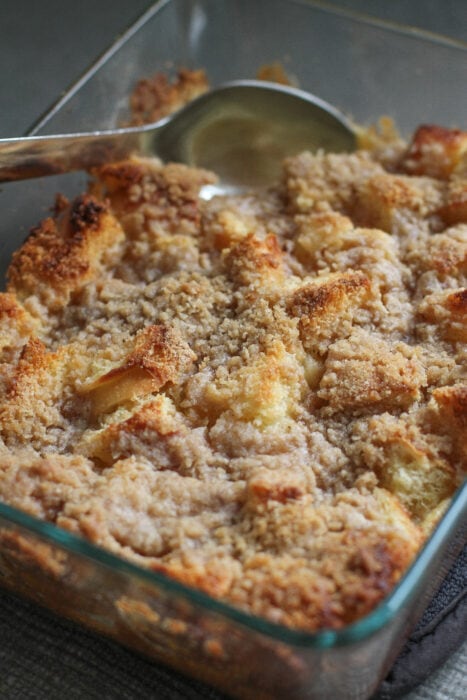
I know I am a day late for your dinner question (so sorry), but when I use an 8x8 pan for the French toast, I just halve the French toast recipe.
I recognize that an 8x8 pan (64 square inches) is not exactly half of a 9x13 pan (9x13 = 117, and 117/2 = 58.5) but it's definitely close enough for something like baked French toast!
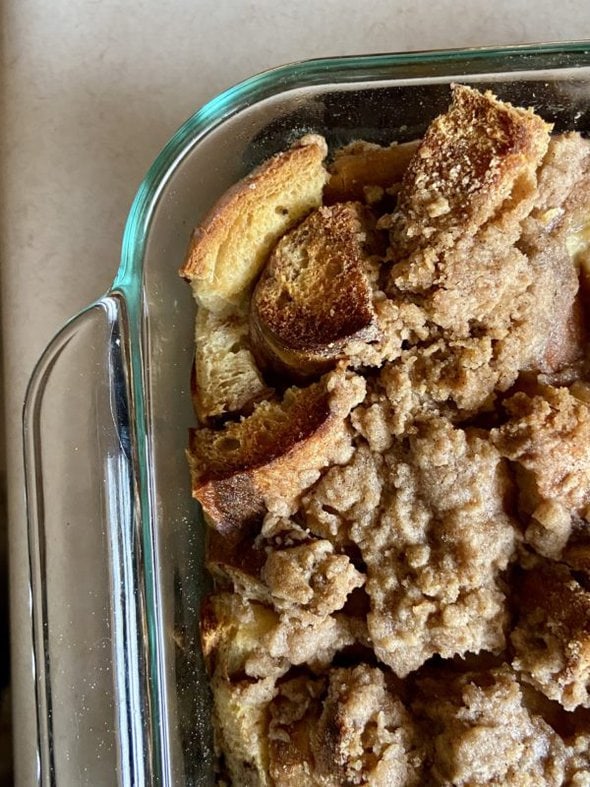
And honestly, I wouldn't even have qualms about using an 8x8 pan for half of a 9x13 brownie recipe, or some other similar baked good.
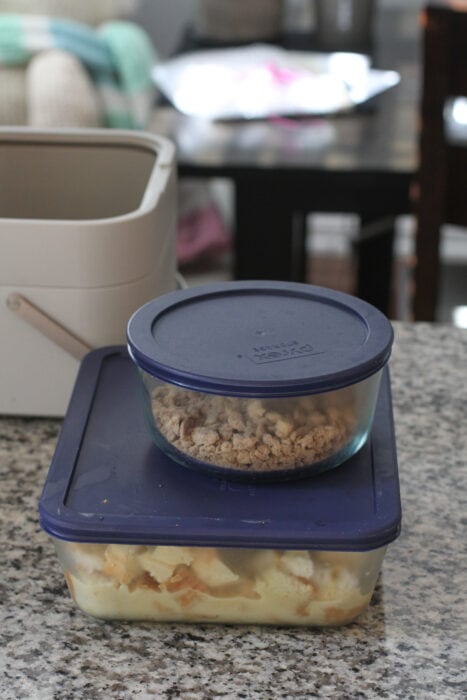
I've also used my rectangle pan, which is 9x7.25, and that comes out to 65.25 square inches, which is super close to being half of a 9x13.
For medical insurance:
I did consider a cost-sharing type of medical plan (many content creators, like podcasters and bloggers, choose them), but for clinicals at school, I am required to have actual, factual health insurance.
And that's usually a requirement coming directly from the hospitals where we do rotations.
Sooo, I am stuck having to get real health insurance.
But, I graduate in May! And then I can work enough to qualify for health insurance at my hospital (which hopefully will be better than what I've got going on right now).
Can I cube raw potatoes and throw them in the freezer for stuff like soups and stews? What is the consistency of the potatoes like once I defrost for cooking? Can I also use them to make roasted potatoes in a 400-degree oven? Same for carrots. Can I freeze celery? Any help would be much appreciated.
-Linda
This one was from the comments in a recent post, and Kristin from Going Country did a good job of answering it (the down and dirty is that frozen raw potatoes are rather mushy and gross once you thaw them and try to cook them.)
But I wanted to add a tiny bit of the science behind freezing produce.
As you all know, water expands when it's frozen. And also as you all know, plants (and that includes produce!) have cell walls that help provide structure to the produce.
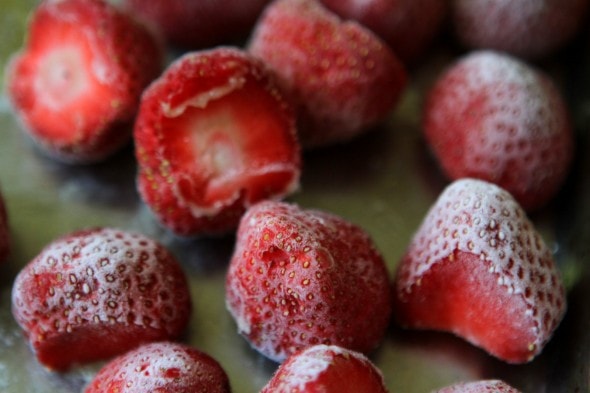
When we freeze produce, the water inside the cells expands and forms crystals, and that bursts the cell walls. So then when the produce is thawed and the water melts, we are left with destroyed cell walls, which is why the thawed produce looks rather deflated overall.
The more water the produce has, the more pronounced this effect is.
(One can imagine how squishy thawed watermelon would be!)
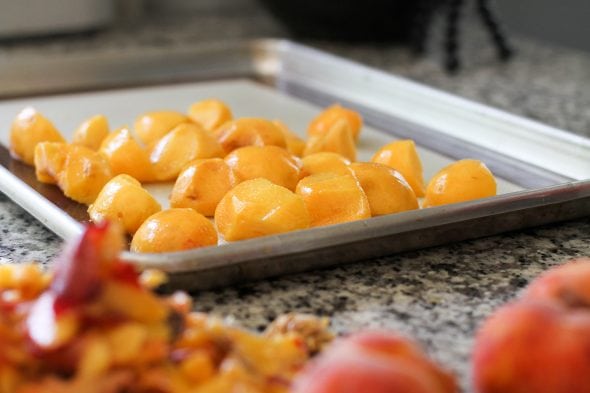
Anyway, the reason I mention this is that removing some of the water from a vegetable can help it to freeze better. For example, sauteed mushrooms and celery are much better when frozen and thawed because you've removed some of the water from those cell walls.
And this is part of the reason that partially or fully-cooked produce does better in the freezer.
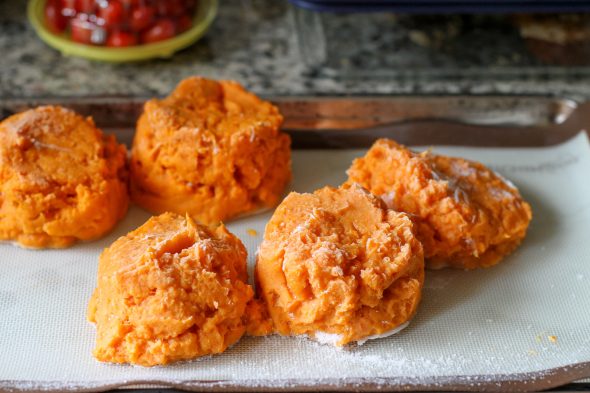
One other relevant thing: commercial producers flash freeze their products, a process that produces smaller (and fewer) ice crystals. We can't really replicate that process at home!
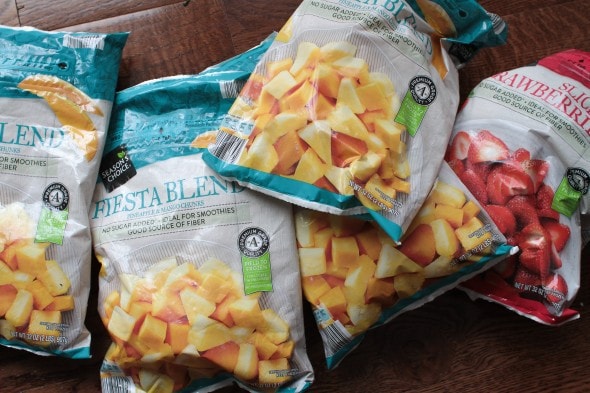
A question I have for you guys: do any of you know why mangoes and peaches retain so much of their texture when frozen? Peaches in particular are very juicy so I am stumped as to why they don't appear to suffer much from the burst cell wall problem.
A rabbit hole I went down regarding percentages of water in various fruits:
- watermelon: 92%
- peach: 89%
- pineapple: 86%
- mango: 81%
- banana: 75%
Based on this comparison, it makes sense that mangoes fare pretty well in the freezer, but the peaches still stump me.
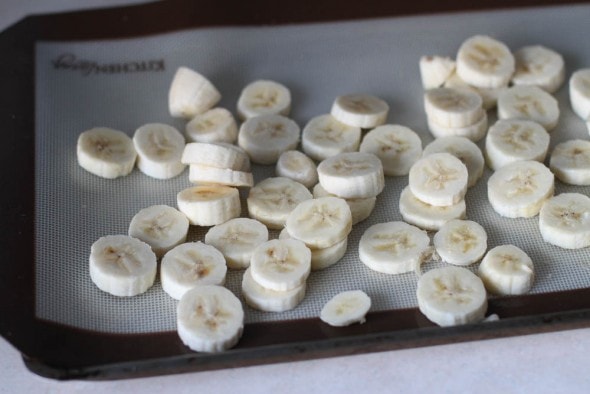
The googling I did tells me that there's some variance in the cell wall structure in fruits, with varying amounts of pectin, so maybe some cell walls are just more resistant to destruction in the freezer!
(A P.S. to this question: if you can't find the answer to, "Can I freeze this food?", it's a good time to apply my "Try it and see!" method, with a small sample.)
(A second P.S.: another reason that par-cooking/blanching produce before freezing helps: it slows down enzymes that would otherwise be working to degrade the food.)
1. Why is it forbidden to share med cards?
2. Many people say they learned English by watching teevee or listening to the radio. Have you thought about trying that to amp up your vocabulary, familiarity with the rhythms, and pronunciations? Sounds super frustrating, but you could try it in small doses. If you hate it, just turn it off.-Jana
Med cards are assigned to us in school; they're basically empty templates for us to fill out about a medication. The filling-out process is part of the learning, so it's considered cheating to share your info with another student.
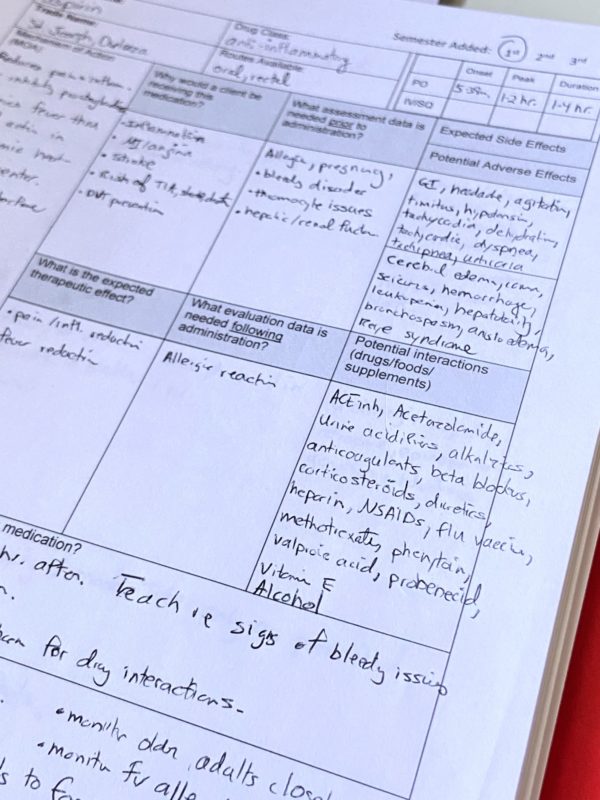
(For the record, I hate doing med cards and I don't find them that helpful! I personally do better learning about a drug in combination with learning about a disease.)
And, your language suggestion is a good one! But I rarely watch TV.
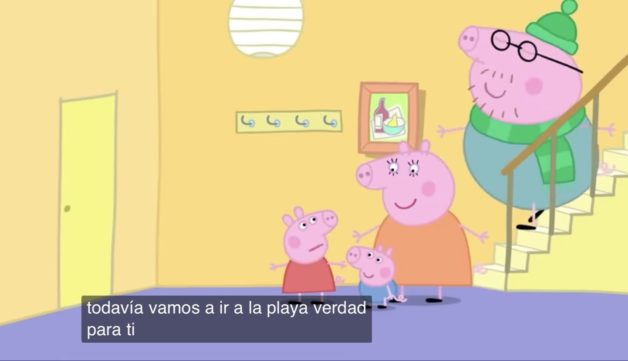
However, after you left this comment, I did put on a Peppa Pig YouTube video in Spanish. Embarrassingly enough, I had to put even that on 0.75 playback speed to keep up. Ha.
I will keep trying!
Your Duolingo streak is impressive. Do you use the free or paid version?
-Tammy
I have the paid version and the reason is: I forgot to cancel after a free trial this summer. Whoops!
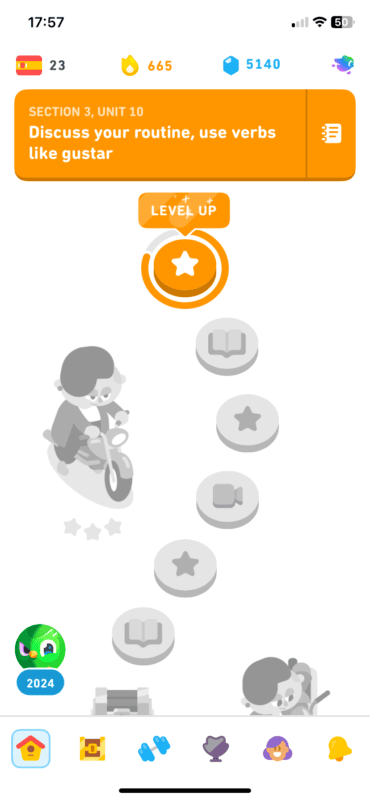
But I will say, the app is way less annoying to use now that there are no ads (some of them were so long in between lessons), so I am not super mad at myself for this mistake.
I consider it a small accidental indulgence. 😉
Alrighty, y'all! I think the main topic for discussion today will be: freezing produce.
But as always, any topic in the post is fair game. Have at it!

It makes sense that you had to slow Peppa the Pig down. One of the things I’ve learned in my masters in literacy is that it’s much harder to acquire and understand a foreign language when we hear it electronically. Not that it’s impossible…it’s just not the same as interacting in person.
We have a Spanish immersion program where I work, and I can’t speak very much at all, but I know how to tell kids to walk in the hallways instead of run and how to line up to walk through the halls—phrases that are repeated ad nauseum all year long!
The cadence and conversational speed that is typical in Colombia can work really well for Spanish language learners! For some shows you can choose the dubbing dialect and I highly recommend changing it to Colombia or Central America. When I was in college, I studied abroad in Spain; most siestas, my host sister and I would watch The Simpsons dubbed in Spanish. I can’t attribute any particular success to this, but I did find that it was a non-stressful way to listen to sustained dialogue and conversation in Spanish.
@Robin, Thank you for this tip. I'm going to check that out!
I’ve seen people recommend children’s books to learn a language. Also, label stuff in the house with the Spanish word and say it out loud every time you use/see that thing.
I know US insurance companies are bad but faith based insurance sounds terrifying to me. I imagine it being a lot more personal and intrusive and even more open to interpretation of what is considered a necessary medical procedure.
@Victoria, 100% on what I've read about faith based insurance!
Books are a great way to learn English. It could also be helpful to read a book you know as you already have the story in your head, and will probably be able to identify new words and expressions more easily (I would recommend this for a book you've read numerous times).
@Sophie in Denmark, ah! learn SPANISH, not English! But the tip goes for any new language one is learning 🙂
@Sophie in Denmark,
I wanna add that listening to music in the foreign language also helps! You'll have to listen often but if you like the songs, that's no problem.
@Maggie, that definitely helps! It also reminds me of being taught Frère Jacques as a kid, only I couldn't speak French, so I had all these nonsense words for the actual lyrics!
@Victoria, From my understanding, faith-based “insurance” isn’t insurance at all. It is cost sharing among a large group. Medical costs are bargained down by the group on the grounds that the patient is paying cash.
Such faith-based plans are not required to follow ACA restrictions. They don’t have to cover pre-existing conditions, preventive care, or reproductive care. Some of them may do so, but they aren’t required to by law. They don’t guarantee that they will pay claims, and they are also not bound by consumer protections such as capping out-of-pocket costs.
This is without even getting into the possible intrusion into people’s lives. If I am wrong about any of the statements above, I hope someone will correct me, but personally, I would not touch such plans with a 10 foot pole.
@Victoria, the thing that put my sister off of that type of insurance was that the participants are encouraged to negotiate for lower rates at the doctors' offices.
@Meg in SoTX, you are right on target with your comment about the faith-based "insurance" programs. If someone out there is considering them, I would strongly encourage that person to call their physician and preferred hospital and see if the "plan" is accepted, and if so, how much is reimbursed. There are many medical costs that can be incurred, even with people in good health--labs, radiology, prescriptions, therapy, to name a few--and those costs can add up quickly (most legit insurance companies will cover at least some of these costs). You are better off paying premiums for a plan that will actually come through for you, should you need it.
In the spirit of the season, I would amend Meg's statement and say I wouldn't touch these plans with a thirty-nine and a half foot pole. 😉
@Kris,
Lol! We watched How the Grinch Stole Christmas last weekend!
@Meg in SoTX, One of my super powers, possibly the only one I have, is browbeating insurance companies into paying denied claims. I am one of several volunteers and I only do it for people in end of life care, or else I would be overwhelmed. The only experience I have with faith-based policies was not a good one. Not only were they decidedly unchristian in their decisions, because they are not registered insurance companies, I was not able to use the threat of the state insurance licensing board---which can be surprisingly effective with standard insurance companies. Frankly, with what some folks pay into the faith-based plans, they could get better coverage through Obama care for less cost. This may not be the case for every faith based plan, I'm just throwing in my single experience.
I’m on day 5 of my DuoLingo streak to learn German!
I also just tried a program called Pimsleur. My library has several audiobooks for learning languages through this method, where a narrator takes you through common conversations and has you repeat the foreign language phrases. There’s supposedly some science around when you are reminded of phrases you learned earlier in the program to retain them.
However, I am a visual learner, so not being able to see the words on the page meant I promptly forgot the subtle difference in conjugating “I understand” and “you understand”. But maybe anyone who enjoys audiobooks and listening to textbooks (like Kristen!) would benefit!
@Andrea G, the science around memorizing those silly bits of dialog is very strong. Basically, we tend to remember the first way we say it, so saying it right the first time is important.
@WilliamB, I believe that. My German friend taught me the familiar version of “excuse me” first, and now I can’t get “Entschuldigung sie” (which is more formal) to stick in my head!
@Andrea G,
I guess autocorrect got you, because the formal version is "Entschuldigen Sie (bitte)".
German native speaker here ;-).
@Peterchen, kind of you to assume auto correct!
@Andrea G, autocorrect does the funniest and weirdest corrections, and if it's your own language one catches it and has a laugh, but if it's another language that can trip you up.
Sometimes it's so persistent that if one can get really unsure!
@Peterchen, aaaand there was an 'if' added where there should be none *lol*
@Andrea G,
I'm on day 205 of my German duo streak. Now, if I could only find a few novels in German. I think I'd like to try this. I'm also watching some TV is German. 🙂
I have really good results from freezing mashed potatoes or twice baked potatoes. Its a good way to use up my wrinkly or starting to sprout potatoes. They always reheat beautifully and the texture is the same as cooking it fresh. And you can freeze them in portions to add alongside your main dish for dinner for one.
Thanks for the suggestion about sauteing and then freezing mushrooms. I've got some mushrooms in the fridge that aren't getting any younger, and I'm going to try doing that with them today.
Mangoes do freeze really well. We have a prolific Mango tree, but it's a lot in a short period of time. In addition to giving them away to friends, I peel, chop and freeze them then use them in a version of a Cowboy Caviar salad (minus the onions and jalapeños) we make frequently.
I have had good luck freezing potatoes to roast or fry if I cut them up and blanche them (boil them for 3-5 minutes) let them drain and then freeze on a sheet pan. Once they're frozen, I put them in a plastic bag.
@Cindi, this is my process as well. French fries, cubes for soups, stews and roasting, it all works. Blanching also keeps the potatoes from oxidizing (turning black from exposure to air).
@Cindi, me also. I do this quite a bit and they're great.
My dear friend came over from Vietnam when she was five. She said her whole family learned English from PBS kid shows. This was before streaming. She especially liked Sesame Street.
Zero ideas here on why peaches hold up better when frozen raw than some other fruits. One of my favorite ways to eat frozen peaches is to let the peaches only partially thaw before I eat them. The still-icy juices and firm, sweet peaches are a warm weather treat.
Back when I used white potatoes more than I do now, I made a beef stew as I normally did, and froze the leftovers for later, as I also normally did. I buy whichever white potato is on sale most of the time, with some exceptions, so I don't know which type of potato this was in my stew, but when I thawed it out later to eat it again, the cooked potatoes were mealy, mushy, and disgusting. I'd never had that happen before and I'd frozen a lot of leftover stews and soups. I've been using celery root or white-fleshed sweet potatoes in my stews that I know I will freeze, ever since.
I finally gave up on Duolingo. I learned some, but I was nowhere near being fluent. I have turned the TV to Spanish at times, but I watch so little TV, that it hasn't been helpful, as Kristen noted. I read some in Spanish, but that isn't making me fluent in speech. I really need a Spanish speaker to converse with. I did so much better struggling along in Guatemala with the natives, some of whom also struggled with Spanish (Kaqchikel was the native language where I was) and we would often end up laughing, but learning along the way.
Ahhh, Peppa Pig! I can't escape. It's the only show my 4yo daughter wants to watch for her (very limited) screentime. :-) She watches in English though haha
Most libraries offer free language apps like Mango or Rosetta Stone. Is Duolingo better?
For learning a language, there’s a difference between targeted conversation, such as Kristen wants, language specific to situations where you will speak it, and fluency.
I used to teach a class for adults who will travel to a country and just needed the kind of sentences related to being a tourist. They didn’t waste time striving for fluency.
Fluency, as JD mentions, comes with having a regular person or group to chat with. Libraries have these groups that meet weekly. The people bring along newspapers and books, etc. in the language to share and take home, too. One such group here took a trip together to Italy after several years of meeting up for chatting.
Kristen, as you speak the sentences to the patients, they will answer you, and you’ll learn a bit more actually from them as you converse. Like a mini chat group!
The ideal way to learn a language is to spend time in the country that speaks it. Like the family (from Vietnam?) that learned from PBS shows. They were hearing English spoken all around them every day all day in addition to Sesame Street.
Oh, and you can get Sesame Street and other shows in the language you want to learn from various sources for fun boosts to your other efforts. I love that idea!
Yes, I'm lucky that my main goal is to be able to have simple, practical conversations with patients; fluency would be great but it is not totally necessary!
I am a big fan of freezing.
Raw veggies: Onions, garlic, ginger, celery, carrots, and various kinds of squash have all been successful, but I use them in soups and stews where a softer texture is desired. I don't think a whole frozen carrot would be good defrosted and eaten raw. Maybe it could be roasted, but it would probably be very soft.
Cooked vegetables: I have frozen broths, soups, curries, and stews, with vegetables, beans, and meat and they all come out fine.
Dairy: Butter, milk, and shredded cheese can all be frozen! When I lived alone I bought huge blocks and shredded and froze them. I lie the freezer bag flat so the cheese doesn't clump up before being frozen.
Meat: I recently started making chicken katsu and freezing it before cooking. Works great and cooks from frozen.
@Meira@meirathebear, Great info here, thanks! I shred Parmesan cheese and keep it in the freezer in a jar but your idea to lay it flat to prevent clumping will be my new way to store it.
I think another part of the reason ghat mangoes and peaches freeze well is their high sugar content. Their juice is like syrup, whereas watermelon juice is like water.
Add jicama to the "don't bother to freeze" list. In the spirit of try it and see, I froze leftover raw jicama before I vacation. Big fail! It defrosted into wet, mushy styrofoam. I wouldn't even puree it for a soup.
My weird accidental food find is dehydrated summer squash. I don't like fresh summer squash, so when I got it in a produce box I dehydrated it to leather out of desperation. Out of more desperation I later added it a soup. I like it. It adds some texture and a greater variety to winter soups.
@WilliamB, That's interesting! I attended a food preservation class once and the lady had a jar of dehydrated summer squash, but I wasn't sure about it. Do you just have it sliced or do you slice and then cut it smaller?
That makes sense about the sugar content!
@Ruth T, usually cut it smaller, depending on the diameter of the squash.
@WilliamB, high sugar content is likely why pecan pie freezes well. Or I should say the filling does, the crust can be so-so. But one can do without the crust lol.
While I don't have a dog in this fight, I want to comment on the faith-based medical share plan. My comment is : BEWARE!!!!
For many years, I worked at a call center and conducted health interviews for people applying for either health or life insurance. When I was assigned to U.S. Health, a regular insurer, I fielded numerous calls from people who were on those medical share plans. They wanted off! Typically, they would tell me that they sent in money for other people who had various diseases/surgeries/hospitalizations, but when the time came for them to need others' help, they were left holding the bag. They did not get reimbursed the full amount, if at all, for their medical needs. From what I gathered, they were scammed.
(It reminds me of my college professor who once said "When I encounter anyone who TELLS me he's a Christian, I feel for my wallet to see if it's still there." In other words, he believed that there are a lot of con artists pretending to be good Christians, and they'll steal your money in a heartbeat.)
U.S. Health, on the other hand, was legit -- a real insurance company, and as such, was required to follow various legal requirements. I talked to a lot of people who were considered independent contractors in their work -- realtors, truck drivers and even a retired NFL player who left the gridiron and became a rancher. (Fun fact: the NFL will insure a football player for 4 years after he quits pro football, but after that, he has to buy his own insurance.) U.S. Health was not Obamacare but people who were not on employers' plans flocked to it.
Two disclaimers: (1) U.S. Health is not the only health insurance company out there, and you would need to compare rates from various companies; an independent insurance agent would help you do so. (2.) I was hearing from people who had bad experiences with those "Christian" medical sharing plans; satisfied customers would not be applying for health insurance and I didn't talk to any of them.
But from what my callers told me, if joining those programs, there's no guarantee that when your time comes, you'll receive the money you need for your family's medical treatment. Tread carefully!
@Fru-gal Lisa,
Although I think you meant to be helpful, your comments regarding your professor’s beliefs really made me bristle. They are quite a condemnation of the Christian Faith. I suppose this professor believed people who said they were of other faiths, agnostics, and atheists are much more honest?
@Bee, it’s less a question of believing people of other faiths (or none) to be more honest and more that other faiths are much less likely to cite their faith as proof of their honorable nature.
@Bee, when I worked at print shops, I learned the hard way that if someone wanted an icthus on their business cards, get the money up front. So many fake Christians out there, truly taking God's name in vain. There was just something about the folks who were in-your-face with symbols of faith that was truly inauthentic. Heartbreaking.
@Jules the First, that's how I read it too.
Thanks, Kristen, for all the answers! (I appreciated your answers in the comments too.)
And I should have known about you and teevee, because I don't watch it either. I've tried listening to the radio in Spanish, but my desire to learn Spanish is weak and doesn't overcome the annoying noise of jabbering that means nothing to me.
Those cartoon pigs have a serious nose placement problem!
This is a message to A. Marie and the other Jane Austen fans:
today's (Dec. 16) Holiday Mathis astrology column has JA profiled under Celebrity Birthdays. Saw it and thought of you. Mathis usually profiles a living person, such as an actor, but JA is so popular she earns the spotlight even in 2024, a whopping 207 years after her passing (if I calculated correctly). So if you haven't seen it already, please look up the Holiday Mathis column online. Happy JA birthday!
Ya, you really have to have people to converse with to be fluent. From all I’m hearing that may be hard to do after 1/20/25.
My ds, who is 24, came to me last Wednesday am and said, "I have appendicitis. I need to go to the hospital". Now, I asked him a few questions and realized he was hurting, so better safe than sorry, right? He just graduated college so his insurance was non-existent and I hesitated for a second, but off we went. 12 hours later, he was in post-op because he did have an inflamed appendix that would have ruptured 48 - 72 later if not addressed. He ended up with pneumonia but it was shut down quickly and he's home now. LISTEN TO YOUR BODY!!!! I am praying that Medicaid can be approved and made retroactive, but I wouldn't change a thing. He learned so much in 4 days and I know it will help him later in life.
I am so glad he is ok!
@Jennifer, You probably know this, but in case you do not: the bills he will receive are those that are calculated for the insurance companies. If Medicaid is not approved, go in there with the bills in hand, tell them you have no insurance and you need the rate adjusted. I have seen bills end up 30% of the original bill. Also, the finance people at hospitals know various programs that might be able to help him. And one final piece of advice: if you go in to get a fee adjustment, don't dress like you are going for a job interview. Don't wear jewelry or designer clothes, even if they were obtained from Salvation Army. You don't want to look like you have a lot of disposable income. And if you feel like crying, do. The more sympathy you garner, the more effective your request. I know this sounds manipulative, that's because it is. But you are playing against a stacked deck, so use every advantage.
@Jennifer, you probably already know this, but young adults can stay on their parents' insurance until age 26. Don't know what your health insurance situation is or if would be possible to retroactively add him. I'm so glad they operated in time and he trusted how he was feeling!
@Lindsey, what great advice. The whole commentariat can learn from your experience. Thank you!
@Jennifer, you did the right thing (as you know, of course) in getting your son to the hospital pronto, no matter how the insurance situation works out. Back in 1986, my appendix ruptured as it was being removed, so I speak from experience. And Lindsey's advice re: the billing is excellent, as always.
@Lindsey @Jennfier - and if a not-for-profit hospital, you also have the option of filing a complaint with your state (YMMV based on your state). My previous State Attorney General went after not-for-profit hospitals who not only did not work with patients but pretty much just turned them over to collection agencies.
Back in my college/university days, we watched Telenovelas. What a hoot and great conversational Spanish.
When my potatoes start getting wrinkly, I grate them, roast them @ 400 for 5 minutes, cool them, place in the freezer on cookie sheets and then bag in gallon ziploc bags.
@Blue Gate Farmgirl,
So, do you use the frozen grated potatoes for hash browns? Just curious. (I love hash browns, and also regret a recent frugal fail: letting most of a 5 pound bag of white potatoes go rotten. Sigh.)
My grandma once advised me that green beans would freeze better, if fully cooked and seasoned first. I do find them to be better; however that’s not to say I haven’t thrown raw green beans in the freezer. They work okay in a soup, but not as a side dish.
My former SIL took a 1 week, Spanish intensive course specifically designed for medical providers in Costa Rica. She was a L&D nurse. She found it quite helpful.
Last time, someone recommended a product for curly hair. I immediately went to the instant gratification website and ordered it because I’ve been trying to find the right product for my older, thinning, curly hair. I really liked the results! Thank you for the suggestion. I think we have a winner.
@PNW Casey, Ooh I need that also and somehow spaced it. Would you mind mentioning the name? Thanks heaps!
@ErikaJS, Strictly Curls - Curl Envy Cream by Marc Anthony. Bright, yellow tube! It really is lightweight and has a very pleasant, very subtle smell.
I have frozen all kinds of things, with mixed results - I find blanching green beans doesn't really make much of a difference (to me). I like the idea of freezing scoops of mashed potatoes or sweet potatoes, then putting them in a freezer bag.
I have frozen watermelon chunks before, with the thought that they could be used pureed in fruity drinks, like watermelon lemonade. I tried making watermelon frozen pops with them, too, which turned out okay, but were not very flavorful. Right now, I have many bags of raspberries from my raspberry patch in my freezer....I might try making/canning jam.
@Liz B., Dehydrating watermelon slices is the best way to deal with a glut of them. Thinly sliced, when dehydrated they are like fruit leather with a concentrated flavor.
6 year Duolingo streak here. I know words but tenses are killing me. I can have slow, stilted conversations with my neighbor, but still lots of pantomime! I think immersion may be the way to go.
Thank you Kristen and everyone for commenting about freezing produce, this was most helpful to me. I shall try some of the methods mentioned, specifically for potatoes.
Note, there are only 2 of us, and a 10lb bag of potatoes sprouts before I can use them up. (In Canada, the potatoes that are harvested at the end of the summer are kept in cold storage through the winter months, so those are still the same potatoes that you are buying in February, and a number of them are already sprouted in the bag when purchased).
I originally tried paid Duolingo when my credit card offered to refund 1/2 of a years subscription. I liked it so much that this year I renewed at full price. Yes, a treat to myself.
I’m interested in learning about the Christian health plan too. Kristen is there any way you can find someone to make a post explaining it for some of us?
A few quick notes on Christian cost-sharing plans from the perspective of someone who has used them regularly for the last 25 years...
When people ask me about them, I say, "They aren't the right solution for everyone."
When I started using them, I was a healthy 20-something who rarely visited the doctor, but wanted a plan in place for emergencies. Same story with my parents who joined the same cost-sharing ministry shortly thereafter. None of us dealt with pre-existing conditions or ongoing health issues.
So it's 25 years down the road. We've been through miscarriages, pregnancies, surgeries for my kids, staples, concussion, stitches, colonoscopy, broken toe, an emergency ten-day hospital stay with five days in the ICU... Funds have come in from other people in the cost sharing plan to completely cover 100% each of those situations. In each situation, we've been able to choose the doctors and hospitals we wanted and navigate these things without wading through tedious referrals.
Things are changing slightly as healthcare costs continue to rise. For future events, we'll cover the first $500-700 of an event and funds will come in to cover the remainder.
There are pros and cons to the cost-sharing plans and to the various ministries who run them. They're not a match for everyone. And there may be a time upcoming when our family switches to a more traditional health-care plan. But for this season, it's been a good fit for our needs.
You're better off with actual, factual insurance. "Faith" based ones have no requirements for reserves or paying claims period. Reminds me of having a MEWA plan (multiple employer welfare arrangement) - another you may as well gamble your money venture. Neither are regulated and both can leave you high and dry. Kristen's school is wise to require actual, factual insurance. What "faith" or MEWA consider approved services is up to the "plan". Some providers, such as MD Anderson, will consider you uninsured. Meaning you pay up front for services. While health insurance companies first and foremost priority is the bottom line, most either have negotiated or will negotiate. You don't get that with your "faith" based insurance. And if the "faith" based tells you to not be truthful about your situation, a pox on them.
I've frozen numerous veggies raw - asparagus, tomatoes (paste and slicers, both go into the chili or spaghetti sauce), zucchini (shredded or slices), and yellow squash. None are used as side dishes but as additions to soups, stews, spaghetti sauce, meat cooked with cooking soups, skillets (leftover steak, potatoes, eggs). I do squeeze water out of grated zucchini before freezing and before using. Cooked potatoes freeze better than raw and are best fried for consumption IMHO.
My niece will be graduating with a Bachelor of Science Degree in Nursing Thursday, December 19, 2024, in New Orleans. What a great Christmas and birthday present.
Are you using a particular app to learn Spanish? Really looking to learn for patients I deal with would so so help.
I'm mainly using DuoLingo, but I also follow some Instagram accounts. Hablamed on Instagram might be helpful because he posts Spanish specifically from a healthcare perspective.
I'm the one who asked about free or paid Duolingo.
I use the free version. I also use Rocket Spanish (paid) and watch movies/shows/videos in Spanish but they speak so darn fast, it's challenging. Lucy, on DL, speaks fairly slowly but Sari speaks so fast that I often have to listen to her more than once to catch what she's saying. Being able to slow down videos on YT is a great.
Yes sometimes I have to press the little turtle button to slow down Sari!