
How to homeschool a kindergartener when you have a preschooler too
Sarah wrote in last week with this question, and initially thought I'd already written about it. I couldn't seem to find a post about it in my archives, though, so I wrote this post. Mea culpa if I'm repeating myself! 😉
I have a question about homeschooling. I hesitated to ask, but since our decision to homeschool versus paying school tuition will directly impact our frugality, I decided it was an appropriate question to ask you!

I'm wondering how to go about homeschooling older child(ren) when you have a baby and/or toddler vying for your attention as well. It's so important to me to pay enough attention to each of my children. I do have some difficulty with time management and I'm wondering if I'm up to the challenge of trying to properly teach my kindergartener while my 2-and-a-half-year-old is around, constantly needing something.
I realize some flexibility is going to be necessary, as well as establishing proper boundaries and expectations for each child. The other detail added to the mix is the fact that we are considering trying for another baby in the next year, which will make things even more interesting!
I am very, very favorable toward homeschooling all of my kids, but I would love to hear some advice about how to structure your days when you're trying to teach a kindergartener, with a toddler and baby around also. Thanks!
-Sarah
Hi, Sarah!
I'm not gonna lie. Homeschooling with small kids underfoot is a bit of a challenge.
But here's the good news: kindergarten doesn't need to take very long at all every day. In fact, with just one kindergartener and some dedicated quiet time, you can easily get a day's worth of work done in 45 minutes to an hour.
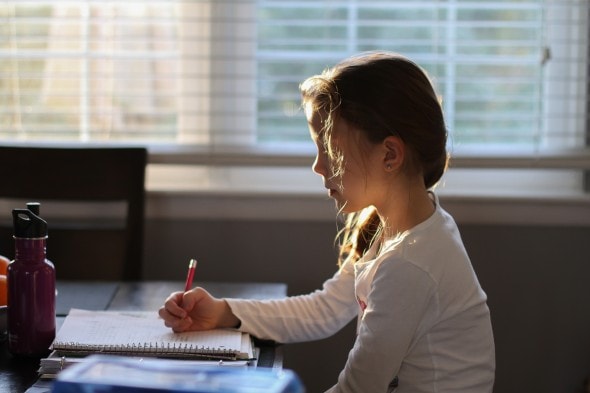
I'm assuming that your 2.5 year old still naps, so what I'd recommend doing is tackling school during naptime. That's what I did when my kids were in kindergarten (except for Zoe, because there was no one younger than her!)
Even if your 2.5 year old doesn't take good naps any more, could you set him/her up with some daily afternoon screen time? Or what about some enforced quiet time in the bed with books?
Because I'm a morning person, I'd naturally have been inclined to tackle school right after breakfast. But that can end up being an exercise in frustration, and I found it to be really easy to just do it right after lunch instead. You can get so much more done in a jiffy without a preschooler interrupting you!
If you do decide to try school in the morning, you could give your preschooler snacks, busy work, or play-doh, but none of those things is quite as effective as a nap. 😉
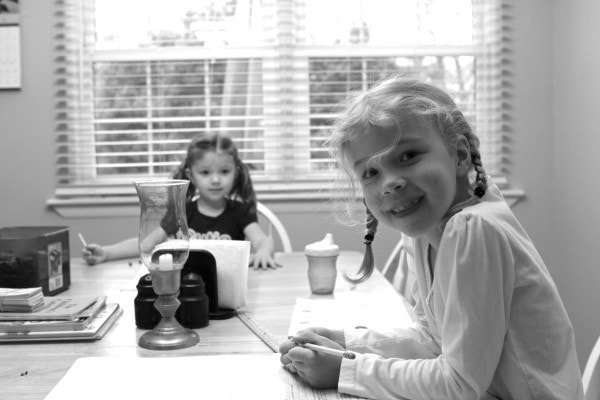
Oh, and aside from the bookwork that you do with your kindergartener, you'll probably be doing a fair amount of reading out loud, and your preschooler might like to join you for that. So, if you want to knock out some work in the morning, read-alouds are a good option.

On a related note, here's what I did for kindergarten with my kids. At the time I wrote the post (2009), Sonia was in kindergarten.

My kids are now a senior, a sophomore, a 7th grader, and a 6th grader, and I'm pleased to say that our rather minimalist kindergarten routine seems to have worked out just fine for them.

(Zoe kind of skipped kindergarten, actually. She hung out with Sonia and me during our school sessions and picked up so much, she started reading the summer before she was due to start school. So we pretty much just moved right into first grade work the fall she was 5. )
One other word of encouragement as you look at the future of homeschooling multiple kids: it's not as impossible as you might imagine.
As kids get older, they can do more and more work independently. Plus, if your kids are pretty close grade-wise, you can often put them in the same history and or science curriculum and knock out two birds with one stone (Sonia and Zoe are one grade apart, so I always have them doing the same history and science!)
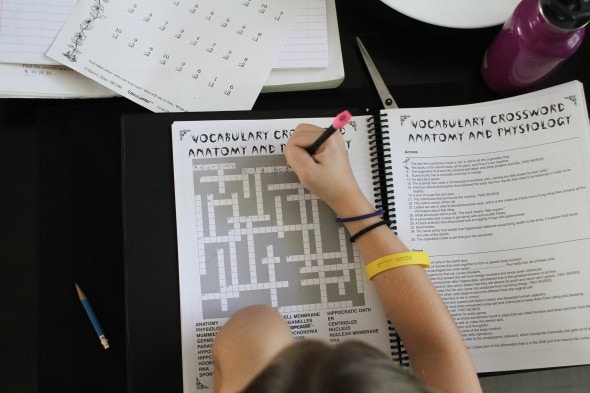
Ok, one other last thing (for real!): remember that you are never committing to homeschooling permanently. All you have to decide is what you want to do right now, and you can revisit the decision year by year. Thinking about it like that helps to take some of the pressure off.
I hope you and your husband come to a schooling decision you both feel at peace with for this year!
P.S. If you're new here and are wanting to read more of what I've written about homeschooling, you can read all of my homeschooling posts right here.



This:
"you can easily get a day’s worth of work done in 45 minutes to an hour"
To Sarah... my street cred is that I have 7 kids; the oldest is a homeschool graduate.
My advice is to rethink what makes up a solid kindergarten education. For us, it's been LOTS of free play, outdoor time, read-alouds (2 hours a day is great), a little math, lots of real-life learning (doing things with mom), LEGO building, minimal screen time, and working on phonics and learning to write. Like Kristen said, that's totally possible to do in under an hour a day.
My kid went to a traditional school and we were surprised she started Kindergarten being a little behind in the writing department. Here's what I learned she had to master by the end of Kindergarten (maybe your child can do much of this already!).
-Recognizing all the letters (upper AND lowercase).
-Writing their own name (using mostly lowercase letters)
-Knowing what sound each letter made (vowels make 2 sounds!)
-Cutting! I mentioned my daughter was a little behind in handwriting, one thing she rarely did before she started school was cut. Her teacher explained cutting develops the muscles and coordination used in writing and pencil grip. I wish we'd done more cutting.
-Recognizing what a word is (spaces between words, a big part of accomplishing this is pointing out the words to the child as you read them, her teacher always emphasised "tapping" each word instead of "sweeping").
-Writing on lines (and not all over the page!), although in Kindergarten she was not writing much, more copying, and even then more often individual letters than words.
-Listening/taking instruction
Funny story about that last one. For years I was a spark leader (in Canada 'Sparks' are a couple years younger than 'Brownies'). Usually we started our year in October, but this one year we started it in September, during the first week of school. The kindergartners came in, all excited, and we had them sit in a circle and began to explain our "opening routine" for meetings. As I was explaining a couple of them got up and wandered off to look at things around the gym. It was only then I realised that during the first week of school "sit and listen to instructions" is a learned skill for some kids.
Also, remember that a kindergartner doesn't need all of her work in one big block. They're still babies, and five minutes here and 10 minutes there suits their attention spans just fine. If you do nothing else, read aloud to her. That's school.
When I told my homeschool reviewer (school district person) that my then 1st grade son ran off from school to play whenever my back was turned, she replied, "Let him play. Kids need to play, and kids in school these days don't know how to." That was so encouraging.
Above all, teach her to love learning.
My cousin has homeschooled 5 kids. Some of the younger ones were very interested in what the older ones were doing, so she made "school" for them as well. They had their own "worksheets" which were coloring sheets or stickers. Some were educational and some were just for fun. It was totally preschooler lead and if they didn't want to do it, there was no reprocusaions. It was just an option to keep them occupied that they enjoyed. It made them feel like one of the big kids. Plus, it was good "training" for school. Mostly, she took advantage of naps and helped her older kids to learn how to self-start and motivate. Which, in my humble opinion, is a great life skill that we all could use more of in the long run.
It astounds me that homeschool Kindergarten takes up only a few hours of the day, maybe even less than an hour. My niece just started full day Kindergarten and boy is she having trouble adjusting. I feel for those Kindergarten teachers that have 30+ 5 year olds and trying to keep them in a desk all day. It gives me more and more reason to try to homeschool!
Yeah, it's because kindergarten just doesn't require a whole lot of formal teaching, whether you're at home or at school. It's not like kindergarteners at school get hours upon hours of focused instruction, so when you do kindergarten at home, you don't need to spend hours and hours doing focused instruction either.
I really do love the flexibility of home school. I went to public school, but I think I would have benefited from a more personalized curriculum. There's something so awesome about letting a kid explore the things they're already interested about; I think standardized education beats that out of you. I really don't think homeschooling is for us (I'm not a patient person 🙂 ) but it's so neat to see it in action.
My kids are 4.5, 3.5, 2, and almost 6 months. We do school by sneaking in a reading lesson (100 easy lessons for the oldest two, alphabet puzzle for the third) whenever there is a free minute here or there. For math, we get the counting bears out at the table, and all three get individualized work (for example: addition and subtraction or skip counting for the oldest, patterns and basic addition for #2, sorting and counting for the third). We also do lots of arts and crafts as a family.
We read tons of books out loud together, and my oldest reads at a second grade level so she recently started reading to the younger kids as practice. (Oh how I love to see her curled up with a younger sibling reading to them!)
In total, we maybe do 20-30 minutes of structured "school time" (reading and math) 2-3 times a week. In September we plan to up that to 4 days a week and add a formal math curriculum for the oldest two, but school still won't take more than 45 minutes a day. Depending on the day, I'll have the younger two playing on the floor near us, napping, or sitting at the table with their own "work" (aka coloring pages and the like).
Like you, I'm a really new home school mom, but one year in I'm amazed how relatively easy it is to squeeze everything needed for early grades into a few minutes a day even with other littles underfoot. The return in extra time for outdoor and creative play makes me very thankful that my girl won't be joining her neighborhood peers for all day kindergarten in the fall.
I just want to say that thriftbooks.com is great for finding all kinds of books including homeschooling ones. I just popped over there and saw that they have the Scott Foresman book for $3.59 versus the Amazon list price of $10.68
Ooh, good to know! I'll have to check that out.
I have homeschooled 3 children over a span of 17+ years. My youngest is in his final year of college.
I chose to school four days a week when they were in the younger grades and use the fifth day for field trips, fun events and sometimes we just took a break. It really helped.
Keep it simple when they are young. Help them to love learning and use those teachable moments. Have fun, relax and enjoy them!
I agree that it's manageable 🙂 You have to adjust your expectations at times - but it's totally doable. I have two 6-year-olds, a 3-year-old newly home from China, and a 2-year-old. My toddlers are actually really inconsistent nappers already, so the school-during-nap strategy isn't super successful for us this year, but we are continually finding what works well for us. It looks different than what works for other families, but that's part of the beauty of homeschooling. My littles usually play pretty well early in the morning, so my 6-year-olds generally do math during breakfast - which is actually when their attitudes toward math (their longest "seat work") are best. Why? I have no idea! It works for us, though 🙂 After math, we have a little bit of play time for everyone, and then I get out our books for our other subjects. Usually I get out some big, creative toys with which everyone can play with less assistance while I read to them (i.e. train tracks, with which the littles still need a lot of help, don't work as well as blocks, which everyone can do on their own), and I read to everyone. The little kids just view this as normal, so sometimes they'll sit on my lap while I read, sometimes they'll just play - it really depends on the day. When we do science experiments, we include them. When we memorize poems, they request that they have turns repeating the poems' lines after I say them, too. All of that sounds very smooth, and in the big picture it is, but that doesn't mean it really is in practice. We have days where I've just started to read our history pages, and one of the littles announces that they've pooped and need a diaper change. We have days when the littles (or the big kids!) can't stop fighting over toys. But we work through it 🙂 I've had days of finishing school after dinner once my husband is home and can amuse the littles for 30 minutes. Without an extra adult, we can usually do all school in 3 hours (though that's not 3 hours straight of school - it's school + play time + interruptions). It's probably actually 90 minutes or less of formal school stuff. It'll probably take some trial and error, but you can figure out what works for you and your family 🙂
We've almost always tackled math first too! Seems to be easier to get the hardest thing out of the way first (we are a family of not-inclined-toward-math kids.)
This is great and a real life post- thanks for sharing!
Thanks for all the good advice everyone!
This is fabulous. My oldest kids go to public school and we have a great experience so far. But, I love having ideas on what to work with for my younger ones, and public school may not always be an option for us. Homeschooling sounds very daunting to me to match up with all the extras public school can provide, But as always you explain it systematically , and therefore doable even for impatient people like me! These posts are so helpful to me should we (and likely we will) need homeschooling in the future. Thank you for always providing a little light and positive attitude in the day
I have a 2-1/2 year old, a 5 year old, an almost 7 year old, and a 12 year old, and I homeschool. I think the biggest thing for me has been realizing that it is okay and necessary to constantly readjust the schedule, because what works one year or term or even month might not work the next, especially with little kids.
What works for us right now is having everybody sit down at the table together (even the baby!) when we start school in the morning, and then have people leave as they finished up their work. I try to start with something even the toddler can enjoy: right now we read some poems and then sing a Greek alphabet song (I decided I wanted to learn ancient Greek, and I am making everybody else learn it with me!). She's usually done a few minutes after that, so she goes off to play or watch PBS Kids. Then I get my younger two started on their seat work (my oldest can get himself started), and my 5 year old can honestly finish in 15-20 minutes most days with no problem. (He only does, in the morning, one math worksheet and one handwriting/spelling worksheet.) Then I work with my 6 year old while the two younger ones play together. Later in the morning, when he does his reading practice, he reads to both me and his little sister, which she enjoys, and when I read to my 6 year old, the younger two just kind of half-listen, half-play, which is fine with me! I still use her afternoon nap as the time when I work my closely with my oldest, while the middle two play quietly together.
Honestly, though, I am a big believer in being pretty low-key with formal academics in K-2. I think we get caught up in the idea that, in public schools, kids that age are in school all day, so we can feel like we need to do more academics with them. But, personally, I think that if they get some phonics instruction and learn to read and learn addition and subtraction facts (neither of which takes a whole lot of time), they are good to go for more serious academics in middle and later elementary. The rest is just reading them good books and giving them time to explore the world and play.
We have 4 girls, 6, 5, 5, and 4 (22 months from oldest to youngest, twins in the middle). This was our first year of school and we are homeschooling. And I spent a bit of time wondering how to give the oldest what she needed without over-pinteresting our school days. I came to the conclusion that many experienced moms have mentioned here, we really did need to do much less than 7 hours a day, and really did NOT want to make it a stressful thing. My husband was slower to jump on board, but I invited ourselves to a friend's house for dinner so she could show him her set up. 🙂 And I encourage you to start off with a small framework, and give yourself 6-8 weeks to get into it, evaluate for a second to see if things are going well, and make small tweaks as needed. About 1 month into our year, I realized we were a little more unschooling than I (and especially my hubs) was comfortable with, so we made a 'morning time' folder (ours has opening prayer, scripture memory (the same verses all year long), and alternating poems, hymns, and bible promises/commandments).
Then we gather at the dining room table or couch/coffee table, our oldest works on math (a simple work book), reading or handwriting, the preK twins have their workbooks that vary between all the preK skills needed (and I think came from Aldi for 4.99), and the 4 year old started the year with a cut and paste workbook, and after she finished that, 'earned' her big girl workbook. We also have a big book of mazes, another of dot to dots, and special 'school only' books for reading (Usborne Christmas gifts to the kids, animal books, science experiments, write and wipe clean, fairy tales...anything to make it fun). And then we make slime or water beads, paint and color, make pictures to mail to loved ones, and play play play.