Monday Q&A-Homemade Yogurt Questions
After I posted my homemade yogurt recipe, I got enough questions to warrant a Q&A post devoted entirely to yogurt.
Several of you wondered if you HAVE to use Mason jars to make yogurt. The answer is a resounding "no!". Any glass jar with a lid that seals can be used.
On Saturday, in fact, I put some of my yogurt in a pickle jar.
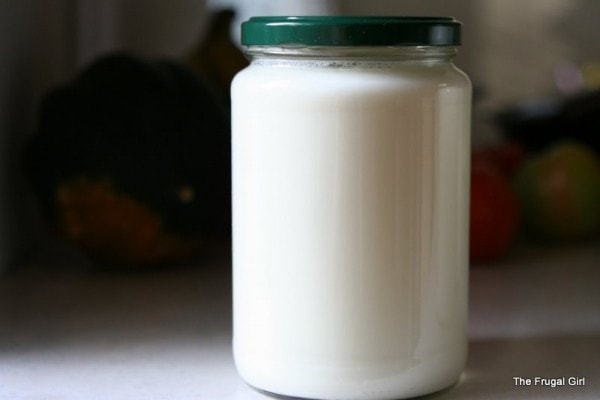
I like this jar because it has a nice wide opening. However, you should know that pickle jar lids need to be thoroughly washed and left in the sun for a while to get rid of the pickle smell. Of course, if you don't mind pickle-infused yogurt, you don't have to worry about that.
The pickle jar should smell fine after a thorough wash, although if yours still smells, you could always leave it out in the sun to take care of any remaining odor.
You can even use plastic containers, as long as they have a good seal on them. Without a water-tight seal, the warm water in the cooler will seep into your yogurt containers.
___________________________________
I also had a few readers that wanted to know if they could re-use the Mason jar lids. I'm happy to say that yes, you can do that. When you are doing honest-to-goodness canning, you need to use new lids each time so that a proper seal will form. When you make yogurt, though, you aren't trying to get a shelf-stable seal, so an old lid works just fine.
As you can see, my lids and bands are banged up...
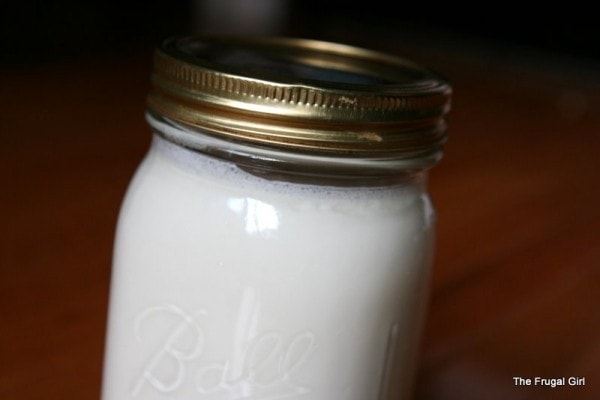
and the outsides are even a bit rusty.
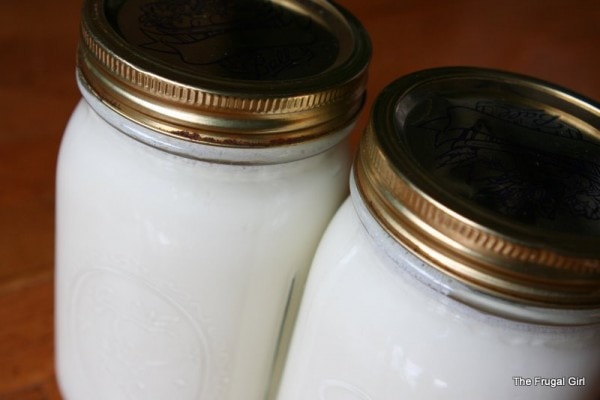
But my yogurt turns out fine and dandy each time, despite the decrepit appearance of my lids.
(I hope it goes without saying that if a part of the lid that touches the yogurt is rusted, you should throw it out and use a new one. Outside rust is fine, inside rust is not).
_____________________
I am fascinated by making yogurt. How much time does it take? How much counter space do you need (an odd question, true, but my counter space is at a premium)? Am I insane for considering this when I work fulltime, have a toddler and am 6 weeks away from giving birth? Thank you for your help.
Kristin
Yogurt is one of those things that takes a while from start to finish, but requires very little hands-on time (kind of like bread!). I'd say the whole process, including the three hours of incubation, takes me about 4 hours. Honestly, though, only about 15 minutes of that four hours requires me to actually do something.
I don't need a lot of counter space to make yogurt. The milk heats on the stove, cools in the sink, and incubates in a cooler on my kitchen floor. I only use the counter when I'm filling my jars with the heated milk. So, I'd say you need enough counter space for four Mason jars, and most kitchens are sufficiently equipped to handle that.
Since you work full-time, it would be pretty difficult to make yogurt during the week. It might be a good weekend project, though, and since it requires so little in the way of hands-on time, you could make it while you tackle other projects.
I know I've said this before, but if any of you are about to make yogurt for the first time, do give this a couple of tries before you decide whether or not it's worth it. I thought it was really time-consuming the first time I did it, but after I got the hang of it, it seemed so much easier. Making yogurt saves me at least $572/year, so I'm really glad that I didn't give up after that first try.
_______________________________________
If you've got more questions about yogurt, ask away!
And in case you're still not tired of reading about yogurt, here are a few more yogurt-related posts for your browsing pleasure.
Why I Make My Own Yogurt
Cost Comparison of Yoplait and Homemade Yogurt
How to Make Homemade Yogurt



I was making my own yogurt a lot, before my husband left. I found it to be fun and very easy! I really should start making my own, since I get milk for FREE from WIC. For now, what I've been doing is to use coupons to buy some yogurt as a treat. I get these great $1 coupons that make a 4 pack of yoplait only cost me $.59 total. It's really taking me longer than I'd hoped to get back in the swing of things, but I'm hoping that soon...Things will have gotten easier.
Liz, I think you have every excuse in the world for not making your yogurt! Don't beat yourself up, ok? If my husband had left me, I don't think I'd be making yogurt either.
Another person's experience: I work fulltime and actually find it *easier* to make yogurt during the week. My method is a little different than Kristen's. I incubate my milk in the oven with the light on, leaving it therefor 8-12 hrs. So I make the milk after dinner, leave it overnight, and put the pot in the fridge in the am, and decant th yogurt at my leisure. It took me a time or two to get the process down; now it's 10min of my time, spread over 8-12 hrs.
And Liz, what Kristen said! Making yogurt has to be way far down on your priority list.
You know, we put pickle/mayo/whatever glass jars in the dishwasher and that gets rid of the smell.
What stinks is so many companies going to plastic containers when the glass worked so much better. At least pickles won't stay fresh in plastic so we can expect them for a while.
i have a question, but it's not about yogurt. I save jars and lids all the time but its so difficult to get rid of the pasta/pickle/hummus, etc. smell. I've soaked them in Dawn detergent, used baking soda and vinegar. I've had lids on my window sill for a week and they still smell of the previous contents of the jar. What else could I try?
Battra, I should clarify that. It's the lid that's the problem. lol
Laura, can you set the lids outside in direct sunlight? That helps to get rid of the smell.
I feel very foolish for asking this, but what does it mean when people say "leave the oven light on"? I've read this a few times, both in your yogurt post and also for giving bread a good place to rise. I have an electric stove (apartment rental - when I buy a house I'm definately going to try to get a gas stove!). Does oven light refer to the pilot light in a gas stove, meaning this is not an option for me?
I really want to make my own yogurt, but my boyfriend is completely opposed to the idea. He said he definately won't eat it, because it seems unnatural (to which I completely disagreed!). I think he might just be messing with me at this point though 🙂
Just waiting to acquire enough jars!
Erika, I think it must be a reference to a gas pilot light. I have an electric oven, and the only way to keep the light on is to leave the door open.
If I want to make my oven warm for bread rising purposes, I turn it on for one minute and then turn it off. Or, I sometimes put a bowl of steaming water on the floor of the oven.
I think that's hilarious that your boyfriend thinks homemade yogurt is unnatural! Because, you know, orange creme savers yogurt from Breyers is SO natural. lol
I say make it and eat it yourself. It keeps for weeks on end, and you could always just make a half gallon at a time.
My oven is also electric and it has the option as did my previous oven of turning on the oven light. Look at the controls more closely and see if there isn't a button or switch or something to control the oven light. (I overlooked mine for years) Most manufacturers allow bakers to turn on the light to look at the oven contents through the glass door without opening the door and losing heat. If you can turn on the light and leave it on, it will provide a small amount of warmth in the closed oven.
I have an electric oven and the light can be turned on and off. I replace my bulb with a 60 watt bulb and it keeps the oven toasty. I leave my yogurt (a gallon at a time) for 36 hours to digest all the lactose for better digestion. Works great.
I have been wanting to try this and have kept putting it off because I don't have the jars. I am so glad someone else asked, because now I realized I can use the jars from my husband favorite salsa!! Only 1 more jar to go, which should be easy! 🙂
So what do you do with all the yogurt you've made? Do you mix fruit with it, use it in recipes, put granola in it? How about sweetening it? I find that I really don't like plain yogurt on its own so I'm curious what you do to make it palatable?
Ben, I find that when I make my plain yogurt (Greek) from raw milk (local source) either using a purchased starter (www.cheesemaking.com Y5 Sweet or Y3 Creamy) or I have had decent results with a small carton of plain Chobani Greek as a starter, that the yogurt is really not that "sour" like a store bought product. If it ages, it will become more sour, but initially it is not very sour and more of a mild sour cream in flavor and texture after straining. If you want to sweeten or add flavoring to your yogurt, do so after it has set. Try mixing in a spoonful of your favorite preserves or top with berries, granola, nuts, a drizzle of honey, etc. The possibilities are endless.
Ok i made the yogurt plain using store bought yogurt for starter. The yogurt set fine nice and thick so i took fresh berries,(rasberries and blackberries), processed them separately and then dump the yogurt out into a bowl and mixed the puree into the yogurt. After mixing I return the jars to the fridge. I notice that the handling made the yogurt and little thin will it set back up? My question is did i just ruin a gallon of yogurt?
@Erika
Sorry for my lack of clarity; I know I'm guilty of that multiple times. When I say "oven light on" I mean the lightbulb. Some ovens let you turn on the lighbulb manually, others require that the door be open. (I think those are designed by people who don't bake.)
If you have an oven without a pilot light (ie, electric oven or gas-with-automatic-ignition), it's a good idea to warm up the oven by doing as Kristen says. Or if you're really into planning ahead, make yogurt after you bake something, using the residual heat from the baking to keep your oven warm. Just be sure the oven cools down to 150F or so or you'll kill your yogurt-beasties.
Maybe you should gently suggest to your boyfriend that he learn a little about the history of yogurt. It originally came from Asian nomadic tribes who carried milk in animal bags that, owing to their nature, contained yogurt critters, which turned the milk into yogurt. (FYI, this is the description that avoids the "icky" parts.)
You can't put the lids in the dishwasher? Hmmm ... I'll have to double check but I'm pretty sure we do. Oh well, no matter.
I've really got to get around to trying this sometime when I have a weekend to myself.
I wash my lids in the dishwasher, but if I am canning, I sterilize them by boiling them. You are the best judge of how clean they are getting and my top rack seems to work fine.
Battra, mine still are kind of stinky after a trip through the dishwasher.
Also, after a lot of trips through the dishwasher, lids like that can start to rust, so I usually hand wash mine (same with my Mason jar lids).
When I've canned anything, I always hand wash and boil the lids and rings. The jars go through the dishwasher, though.
WilliamB - Thanks for the clarification! I do have a light in my oven, but I wasn't aware that it put off any heat (I just use it to spy on my food while it's cooking!). There is a switch on the top of the oven that turns it on. That's really good to know!
Also, I had no idea how yogurt was created so maybe I should do some history research myself, just out of curiousity! Honestly, yogurt grossed me out a lot more before I read the article on how to make it homemade (the texture weirded me out). Somehow it seems a lot better once you know exactly what's going into it!
Hi, I enjoy your blog. have you ever tried making crockpot yogurt. I've made it with great success, and it is very easy.
Kristen~
I just made yogurt for the **first** time a couple days ago and after much panic and worry realized that it was soo easy! I then had to make some homemade granola, which makes the best power breakfast 🙂 Thanks for your great tips and for taking the unknown out of something as nummy and useful as yogurt. My family loves it. Oh! We have also started making bread regularly and the other day I went out and bought it since I ran out of flour. I felt so weird buying it again, so I know how you felt when you were buying up some for your vacation.
I work outside the home more than full time and have two school-aged kids. It's a busy life. But I've been streamlining my homemade yogurt making more and more, and it's SUPER easy.
Here's my latest unvention (unvention is not a typo, knitters will recognize it): I now heat the milk in the microwave in the mason jar I intend to use for incubation. If you do this you MUST have a good set of oven mits or heat resistant rubber gloves so you don't burn yourself on the hot jar of milk!!!!!!!
Fill the jar no more than 2/3 full--this is somewhat less than a quart, but milk expands when it heats. I took about 6 minutes on full power in my microwave to bring the milk to 180 degrees. I started with 5 minutes and then checked after every 30 seconds until the desired temperature was reached. Now I know exactly how long it takes every time.
I let my jar of milk cool to 120 degrees on the counter, no more ice bath (I'm afraid an ice bath might cause thermal shock and bust the jar). It takes about 20 minutes.
When 120 degrees is reached, I stir in the old yogurt, cover it, and put the jar in an insulated container over night. My jar fits in a pre-heated (with hot water) insulated "lunch jar" I got for about $8 at Target (it had three plastic bowls with lids that fit inside for taking a hot or cold lunch to work). I put the whole thing (insulated thermal carrier with Jar of innoculated milk inside) into a thermal lunch bag and set it in a place free from drafts overnight. Frugal Girl's use of the cooler and hot water is still the best idea I've seen for making multiple jars at a time. But our family eats less than a quart a week, so the single jar insulation method works for us.
This makes great yogurt and it's easy as pie. Very little time or cleanup is involved. It's totally doable for this mom who works outside the house.
Just tried my second batch and this time I've added fruit. I used frozen peaches and cherries. I micro-cooked them with a good amount of sugar, drained off some of the extra liquid, then used my stick blender to mash them into a pulp. I made sure to cool the fruit to 120 degrees, then I added it to batches of the warm milk/yogurt starter liquid and poured it into pint size jars. The result was 3 pints of cherry yogurt, 3 pints of peach yogurt and 4 pints of vanilla. I'm so excited! Thanks for giving me the courage to try something new! I have allergies to many of the additives in commercial yogurt. Now I can make my own! Aloha! *;)
So since it's just going to be me and Her Majesty for a while, I know there's no way we'd eat that much yogurt. If I made it using half a gallon, would I still add the whole cup of starter yogurt or should I only do half a cup?
@Ben I mostly make the vanilla yogurt version (it's included in the yogurt recipe, down at the bottom, I think). We eat that with granola on top for breakfast and lunch, and sometimes we mix in jam or fresh fruit. I also use it to make yogurt smoothies, which we drink with our lunch about 75% of the time.
Try the vanilla version and use whole milk....I think you'll be surprised at how tasty it is. The whole milk helps to keep it creamy and not as sour as some yogurt.
Jen, I'm so glad to hear that yogurt and bread-making are no longer scary! That's awesome.
Jan, that's a great method for making smaller quantities. If I did that, though, I'd have to make yogurt almost every day. lol I'll have to keep your recipe in mind for my empty nest days, maybe.
Karelin, how did it turn out? I still need to experiment with that, because my husband likes cherry yogurt.
Sabrina, I think you'd just need a half cup of starter, although adding a cup wouldn't hurt anything.
But if we want to give it a flavor, say, key lime, how would we do that?
Instead of using a seal and ring, would it be possible to use the plastic lids that are now made for mason jars?
Has anyone tried making yogurt in the crockpot? I found a recipe for it and thought it sounded really easy! I have a gallon of whole milk and am going to try it in the next week or so.
@A. M. Turnmire Yep, that'd be fine. I made some of mine in small plastic containers with plastic lids this week. As long as the lid will keep out water, it will work.
Linda, a lot of my readers have mentioned doing it that way. I prefer to incubate mine in the jars so I can easily refrigerate it without disturbing it post-incubation, but if you think the crock pot will work well for your lifestyle, go for it!
I've been using a yoghurt maker, which requires 10 hours to get the job done before putting the yoghurt in the fridge for three hours. My problem is that I start it in the late morning after my three kids are settled, 2 at school and our baby down for a nap. 10 hours later is usually after all their bedtimes, and I'm exhausted. I'm finding myself waking up at 4am remembering that the yoghurt is still in the yoghurt maker on the counter because I forgot to put it in the fridge. It's such a waste and breaking my own yoghurt-making frugal heart. How long can the yoghurt sit in the machine on the counter (which automatically turns off after the time it has been set for) before putting it in the fridge and still be considered safe to eat?
Hi, I'm addicted to Greek Gods honey yogurt and it is SO expensive, I'd like to try and make my own. Your recipe for vanilla sounds great, but do you know if I could subsitute honey for the sugar? If so, how much approximately?
I would imagine that you could substitute honey...it just might make your yogurt a little thinner.
Hi! Has anyone tried using soymilk and soy yogurt to make yogurt at home? If so, are there any tips for working with soy that I should know? I prefer the vegan option. Thanks.
P.S.: Enjoyed your story on CBN!
Hey Kristen,
I was so excited to try the yogurt! I don't know if you are getting these comments anymore, because the post is from October, but I had a question.
I made the yogurt last night and this morning it's thick in the center, but there is a thin layer of liquid on the outside. Is this normal?
That has happened to me once or twice and I don't know why! The liquid is safe...it's just whey, but ideally it should not be separated.
Did you use a name-brand starter, like Yoplait or Dannon?
Hi - it looks like you are still answering questions about homemade yogurt, so I have a couple of questions as I fall into the category of a person who is still trying to master it (I got it once but haven't been able to replicate) 🙁 So..I just made some and I thought it was going to be great, but when I tasted it, it wasn't very tangy or "yogurty" tasting - it is just bland. Do you have any thoughts on this? Also, I made mine thicker by straining it, it is thick, but it also got a little chunky. I ended up putting it in the food processor and its creamy now - but do you have any thoughts on why it got "chunky"??
Thanks so much!!!
Christina
Hmmm...what starter did you use? I highly recommend using Dannon or Yoplait.
If you want your yogurt to be tangier, you can leave it in the cooler for more hours...the longer you leave it, the tangier it will be, I think.
I have no idea why it got chunky. That's really odd. I'm sorry I'm not more help! lol
I just made your yogurt today. How long does it take to thicken up?
Thanks.
shelly
Hi!
I too have a yogurt question. I used about 3/4 gallon of whole milk (because my hubby drank some before I could stop him) and a whole container of Yoplait. I followed the directions, but my yogurt neve "set". It is still quite watery. Do you have any idea where I went wrong?
Oddly, if you add too much yogurt it doesn't set up as well. Try it again with less. I use about a tablespoon per gallon or half gallon jar.
Any ideas how I could make Key Lime yogurt? My 3-year-old will only eat that flavor,and if anyone knows a good way to do this I would really apppreciate it!
key lime juice is available at my k-mart. I have not seen it anywhere else.
probably add the juice after incubation is complete?
Have you or do you know someone who has added anything like Benefiber to a batch of yogurt? I go out of my way to find a enhanced yogurt for my hubs since the rest of his diet is pretty shaky.
can I make the yogurt in 1 cup jam jars instead of the quart jars? would the incubation time be the same?
thanks!
since is the same as pickles canning why would all the jars need to be in the frig? and are you saying that once you open a jar thats when it will last a month. and the unopen jars will be fine until open and then will last for a month?
Pickles are processed in boiling water after they're jarred, whereas yogurt is not.
An unopened jar should last for at least a month, and an opened jar would probably last for two weeks. I haven't experimented beyond then as we go through our yogurt quickly.
I tried making yogurt last night. I used pint jars and a 1/2 gallon of milk. I used FAGE yogurt for the starter. I put the jars in the cooler and set my alarm to wake me up to put them in the fridge after 3 hours. I woke up all excited to have yogurt and strawberries for breakfast and they were liquid. They looked just like a glass of milk, not thick at all. What do you think I might have done wrong? I don't have a heavy bottom pan. (I switched from my non-stick pans to stainless , which I love.) Would the weight of the pan matter in the thickening of the yogurt?
I just thought of another thing. When I poured the milk into the jars they were still quite warm to hot from having been sterilized. Would that have done it?
I let mine set up in a cooler for at least 12 but usually 24 hours. You could try incubating longer or try a different stater. If the milk was much hotter than 120*F when you added the starter you might have killed it.
Hi Jeannie,
I am no expert, but I have had A LOT of failed yogurt attempts and your second hunch is probably more likely, and you killed the starter bacteria. Everything needs to be sterilized and cooled, I learned the hard way (which sounds similar to your experience...times by 5!). 🙂 I have had the best luck with sterilizing and being patient - which means letting everything cool and warm to the right temperatures. Hope this is helpful. 🙂
Thanks Christina. I am a very cautious cook. I follow directions to the T. I didn't see where it said to cool the jars. Her picture showed them in the pan so I left mine in the pan. My friend who first told me about making homemade yogurt, who's first attempt came out perfectly, couldn't figure out why mine didn't come out. So next week I'll try again. I want to use an organic starter instead of Yoplait or Dannon. Have you tried something other than those 2 for starters?
Thanks again for your encouragement and help. I feel a lot better. 🙂
Great! Yes, stick with it for sure!! 🙂 As for a starter, I have honestly had the best success with Dannon. I did not have any luck with starting with a greek yogurt starter - don't know why - it shouldn't matter as long as it says "live active cultures"...with that said...I would try Nancy's - can you get that in your area? That is the next one I am going to try, I have been eating that yogurt right now and I just have a hunch it will be a good starter. Nothing more than a hunch - but I'm giving that one a try next! Good Luck - let me know how it turns out.
Nancy's was one I was going to try but I couldn't find the small ones on my end of town. I will let you know. Thanks again!!!
Christina!! I did it! I am eating my homemade yogurt with my homemade granola and organic strawberries right now for breakfast. I used the whole cup of starter even though I only used a 1/2 gallon of milk. I also think the first time I didn't have enough water in the cooler. (I was so concerned about getting the temp right the first time I didn't see I didn't have a full gallon of water in there.) And my jars were cooled this time. Thanks again for your encouragement and your tips!!!
So I've tried making yogurt a few times now. After I let it sit, I strain it to get it thicker. Even if I didn't strain it, I end up with whey to pour off. The last time I made it I started with a half gallon of milk and only ended up with 1 pint (16 oz) of yogurt. The cost ended up being the same if not more than store bought yogurt. I saw on apartment kitchn that they got 32 oz of yogurt from a half gallon. Why am I ending up with such little volume? I AM ending up with a lot of whey, but the yogurt is still not very thick (ideally I'd like to strain it to greek yogurt consistency). I'm using whole milk.
That's so odd...when I make my yogurt, I get a gallon of yogurt from a gallon of milk. But then again, I'm not straining mine to be like Greek yogurt.
Something is going wrong if you've got a bunch of whey to pour off right away. Is your thermometer working properly? Did you carefully follow the temperature instructions? Did you use a good starter? (I've heard Greek yogurt doesn't mix in very well, so try using Dannon or Yoplait regular yogurt).
I did use a thermometer and closely monitored the temperature. I used greek yogurt as a starter so maybe I'll try using a thinner starter next time and see how that works out. Thanks for the tips!
Hi, In your instructions, it doesn't give an approximation on how quickly to heat the yogurt to 185-195. I was nervous about the milk scorching, and set my stove to 3, then 4, then 5 after 4 hours of cooking! And I only ended up with 3 quarts worth - I think because I took so long to heat it up that quite a bit of it must have evaporated. I read the other comments and noticed that someone else ended up with less than what they started with as well, but they didn't say how quickly they heated the milk. I'm definitely going to try this again, and see what happens when it is heated quickly.
Have you ever used whole raw milk to make yogurt? We're going to get a milk cow soon, and I wondered if the process is going to be the same.
Thanks a bunch!
I usually heat mine over medium heat, and it takes around 15 minutes. And yes, you can definitely use raw milk!
I love making homemade yogurt but sometimes it ends up being too much and I hate throwing it out! Most of the time my 18 month old gobbles it up with me but sometimes some doesn't get eaten. We just got a blender so I think I will try using the extra in smoothies but my big question is: Can you freeze yogurt? And then thaw it out later? I think maybe you could but I was wondering if you had any experience with this.
P.S. I adore your blog!!!!!
I don't imagine yogurt would freeze very well. Is your yogurt actually going bad? I've kept unopened jars for up to a month and they've been fine. Also, you could try making a half batch (just use a half gallon of milk). And yes, smoothies are GREAT for using up yogurt!
Just curious, when your yougurt sits in the fridge awhile, does it form a liquid on top of it? If so, do you stir that into your yogurt, or pour it out of the jar? My yogurt is always real thick to start with, but then once I stir the liquid in, it gets runny and I'm not a fan of that... I didn't know if the liquid was essential to keep in the yogurt for flavor or nutrients or anything like that?
Yep, that's totally normal! It's whey, and you do not have to eat it. It's pretty nutritious, so you could save it to throw into smoothies if you wanted. Some people also use the whey when they bake.
I want to make a 1/2 batch - can I use pint jars instead a quart jars? If I use pint jars,how long should it stay in the cooler? Also, does the water come just below the lid or are the jars submerged? Thanks!!!
Yep, you can! But you won't need as much water...just add enough to bring the water level at least 3/4 up the sides of the jars. Or, you could always just use two of the quart jars.
Have you tried to make yougurt from soy bean milk?
I haven't, but from what I've heard, you need to make some modifications. Try googling for a homemade soy yogurt recipe.
You use a dutch oven in your recipe...does it have to be a dutch oven/ceramic cast iron or can it be any pot large enough? i.e. does it react to different materials in the cooking process?
I think any pot would be fine. I suppose it's possible that a bare cast iron pan might impart a bit of a metallic taste, but that's total conjecture on my part!
Will lactose free milk work or does it need to be regular milk?
Yep, I think lactose-free works fine.
For those that like to save time, I use the microwave to heat the milk (same temperatures) but it doesn't take the time as on the stove. Then follow the same process afterward. My yogurt turns out great.
I just made yogurt with your recipe for the first time and it was a success. However, my yogurt did come out runnier than I prefer. I was wondering how I could thicken it up a bit?
For now, you can strain it through a strainer lined with a thin towel or a coffee filter. This will give you a more Greek-style yogurt. For next time around, you could use whole milk if you didn't already, as whole milk makes a thicker yogurt.
Also, sometimes my batches are thicker and some are thinner. I think it's just the reality of things when you're dealing with live bacteria, you know?
If your yogurt is too thin to eat with a spoon, you can always use it in a smoothie instead.
My daughter and I made our yogurt thicker by using a gallon of whole milk and removing one quart and replacing that with 1 quart of 10% cream. Our yogurt turned out lovely and thick even after you stir it up the next day.
I love the tartness of Greek yogurt. (plain yogurt)...can we make this taste like that? I don't typically buy fat free things, but the non fat free isn't as tart so I am forced to buy it. But I want to make my own and save money. Any suggestions?
Thank you!
Kathy
Yep, I think if you make the plain version, it should be fairly tart. You can always give it a try and then see if you think it's good.
If I am making vanilla yogurt, can the starter be vanilla flavored or does it have to be plain?
You can definitely use a vanilla starter, even if you're making a plain batch. I often use the Yoplait thick and creamy vanilla cup.
Can you use a different kind of milk like Almond Milk, Rice Milk or Soy Milke in this recipe?
That usually requires some change in method. I am not experienced with that, though, so I'd do some googling to find someone who IS experienced!
I have been following your method for making yogurt for a few months now may kids can eat a whole jar in one sitting so we love it and go through it fast. I have done so much reading and experimenting on the subject. I am able to successfully make plain, honey vanilla, and am working on a lemon flavor. My kids sampled my lemon today and said it tasted like lemon pie. S I think I might have it after many many failing attempts. I have so many questions and have washed I had your phone number saved in my phone many times while making. But this is what I have to ask today.
Last week I made a batch and it had chunks. It was fine on thickness and flavor but had chunks. I took a whisk and whipped it around after it had been refrigerated and it made it thick and creamy and no lumps...but I can not figure out why they were there in the first place!??
My other question is this...when I make your vanilla flavor using honey instead of sugar sometimes little brown flecks rest at the bottom of the jar. When we are ready to eat I stir it and it seems to disappear. Is this from the vanilla flavoring?
Last question...so many of the things i have read have an incubation period of 8+ hours. Why does this method only say 3 and is it true that the longer you let it incubate the more tart the flavor?
I think I have more questions. But this will be good enough for now. Thanks so much. I love this recipe.
Is it safe to add fruit to the yogurt. If so fresh or from a can.
Thank you,
Can't wait to try!!
I like to add it after I make my yogurt...adding it before can sometimes make the yogurt watery.
I have a gas oven with a pilot light that works perfectly for yogurt (and bread rising). I have done this for over 30 years. When the yogurt is ready for incubation, I put it in the oven with the door closed and let it sit for about 12 hours. The only time I have problems is if the culture is weak.
Can this be done with the starter from greek yogurt? My baby is the one who eats the most yogurt and I have been buying him plain greek whole milk/cream top yogurt. Would that work or should I buy a regular plain yogurt?
I've heard of people using Greek yogurt as a starter successfully, but I haven't tried it myself.
Left over yogurt can be used in any recipe calling for milk, or butter milk. it can be used in bread, pancakes, salad dressings, and even white sauces. the possibilities are endless.
what about the process of using almond, rice, soy milk
mona
I've never done it, so googling is your best friend! That way you can find other people who've actually got experience with non-dairy yogurt making.
I made a batch of yogurt using two quarts of skim milk and ended up with less that a quart of yogurt and lots of whey. Is this a typical yield ?
Thanks!
Nope-at least not when I make yogurt. I use a gallon and get four quarts of yogurt.
Skim milk tends to make thinner yogurt, though. Milk with more fat will yield a creamier, thicker yogurt. Also, double check your temps and try a Dannon or Yoplait starter (not Greek).
is this safe to consume if I'm pregnant?
Oh yes-I see no reason not to consume yogurt. This is just as safe as the commercial stuff, assuming that the milk you started with is fresh.
Possibly safer, considering the chemicals they put in products now-a-days.
Hi,
How do I thin my yogurt when its too thick? Can I add water to thin and make a little light?
Hope hear from you soon
Thanks for great work
Kwaku
I'd probably mix milk in if you feel like the yogurt is too thick.
I made yogurt in an instant pot. When it was cooling down the skim layer turned light orange. My yogurt turned light orange (just a tinge but noticeable).
The texture turned out perfect, but any idea why?
My wife makes unsweetened, unflavored yogurt. The last batch has little brown specks in it. Do you know what these are?
Boy, I sure don't! Sometimes the vanilla in mine makes specks, but I can't imagine what those would be in plain yogurt.
I buy Greek yogurt because they say it is fat free. So if I make yogurt with whole milk and strain the whey does it reduce the fat and calories?
I have spent almost the entire evenng reading and making notes from your posts. Thanks so very much for all your information.
Nope, straining it will just remove the whey, which is not the fatty part of yogurt.
To make fat-free yogurt, you'd have to start with fat-free milk.
So glad my post has been helpful to you!
Why did the whey go to the top of the yogurt l made in jars l did put in a cooler for 12 hours and l used low fat milk
Usually the whey will separate to the top after I open a jar of yogurt, but not before. I do use whole milk, but I'm not sure if that would make such a difference.
Did the whey separate even before you opened the jars?
I’m thinking about making yogurt in my instant pot. I am wondering if, after it is done, can I put the yogurt in mason jars and use the old lids to store in the fridge? I’m not actually cooking the yogurt in the jars, so I wonder if there is a difference?
That should work fine as long as you sterilize the lids (boiling them will work just fine.) I noticed if I don't sterilize the lids, the yogurt doesn't last nearly as long without developing mold.
I was wondering why you should throw out lids that are rusty on the inside. Tetanus? I don’t know much about rust, but I was thinking if the lid is clean it would be fine. Thanks!
I mean, if the lid is pretty rusty, then rust bits could fall into the yogurt.
Lids are pretty cheap, and by the time they get rusty, I usually feel like they've done their duty!
I love this instruction and recipe for yogurt.
I was regularly making mu own back in the 80’s and ready to jump back in.
Here a couple of things I remember:
You can keep the yogurt warm enough in an insulated container without the water bath. I let it set overnight in an insulated container wrapped with an extra blanket.
If you want to use lower fat milk, you I can add nonfat dry milk (powder ) to add milk solids which adds thickness. I think I was using 1/2 cup powder to each gallon of milk. Worth a try.
We are trying to replicate some of the sugar free yogurt my husband seems quite addicted to. Here’s my plan:
To the completed yogurt, I will mix in Monkfruit granulated sweetener.
I will add finely ground freeze dried fruit, such as berries and apples. Mixed in, this should add nice flavor.
I will let you know how it goes!